
Man Shot Multiple Times After Being Boxed Into Clinton Avenue Driveway
An unknown gunman fired repeatedly at a man trapped in a Clinton Avenue driveway near Leflore High School; his wounds were not life-threatening.
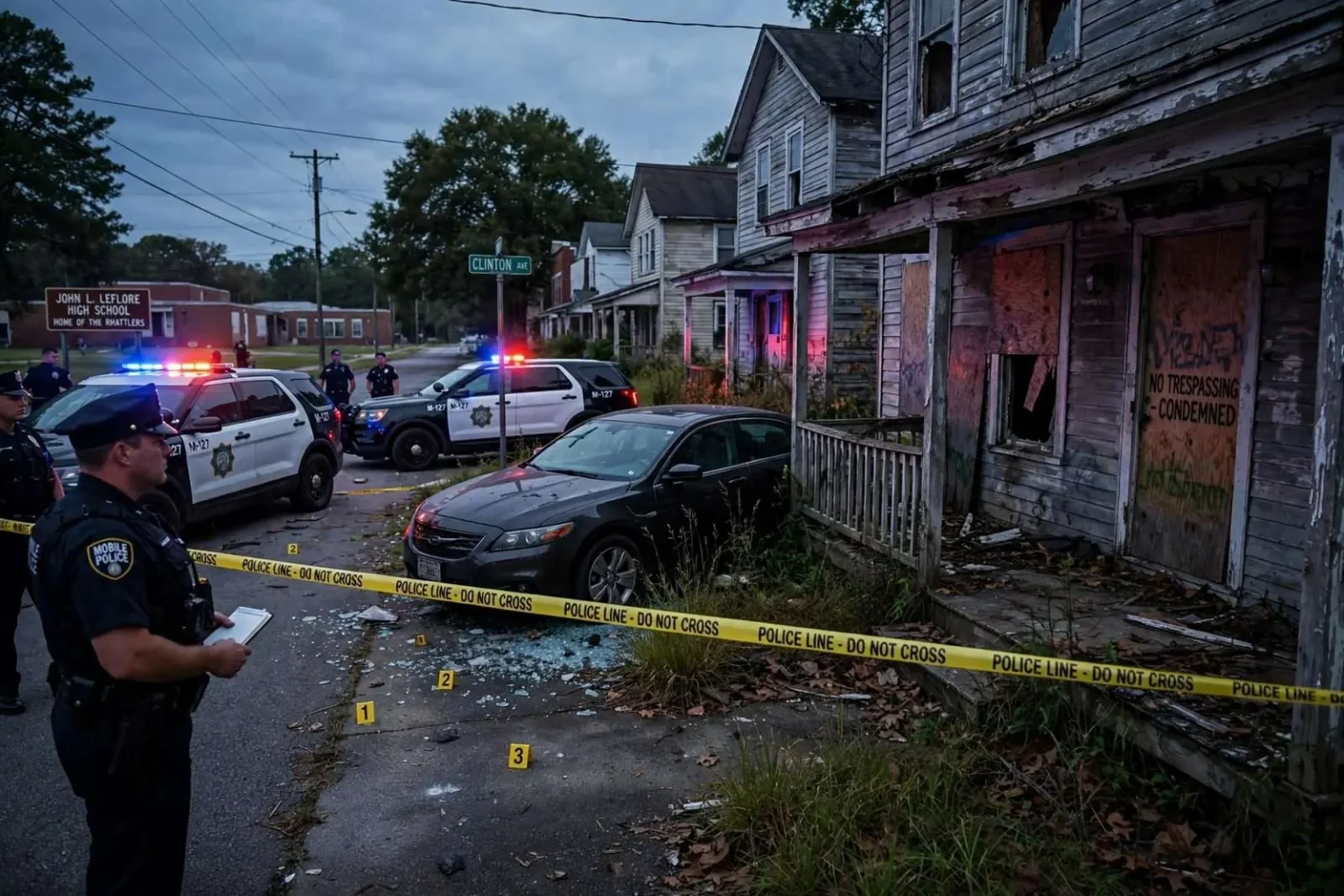
Mobile police are investigating a Sunday-evening shooting on Clinton Avenue near Leflore High School that left a man wounded multiple times. The incident turned a residential block in the Toulminville area of the city into a shooting scene as the weekend ended, drawing patrol officers, investigators, and the attention of a neighborhood that sits in the shadow of one of Mobile’s best-known high schools.
According to investigators, the victim was backed into the driveway of an abandoned residence when an unknown man stopped in front of the driveway, got out of a car and fired repeatedly. The shooter then ran off before officers arrived. The account describes not a chance encounter or a dispute that escalated, but an ambush: a car deliberately positioned to trap the victim’s vehicle in a driveway, followed by a shooter on foot closing the distance.
Boxing in a target’s vehicle is a hallmark of planned attacks, and investigators treat such cases differently from shootings born of arguments. The choice of an abandoned residence’s driveway, a location with no witnesses at home and no surveillance of the kind occupied houses generate, adds to the picture of an attack that was thought through, at least to the extent of picking a place where the victim could be cornered and the shooter could leave on foot quickly.
The victim and the response
The victim was taken to a hospital with injuries described as not life-threatening. Despite being hit multiple times, the man’s wounds were assessed as survivable, and hospital staff presumably had him stabilized while detectives began working the scene on Clinton Avenue. An officer at the scene initially said only that a man had been shot and hospitalized; the fuller account of the ambush-style attack emerged the following day, after investigators had spoken with the victim and pieced together the sequence from his account and any physical evidence.
That two-step release pattern, the sparse initial confirmation followed by the detailed account a day later, is common in cases where the early scene work is still underway. What the first-night release omits, investigators are still validating; what the second-day account includes, the boxed-in driveway, the car stopping in front, the shooter firing repeatedly and fleeing on foot, reflects a timeline assembled from the victim’s own statements and the evidence around the abandoned property.
The choice of location raises questions investigators will pursue. Clinton Avenue runs near John L. Leflore High School, and the surrounding blocks mix longtime residents, vacant houses, and through traffic. Whether the victim lived nearby, was visiting, or was followed to the block is a central question in establishing motive, as is whether the shooter and victim knew each other, a determination police had not made public.
Police did not identify a suspect or offer a motive. That silence reflects both the early stage of the investigation and the nature of ambush-style shootings, where the shooter’s identity is often the single fact most jealously guarded by investigators because it is the hinge on which any arrest turns. Details about the car, its make and model, its direction of travel, whether others remained inside it, have likewise not been released, keeping the pool of people who could recognize the vehicle from being narrowed prematurely.
Investigators will work the case on several tracks at once. Shell casings from the scene can be matched against ballistics databases and other shootings. The abandoned residence will be checked for cameras on neighboring structures, and officers will canvass the blocks around Clinton Avenue for anyone who heard the volley of shots or saw the car stop in front of the driveway. And the victim himself, once his condition allows, will be interviewed at length, because in ambush cases the victim’s own history and associations are usually the most productive line of inquiry into motive.
The neighborhood context
The Toulminville area has lived with gun violence for years, and Sunday evening’s shooting landed in a community where residents have organized against it repeatedly. Clinton Avenue sits in the heart of a neighborhood defined by its history, the birthplace of Hank Aaron, home to Central High School before integration, and a corridor of Black-owned businesses and institutions that shaped Mobile’s civil rights era. It is also a neighborhood where vacant houses, including the abandoned property whose driveway became the scene, mark the blocks that have lost population over decades.
The proximity to Leflore High School adds a dimension the community feels acutely. A shooting within sight of a school campus, even on a Sunday evening when the campus is empty, resonates with parents and teachers who contend with the spillover of street violence into students’ lives. School leaders in the area have long partnered with police and community groups on anti-violence programming, and each nearby incident renews those conversations about safety on the routes students walk.
For the immediate blocks, the aftermath of a shooting follows a familiar pattern: crime scene tape through the evening, investigators under the streetlights, shell casings marked and photographed, and by morning the tape is gone and the driveway looks like a driveway again, except to the people who live around it and know what happened there.
Anyone with information about the shooting was encouraged to contact Mobile police or CrimeStoppers. In a case with no identified suspect, no description of the shooter or the car, and a victim who survived, tips from the community are likely to be the decisive evidence, and CrimeStoppers offers anonymity and, in qualifying cases, reward money for the information that leads to an arrest.
The survival of the victim gives investigators something many shooting cases do not have: a living witness to the attack. A man who was boxed into a driveway and fired on multiple times saw the car, the shooter’s movement, and the direction of flight, and the precision of the next-day account, down to the abandoned residence and the positioning of the car, suggests investigators obtained meaningful detail from him. Whether that detail translates into a suspect will depend on what it matches: prior contacts, known disputes, or recognition by someone who knows the area and the players in it.
Mobile’s experience with ambush-style and vehicle-related shootings has shaped how the department resources such cases. Detectives from the department’s investigative divisions take over from patrol after the scene work, and cases with no identified suspect are assigned for long-term follow-up, where the casework depends on ballistics matches, informants, and the slow accumulation of intelligence rather than quick arrests.
For now the public record holds the essentials: a Sunday evening on Clinton Avenue near Leflore High School, a man boxed into the driveway of an abandoned residence, an unknown shooter who stopped a car in front of him, got out, and fired repeatedly before running off, a victim hospitalized with non-life-threatening wounds, and a police department with no suspect named, no motive offered, and a request to the community for the information that fills the gap between the two.
The economics of vacant property run through this case as background. An abandoned residence is more than a gap in the streetscape; it is a blind spot, a place with no lights on, no one listening, and no reason for casual passersby to slow down. Communities that have tracked the fate of abandoned houses in the Toulminville area note the correlation between vacant structures and serious crime, and neighborhood groups have pressed the city over the years on demolition lists, code enforcement, and the slow pace of getting derelict properties cleared or restored.
Police departments also use cases like this one to make the standing ask that residents with doorbell cameras and home surveillance register their devices. Even a camera two houses away that catches a car slowing before the driveway can give investigators the vehicle description that no one on the block was able to provide. In a shooting with no named suspect, those fragments, a partial plate, a silhouette, a turn signal at a corner, are often the first domino.
The shooter fled on foot, which suggests a planned exit as much as a planned attack. A car left the scene with the shooter already gone, meaning any witnesses who saw the vehicle afterward saw it without its accomplice, and the route the shooter took on foot passes through blocks where residents know every face. That mismatch, an anonymous shooter moving through a neighborhood where strangers are noticed, is where the department’s appeal to the community carries its best odds of success.
Until an arrest is made, the shooting on Clinton Avenue remains an open file in one of Mobile’s most closely watched categories of crime: a targeted attack in a residential neighborhood, survived by its victim, solved if the community decides to talk.


