Master Gardener Advice: Beating Back Aphids, Whiteflies and Mealybugs in a Mobile County Summer Garden
Mobile County Master Gardener volunteers explain why aphids, whiteflies and mealybugs surge in summer gardens and outline quick fixes and long-term Integrated Pest Management strategies, alongside two upcoming free gardening programs at Mobile's Jon Archer Center.
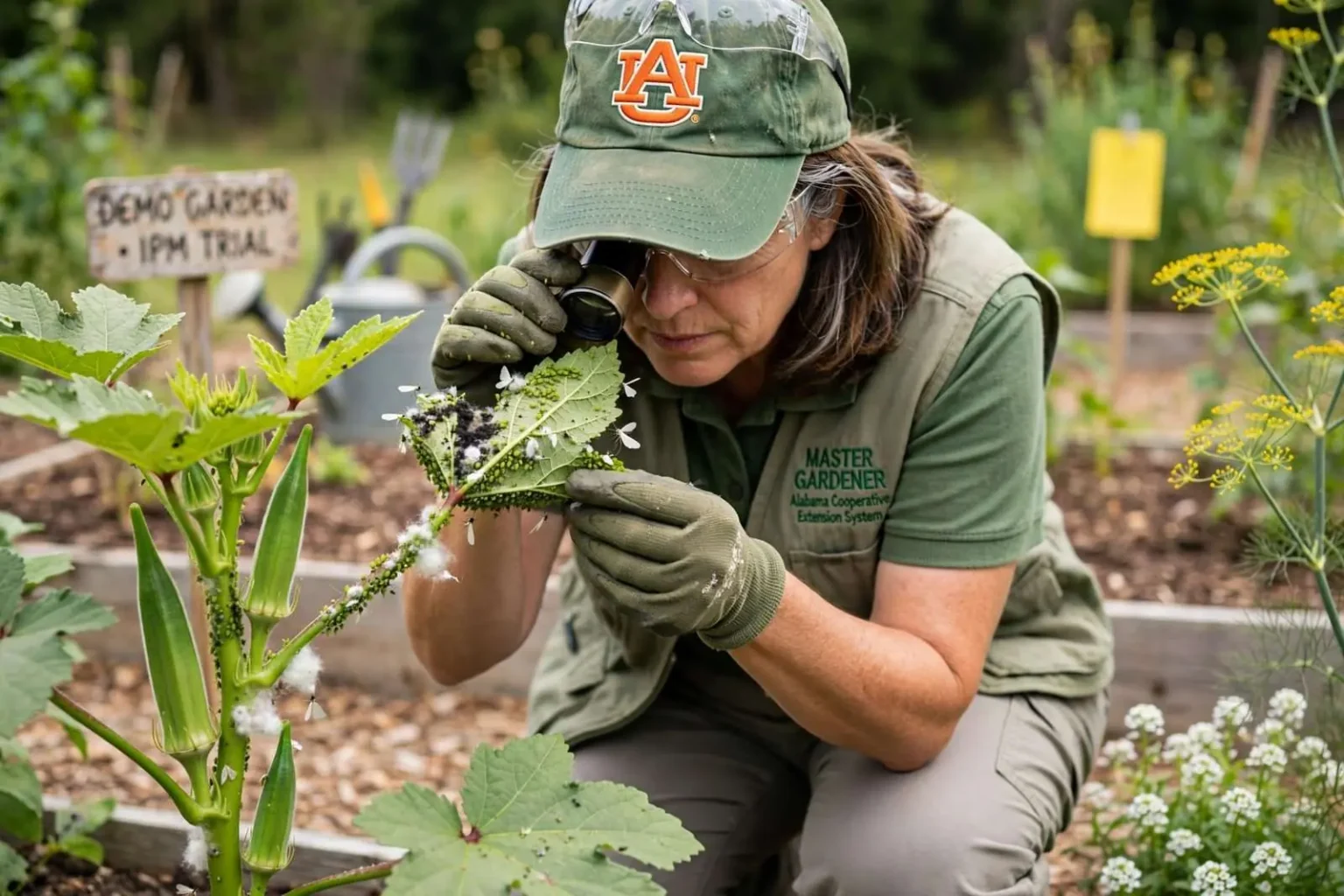
As summer heat settles over Mobile County, local gardeners are reporting a familiar nuisance: swarms of aphids, whiteflies and mealybugs descending on okra plants, ornamental shrubs and other backyard favorites. Master Gardener volunteers with the Alabama Cooperative Extension System say the timing is no coincidence, and that the insects gardeners are seeing now didn’t simply appear overnight. All three pests belong to the same insect family, Hemiptera, and share several destructive habits. Each one pierces plant tissue to feed on its sap, a process that can spread plant diseases in the process. All three also excrete a sticky substance called honeydew, which coats leaves and stems and becomes a growing medium for black sooty mold. While the mold itself isn’t a disease, its presence is a telltale sign that a pest infestation is already underway.
Extension specialists note that these insects reproduce quickly, especially once warm weather arrives, and a small population can explode into a full infestation within days. Aphids are known for maturing and reproducing rapidly, which is part of why populations can seem to appear “out of nowhere” during the hottest stretches of summer. The truth, gardeners are told, is that many of these pests took up residence the previous year and simply waited out the winter before becoming active again, meaning effective control really begins months before the first bugs are ever spotted. For homeowners already dealing with a heavy infestation rather than just a few stray bugs, Extension experts recommend a two-pronged approach: an immediate knockdown treatment paired with a longer-term Integrated Pest Management, or IPM, strategy.
The Gulf Coast pest calendar
Mobile County’s subtropical climate — USDA hardiness zones 8b to 9a — creates a pest calendar that differs sharply from the rest of Alabama. The average last frost date falls in early March, and the first frost often doesn’t arrive until late November or December. This long growing season gives Hemiptera pests a massive reproductive window. Aphids can complete a generation in seven to ten days at eighty degrees Fahrenheit, meaning twenty or more generations per season are theoretically possible. Whiteflies, particularly the silverleaf whitefly (Bemisia tabaci) that has established itself across the Gulf Coast, thrive in the humidity that blankets Mobile from May through October. Mealybugs, protected by their waxy coatings, survive brief cold snaps in bark crevices and leaf litter, emerging when temperatures climb back into the seventies.
The Alabama Cooperative Extension System, operated through Auburn University and Alabama A&M University, maintains a network of county offices that serve as the first line of defense for home gardeners. The Mobile County office, located at the Jon Archer Agricultural Center on Schillinger Road, runs the Master Gardener volunteer program that fields thousands of pest identification calls each summer. Master Gardeners complete a fifty-hour training course covering entomology, plant pathology, soil science, and pesticide safety, then volunteer a minimum of twenty-five hours annually answering diagnostic questions, staffing plant clinics, and maintaining demonstration gardens at the Agricultural Center and the Mobile Botanical Gardens.
Identifying the enemy
Accurate identification drives effective treatment. Aphids are small, soft-bodied insects, typically green, black, yellow, or pink, that cluster on new growth and the undersides of leaves. They feed in colonies, and their piercing mouthparts extract phloem sap, causing leaves to curl, yellow, and distort. The honeydew they produce attracts ants, which “farm” aphids for the sweet secretion and protect them from predators — a mutualism that complicates control. Whiteflies, despite the name, are not true flies but close relatives of aphids and mealybugs. Adults are tiny, white, moth-like insects that flutter up in clouds when disturbed. Their nymphs are flat, scale-like, and immobile, attached to leaf undersides where they feed. Mealybugs appear as cottony white masses in leaf axils, on stems, and at the base of plants. Their waxy filaments provide protection from contact insecticides and desiccation, making them among the most difficult Hemiptera pests to eradicate.
Knockdown and IPM: the two-pronged strategy
A horticultural summer oil can quickly reduce mealybug and whitefly populations on shrubs. These refined petroleum or plant-based oils work by suffocation, coating the insects’ spiracles and disrupting gas exchange. Timing matters: apply in early morning or late evening when temperatures are below ninety degrees to avoid phytotoxicity, and ensure thorough coverage of leaf undersides where the pests congregate. Multiple applications at seven- to fourteen-day intervals are usually necessary because oils have no residual activity and do not kill eggs. Aphids, by contrast, tend to stay put once dislodged, so a strong daily spray of water from a garden hose can physically knock them off host plants and keep numbers down. This mechanical approach, while labor-intensive, preserves beneficial insects and avoids the resistance buildup that plagues chemical controls.
Gardeners who have lost an okra crop or watched a prized hibiscus decline understand the temptation to reach for broad-spectrum insecticides. Extension agents caution that pyrethroids, organophosphates, and neonicotinoids kill the very predators — lady beetles, lacewings, syrphid flies, parasitic wasps — that provide natural suppression. A single ill-timed spray can trigger a secondary pest outbreak by eliminating the beneficial complex. The IPM framework prioritizes cultural controls first: proper plant spacing for air circulation, resistant cultivars where available, sanitation to remove overwintering sites, and avoidance of excess nitrogen fertilizer, which produces the succulent new growth that aphids and whiteflies prefer.
Biological allies in the backyard
Mobile County’s diverse insect fauna includes numerous natural enemies of Hemiptera pests. The convergent lady beetle (Hippodamia convergens) and the multicolored Asian lady beetle (Harmonia axyridis) consume hundreds of aphids per day as adults and larvae. Green lacewings (Chrysoperla spp.), attracted to gardens with pollen and nectar sources, lay eggs on slender stalks; their larvae, called “aphid lions,” are voracious generalist predators. Tiny parasitic wasps in the families Aphidiidae and Aphelinidae lay eggs inside aphids and whitefly nymphs; the developing wasp larvae consume the host from within, leaving behind the characteristic “mummy” — a swollen, tan or black husk that signals successful parasitism. Encouraging these allies means tolerating low-level pest populations as food sources, planting insectary strips with flowering plants like sweet alyssum, buckwheat, and fennel, and avoiding broad-spectrum insecticides during peak beneficial activity.
The Mobile County Master Gardener program maintains a demonstration insectary garden at the Jon Archer Agricultural Center, showcasing plant combinations that support beneficial insects throughout the growing season. Volunteers conduct weekly scouting walks, recording pest and beneficial populations to demonstrate IPM principles in action. Data from these walks feed into Extension’s statewide pest monitoring network, which tracks population trends and issues alerts when threshold levels warrant intervention. Home gardeners can access these alerts through the Alabama IPM Communicator, a weekly electronic newsletter, and the Extension’s social media channels.
Crop-specific strategies for Mobile gardens
Okra, a Gulf Coast staple, presents a particular challenge. Its tall, open habit and continuous flowering make it a magnet for aphids and whiteflies throughout the summer. Extension recommends planting okra in wide rows with thirty-six-inch spacing to maximize air flow, interplanting with trap crops like nasturtium or sunflower to draw aphids away from the main crop, and scouting daily during peak season. When aphid colonies exceed ten per leaf on twenty percent of plants, a targeted application of insecticidal soap or neem oil can reduce populations without decimating beneficials. For whiteflies, yellow sticky traps placed at canopy height provide both monitoring and mass trapping; replace traps weekly as they lose stickiness in the humidity.
Ornamental shrubs — gardenias, azaleas, camellias, hollies — form the backbone of Mobile’s residential landscapes and host mealybugs and whiteflies year after year. The waxy coatings of mealybugs and the protected nymphal stages of whiteflies make contact sprays ineffective unless applied with high pressure to penetrate the canopy. Systemic insecticides, applied as soil drenches in early spring before bud break, can provide season-long protection for high-value specimens, but Extension stresses that systemics should be a last resort due to their impact on pollinators and soil microbiota. For gardeners committed to organic methods, repeated applications of horticultural oil, timed to catch crawler emergence (the mobile first-instar nymphs), offer the best chance of suppression.
Sooty mold: symptom, not disease
The black sooty mold that alarms gardeners is a fungal complex — primarily Capnodium, Fumago, and Scorias species — that grows on honeydew. It does not penetrate plant tissue or cause direct damage, but heavy coatings reduce photosynthetic capacity and aesthetic value. The mold disappears once the honeydew source is eliminated, though weathering can take weeks. A strong stream of water or a dilute soap solution can accelerate removal. The key insight Extension emphasizes: sooty mold is a diagnostic tool. Its presence tells you where sap-feeding insects are active, often before the insects themselves are visible. Scout the plant parts above the mold; that’s where the colony is feeding.
The long game: building resilient gardens
Mobile County gardeners operate in a region where pest pressure is not a seasonal anomaly but a constant baseline. The Extension’s Master Gardener program teaches that resilience comes from diversity — of plants, of habitats, of management strategies. A garden with ten species of flowering plants, a water source, minimal pesticide use, and soil rich in organic matter will support a predator complex that keeps Hemiptera pests below damaging thresholds most years. In outbreak years, when weather patterns favor explosive reproduction, the IPM toolkit provides graduated responses that protect the garden’s ecological infrastructure.
The Alabama Cooperative Extension System’s Mobile County office offers free soil testing, plant diagnostic services, and personalized IPM consultations for home gardeners. The Master Gardener Helpline, staffed by trained volunteers Monday through Friday during the growing season, fields questions on pest identification, pesticide selection, and cultural practices. For the gardener watching aphids cluster on okra, whiteflies cloud a gardenia, or mealybugs colonize a hibiscus, the message is the same: you are not alone, the pests are not invincible, and the garden that survives is the one managed with patience, observation, and respect for the complex web of life that makes the Gulf Coast both a paradise and a battlefield.