MAWSS Program Targets Aging Private Sewer Lines to Curb Overflows in Mobile
MAWSS is continuing its Private Lateral Replacement Program to reduce rainwater and groundwater entering the sanitary sewer system, offering financing and grants to help homeowners fix aging pipes.
Mobile Area Water & Sewer System (MAWSS) is continuing to push its Private Lateral Replacement Program, an effort aimed at reducing the amount of rainwater and groundwater that seeps into the sanitary sewer system through aging pipes on private property. The program reflects a broader reality facing utilities across the country: much of the underground infrastructure that protects public health was installed generations ago, and the slow, steady failure of that infrastructure now demands sustained attention.
The program was developed as part of MAWSS’s ongoing effort to protect the health of the community and the environment. It targets a problem utility officials call infiltration and inflow, or I&I: extra water that enters the sewer system during rain events and wet weather. Infiltration refers to groundwater that enters through cracks, joints, and holes in pipes. Inflow refers to stormwater that enters through direct connections such as downspouts, yard drains, or cross-connections to storm sewers. Together, that additional flow contributes to sanitary sewer overflows, backups into homes and buildings, reduced sewer capacity for customers, and added costs from having to transport and treat storm water that was never supposed to be in the sanitary system in the first place.
An Aging, Extensive Network
The scale of the problem is significant. Private laterals, the pipes that connect individual homes and businesses to the public sewer system, account for more than 1,000 miles of pipe connected to the MAWSS collection system. Roughly 75% of those private laterals were built before 1976, primarily using vitrified clay pipe, known as VCP. That concentration of older material means a large share of the network is now at or past the age at which failures become more frequent.
VCP laterals have joints spaced every three to five feet and typically run between 50 and 150 feet in length. Over time, those joints begin to fail, allowing roots and storm or ground water to work their way into the pipes. As roots continue to grow, they force the joints open even wider, letting in more water. Meanwhile, as the surrounding pipe settles over the decades, the joints separate further, causing the pipe itself to crack and break. Because the laterals sit on private property, the utility cannot simply repair them the way it maintains its own public mains; the property owner is generally responsible for the portion that serves their home or business.
The distinction between public and private infrastructure matters for both cost and accountability. MAWSS maintains the larger trunk lines and treatment facilities that belong to the public system. But the first connection from a building to that system — the lateral — is the owner’s to keep in good repair. When thousands of those laterals develop small leaks, the combined effect is anything but small: a modest amount of seepage from each property can add up to a substantial volume of extraneous water moving through the entire collection system during a storm.
How MAWSS Finds Failing Pipes
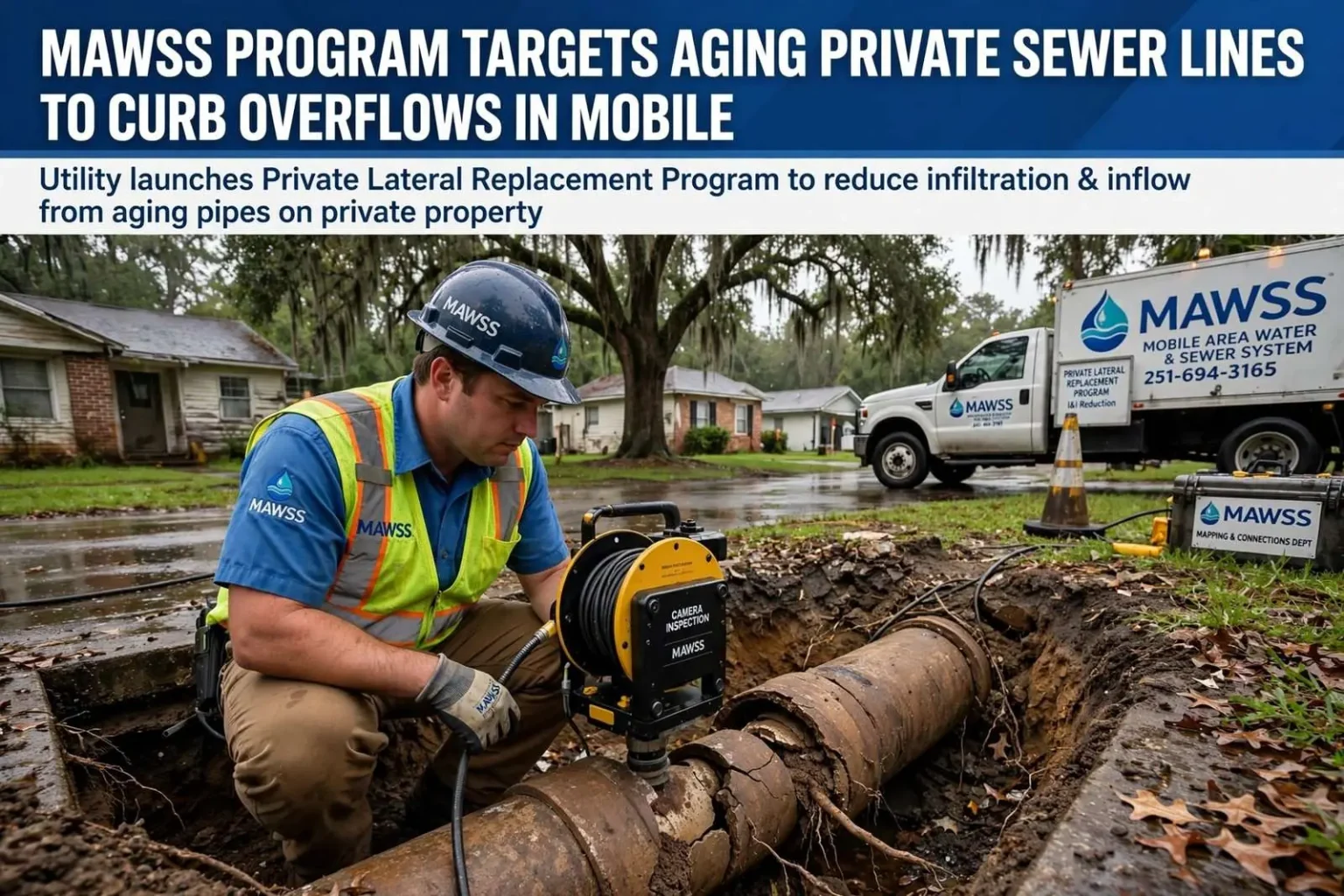
MAWSS relies on several methods to identify which private laterals need repair. One approach involves forcing smoke into the sanitary sewer system and watching for where it escapes; smoke exiting a lateral indicates there’s a leak. The smoke test is a straightforward way to reveal connections that should not exist, because smoke will follow any open path between the system and the surface. Camera inspections are also used to spot laterals with roots, cracks, separated joints or deteriorated pipe walls, all of which prevent the line from being watertight and allow rainwater or groundwater to seep in. A small camera pushed through the pipe gives crews a direct look at conditions that would otherwise be invisible beneath the soil.
In some cases, crews conduct direct visual inspections of lateral discharge during an actual rain event to confirm a problem. Watching how a lateral behaves while it is actually raining helps separate a genuine inflow source from a condition that only looks risky on paper. Because storm water and groundwater can enter the sanitary sewer system through both public and private property wastewater pipes, MAWSS says addressing private laterals is a necessary complement to maintaining its own public infrastructure. Residents can find additional detail on the requirements property owners face under Policy 3.14, Property Owner Sewer Repair Notices.
Identifying the problem is only the first step. Once a failing lateral is documented, the property owner receives notice that repair work is required, and the question of how to pay for that work becomes practical and immediate. A sewer lateral is not something most homeowners think about until it fails, and an unexpected repair can carry a price tag that is difficult to absorb without help.
Help Finding a Contractor and Paying for Repairs
To make repairs more accessible, MAWSS periodically solicits pricing from licensed plumbers who are qualified to perform lateral repairs, and makes that contractor contact information and unit pricing available to property owners who need work done. Having a vetted list of contractors and a sense of typical costs helps owners compare options rather than starting from scratch when a problem is discovered. Qualified plumbers familiar with lateral replacement can also help ensure the repair meets the standards the utility expects.
MAWSS also offers financing assistance to residential property owners whose homes fail a private lateral investigation test, helping offset what can otherwise be an unexpected repair expense. Homeowners interested in that option can get more information from the MAWSS Mapping and Connections Department. Financing can spread the cost of a repair over time, which matters for a household that cannot comfortably pay a large sum at once but still needs the line brought back to a watertight condition.
For property owners with low to moderate incomes, MAWSS offers a separate grant program intended to help cover the cost of lateral repairs. More information on eligibility and how to apply is available through the MAWSS Collections System Department. Grant funding aimed at income-qualified residents recognizes that the burden of aging infrastructure should not fall hardest on those least able to absorb an emergency repair bill.
Why the Problem Matters in Mobile’s Climate
The program takes on added weight in a Gulf Coast community like Mobile, where heavy seasonal rainfall and a low, flat coastal terrain make infiltration and inflow especially consequential. When the ground is already saturated, groundwater pushes harder against aging pipe walls, and when a storm drops several inches of rain in a short window, every open joint and every improper connection becomes a fast channel for extraneous water. In neighborhoods where many homes were built in the same postwar decades, laterals tend to be similar in age and material, which means failures often cluster together rather than appearing one at a time.
That clustering is what makes a utility-led, owner-assisted program a practical response. Rather than waiting for overflows and backups to force emergency action, MAWSS is working through the network methodically, pairing its own inspection data with financial tools that let owners act before a failure becomes a crisis. The approach treats infiltration and inflow as a shared problem with shared responsibility: the utility maintains the public mains, and property owners maintain the laterals that feed them, but both sides benefit when the system as a whole carries less unnecessary water.
What a Lateral Repair Typically Involves
For an owner who receives a repair notice, the work usually begins with a confirmation inspection, often a camera look inside the pipe, to pinpoint where the line has failed. From there, the repair method depends on conditions such as the lateral’s depth, length, and the landscaping or pavement above it. In some cases a traditional excavation simply digs down to the damaged section and replaces it. In others, trenchless methods can rehabilitate the line with less surface disruption, either by pulling a new pipe into place through the old one or by inserting a liner that cures into a seamless new interior. A qualified contractor can explain which option fits a given property, and MAWSS’s vetted contractor list is meant to connect owners with plumbers who perform this kind of work routinely.
By combining pipe inspection, financing assistance and income-based grants, MAWSS is aiming to chip away at a problem built up over decades of aging infrastructure, one lateral at a time, while easing the burden on Mobile-area homeowners who discover their private sewer connection needs work. The program’s logic is cumulative: each lateral returned to a watertight state removes a small but real source of extraneous flow, and across a network of more than 1,000 miles of private pipe, those individual fixes add up to meaningful relief for the broader collection system.
For property owners who want to stay ahead of trouble, the practical takeaway is straightforward. Watch for slow drains, recurring backups during wet weather, or notices from the utility, and treat them as early signals rather than one-off annoyances. Engaging with MAWSS’s contractor list, financing options, and grant programs before a failure becomes an emergency can turn a stressful discovery into a manageable project — and helps protect both the individual property and the shared system that serves the whole community.