MAWSS Sewer Rate Increase Would Add About $3.41 a Month to Mobile Bills in 2027
MAWSS is proposing a 6.2 percent increase in base sewer rates starting Jan. 1, adding about $3.41 a month for a typical household. A public hearing is set for Nov. 18, with a board vote Dec. 7.
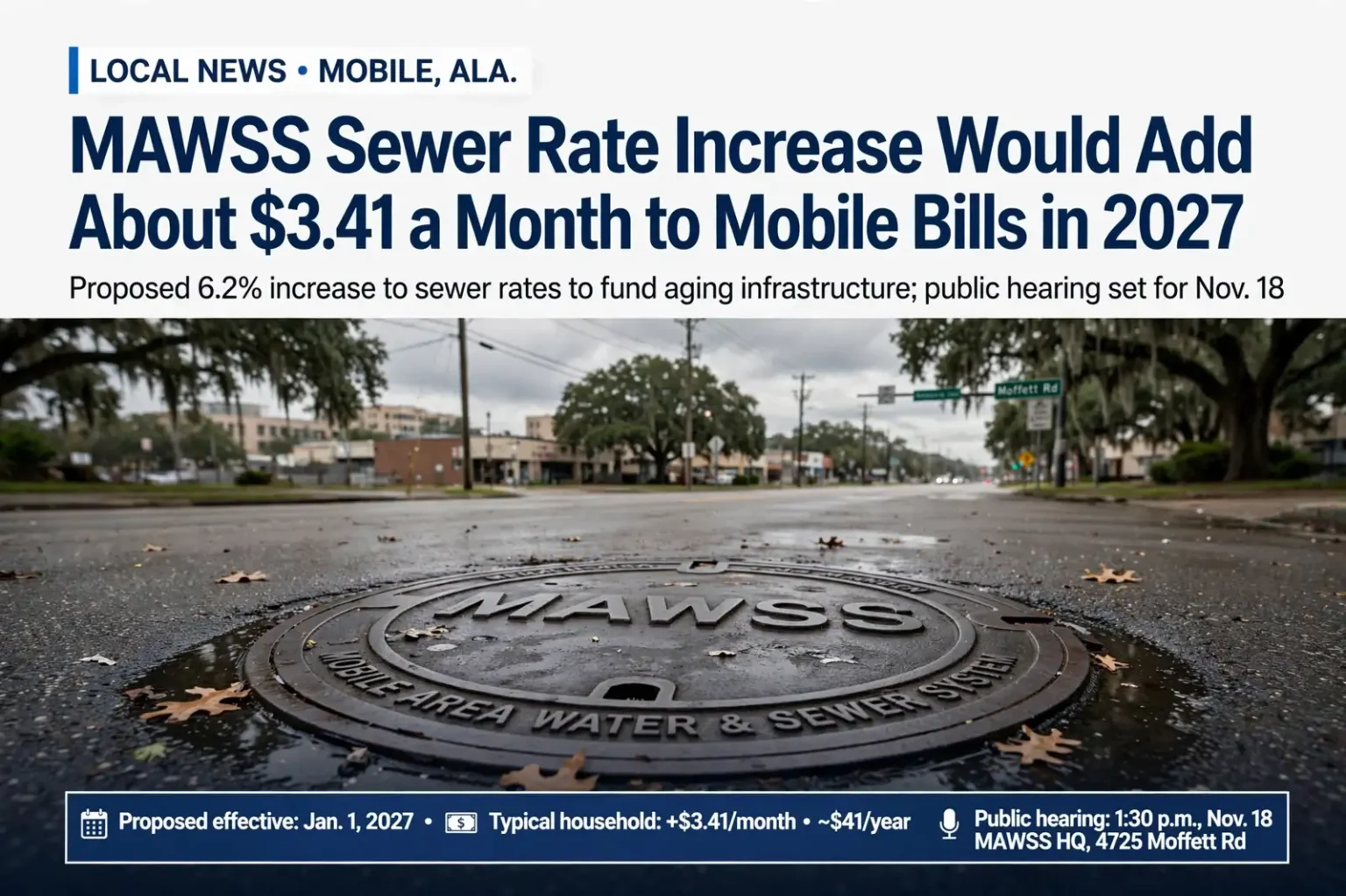
MOBILE, Ala. — Customers of the Mobile Area Water and Sewer System would pay more for sewer service next year under a MAWSS sewer rate increase proposed to take effect Jan. 1, 2027, a change the utility says is needed to keep pace with rising costs and an aging network of pipes and plants.
The proposal would raise base sewer rates by 6.2 percent while leaving the rate customers pay for the water they use unchanged. For a typical household that uses 5,000 gallons a month, MAWSS estimates the combined effect would add about $3.41 to the monthly bill, or close to $41 over the course of a year.
The increase is not final. Customers will have a chance to ask questions at a public hearing in November, and the utility’s governing board is scheduled to vote on the new rate schedule in early December.
What the MAWSS sewer rate increase would change
At the heart of the proposal is the base sewer charge, which is tied to how much water a household uses. That charge would climb by 64 cents per 1,000 gallons, from $10.34 to $10.98.
A second, smaller piece of the bill would rise as well. The monthly sewer capital improvement fee for customers with standard residential meters would go from $2.13 to $2.34, an increase of 21 cents, or 9.9 percent. Capital improvement fees are flat monthly charges that utilities use to help pay for long-term construction and replacement projects rather than day-to-day operations.
Put together, those two changes account for the utility’s estimate for a typical customer. At 5,000 gallons a month, the higher usage-based sewer charge adds $3.20, and the higher capital improvement fee adds 21 cents, for a total of $3.41 a month.
Households that use more or less water than that benchmark would see a larger or smaller change, because the main sewer charge is calculated on volume. A household using 3,000 gallons a month, for example, would see the usage-based portion of the sewer charge rise by about $1.92, plus the 21-cent capital fee increase.
- Base sewer rate: $10.34 to $10.98 per 1,000 gallons (up 6.2 percent)
- Sewer capital improvement fee (standard residential meter): $2.13 to $2.34 a month (up 9.9 percent)
- Water consumption rates: unchanged for typical customers
- Typical household (5,000 gallons a month): about $3.41 more a month, or nearly $41 a year
- Proposed effective date: Jan. 1, 2027
Why the utility says it needs more money
In a public notice about the proposal, MAWSS pointed to “aging infrastructure” and higher costs it says are necessary to “protect public health and the environment.”
The utility also noted that it has put about $400 million into system upgrades over the past six years. That kind of spending is typical of older Southern cities, where water and sewer lines laid decades ago are reaching the end of their useful lives and must be replaced or rehabilitated to prevent leaks, breaks and sewage overflows.
Sewer systems in particular face heavy demands along the Gulf Coast. Heavy rain can seep into aging pipes and manholes, overwhelming lines and treatment plants and leading to overflows into creeks and bays. Utilities across the region have been investing in pipe lining, pump station upgrades and plant improvements to reduce those problems and comply with environmental regulations.
What it means for a household budget
For most families, the change would be modest but noticeable over a full year. At the utility’s benchmark of 5,000 gallons a month, the extra $3.41 adds up to about $40.92 across 12 billing cycles. Larger households, or those that water lawns heavily in the summer, would pay more because the main sewer charge rises with every 1,000 gallons used.
Residents who want to limit the impact can look at their own usage. Fixing leaking toilets and faucets, running dishwashers and washing machines only with full loads and installing water-efficient fixtures all reduce the number of gallons that flow through the meter, which in turn lowers the volume-based sewer charge. Customers can find their monthly usage, measured in gallons, printed on their MAWSS statements.
A $152 million budget for 2027
The rate changes are part of MAWSS’s proposed $152 million budget for 2027. The spending plan projects roughly $6.8 million more in revenue than the utility’s 2026 budget.
Operating and maintenance expenses are budgeted at $81.99 million for 2027, up from $78.17 million set aside for this year. That is an increase of about $3.8 million, or roughly 4.9 percent, in the cost of running the system day to day, covering items such as treatment chemicals, electricity, equipment, repairs and personnel.
Changes for wholesale, industrial and large-volume customers
Beyond residential sewer bills, the proposed schedule would adjust a long list of other rates and fees depending on the type of customer and how much water they use.
Wholesale water sold to Prichard Water and Sewer would go up 6 percent, from $3 to $3.18 per 1,000 gallons. Prichard operates its own water and sewer utility but buys water from MAWSS, so the change could eventually affect costs for that system.
Industrial wastewater surcharges, which businesses pay when the wastewater they send into the sewer system contains higher concentrations of certain pollutants than normal household sewage, would also rise. The largest jump would be in the charge for excessive ammonia nitrogen, which would increase 57 percent, from $1.48 to $2.32 per pound. Ammonia nitrogen requires additional treatment before wastewater can be safely released.
Other proposed changes include:
- Untreated water: up 7.7 percent, from $310 to $334 per million gallons
- Wholesale untreated sewer rate: up 4.3 percent
- Wholesale treated sewer rate: up 4.4 percent
- Prichard Water and Sewer wholesale water: up 6 percent, from $3 to $3.18 per 1,000 gallons
- Ammonia nitrogen surcharge: up 57 percent, from $1.48 to $2.32 per pound
Discount for the biggest water users would end
The proposal would also drop a discounted water rate now available to the system’s largest customers. Customers who use more than 2 million gallons currently pay $3.68 per 1,000 gallons for water consumed above that level.
Under the new schedule, those customers would instead pay the proposed standard rate of $3.97 per 1,000 gallons for all of their water. For the volume above the 2-million-gallon mark, that works out to a 7.9 percent increase.
The change would mainly affect large commercial and industrial users rather than households, which use only a few thousand gallons a month.
How customers can weigh in
MAWSS will hold a public hearing where customers can learn more about the proposed rates and ask questions before the board takes action.
- What: Public hearing on the proposed 2027 MAWSS rate schedule
- When: 1:30 p.m. Wednesday, Nov. 18
- Where: MAWSS headquarters, 4725 Moffett Road, Mobile
- Board vote: Monday, Dec. 7
If the board approves the schedule, the new sewer rates and fees would take effect Jan. 1 and begin showing up on customer bills after that date.
Who decides
MAWSS is a publicly owned utility. It is operated by the Board of Water and Sewer Commissioners of the City of Mobile under a deed of trust from the city, and its seven board members are appointed by the Mobile City Council. Because the board, not the City Council, sets rates, the Dec. 7 vote is the key step in deciding whether the increase moves forward.
The modern system traces its roots to Oct. 1, 1952, when the Board of Water and Sewer Commissioners contracted with the City of Mobile to buy the city’s water and sanitary sewer systems. That same year, the Big Creek water project went into service, creating the lake in west Mobile County that remains the system’s main source of drinking water. In 1968, the board merged with the City Water Works Board and took over the raw water system as well.
Part of a wider trend
Mobile is not alone in facing higher utility costs. Water and sewer providers across Alabama and the nation have been raising rates in recent years as they deal with inflation in construction materials and chemicals, stricter environmental requirements and the need to replace infrastructure that in many cases was installed generations ago.
Nearby, Saraland raised its water rates 2.5 percent and its sewer rates 5 percent beginning with October statements this year, citing rising operating costs.
For MAWSS customers, the proposed increase would be limited to the sewer side of the bill for most households. The rate customers pay for the water itself would stay where it is, meaning the bulk of the change for a typical family would come from the higher sewer charge tied to their monthly water use.
What happens next
Customers who want to understand how the change would affect their own bills can compare their typical monthly water use, listed on their statements, against the proposed sewer rate of $10.98 per 1,000 gallons and the new $2.34 capital improvement fee.
After the Nov. 18 hearing, the proposal will go to the board for its Dec. 7 vote. If approved, the 2027 rate schedule and the $152 million budget would set the utility’s finances for the coming year, including continued spending on the upgrades MAWSS says are needed to keep water flowing and wastewater treated safely across the Mobile area.