Mayoral Candidate’s Facebook Remarks About Local Server Spark Backlash in Mobile
A Mobile municipal judge running for mayor drew sharp criticism after mocking a Facebook video subject's job as a restaurant server, prompting the man to say he now fears for his safety and has changed his walking route to work.
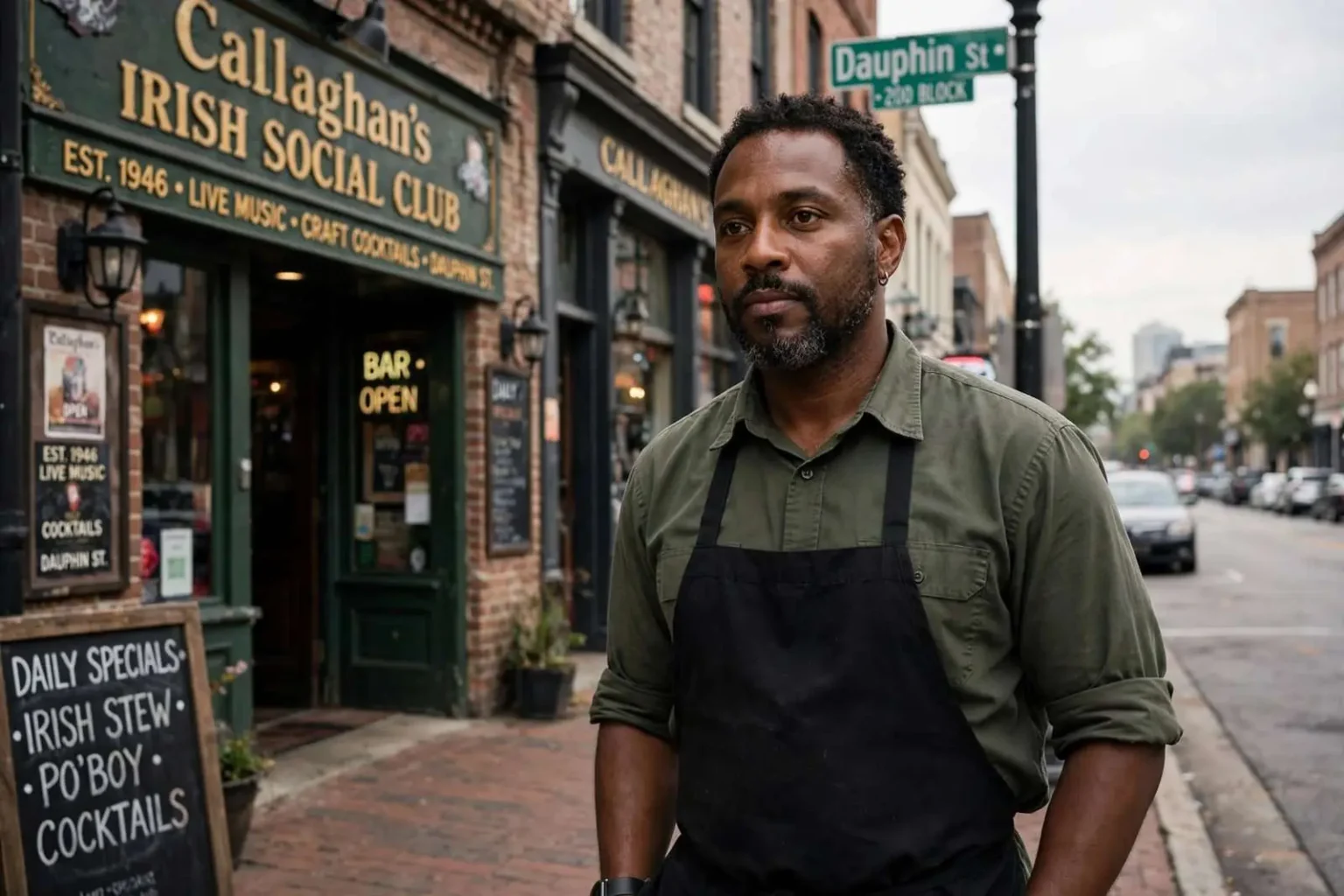
Bruce Malone says he has stopped taking his usual walking route to work. He says he has had trouble sleeping. And he says he never expected any of it, all because he agreed to appear in a campaign commercial in the middle of Mobile’s contentious mayoral race. Malone, a familiar face downtown and in the historic district through his work at Callaghan’s Irish Social Club and SOCU, became the subject of intense social media debate last week after Mobile Municipal Judge Karlos Finley criticized his appearance in a television ad for Mayor Sandy Stimpson.
Finley is one of four candidates challenging Stimpson as the mayor seeks a third term. The controversy began after Finley posted on Facebook criticizing Stimpson’s newest campaign commercial, which touts the removal of a group of blighted houses in the Campground neighborhood that had become a gathering spot for drug activity. The ad features Malone and another man praising Stimpson’s handling of the issue and endorsing his re-election bid.
Finley’s Facebook Posts Draw Fire
In a series of posts beneath his own Facebook update, Finley took aim at Malone directly, describing him as a restaurant server who walks to work and does not own a car. “He has no car. How he has benefitted from the Stimpson Administration, other than the paycheck he probably got for doing the commercial, I don’t know,” Finley wrote. In another post, he added that Malone and the second man in the ad were “not the kind people I’m looking to encourage,” and said the city needed “more entrepreneurs… not more servants.”
In a third post, Finley singled out both men in the ad by their appearance, writing that he had “known the darker skinned man for years as a server at Callahan’s Irish Pub” and noting he also serves at SOCU on Dauphin Street. “We need more entrepreneurs in this city, not more servants,” he wrote, adding that “the goal should be to own the restaurant.”
Backlash From Community Leaders
The remarks quickly drew backlash online, with critics accusing Finley of belittling Malone’s livelihood and making class-based and racial insinuations. Mobile City Council members, pastors, and small business owners weighed in across social media platforms. Councilman C.J. Small, who represents the district that includes Callaghan’s, issued a statement saying Finley’s comments “demean honest work and reveal a disconnect from the people he’s asking to elect him.”
Reverend Thomas Mercer of the Historic Avenue Cultural Center said the posts reflected “a troubling elitism that has no place in public service.” He noted that many of Mobile’s most respected citizens have worked in the service industry at some point in their lives, and that the city’s economy relies heavily on hospitality and tourism workers. “To suggest that serving tables or tending bar is somehow less valuable than entrepreneurship shows a fundamental misunderstanding of how this city functions,” Mercer said.
Malone, reached by phone Thursday, said he was stunned by the attention. “I just agreed to be in a commercial for the mayor because he asked me to, and I think he’s done a good job,” Malone said. “I didn’t know it was going to turn into all this. I walk to work because I live downtown and it’s a nice walk. I take the bus sometimes. I don’t see what that has to do with anything.”
The Campground neighborhood, where the blighted houses were removed, has been a focus of the Stimpson administration’s neighborhood renewal efforts. The houses, located on a cluster of streets near the intersection of St. Stephens Road and Dr. Martin Luther King Jr. Avenue, had been cited repeatedly for code violations and were the subject of numerous police calls related to narcotics activity. The city’s Legal Department, working with the Building Department, pursued demolition orders through the Municipal Court system, a process that took more than two years.
Stimpson’s campaign said the ad was intended to highlight tangible results in a neighborhood that had struggled for decades. “The mayor asked real residents from the area to share their experience,” said campaign spokesman Jonathan Armstrong. “Bruce Malone is a real person who lives and works in Mobile. His perspective is as valid as anyone’s.”
Finley’s Campaign Responds
Finley’s campaign declined to make the judge available for an interview but released a written statement Thursday afternoon. “Judge Finley’s comments were about the contrast between the mayor’s photo-op approach to neighborhood problems and the need for systemic economic development that creates ownership opportunities,” the statement read. “He was not criticizing any individual’s employment but rather a political strategy that uses working people as props while failing to address the root causes of poverty in our communities.”
The statement did not address the specific language about the “darker skinned man” or the characterization of service workers as “servants.” Finley, who has served as a municipal judge since 2013, is running on a platform emphasizing criminal justice reform, economic development in underserved neighborhoods, and government transparency. His campaign has reported roughly $45,000 in contributions through the most recent filing period, compared to Stimpson’s war chest of more than $300,000.
Race and Class in Mobile Politics
The exchange has reopened conversations about race and class in Mobile’s municipal politics. The city, roughly 51 percent Black and 43 percent white, has a history of racially polarized voting in mayoral elections. Stimpson, who is white, won his first term in 2013 with a coalition that crossed racial lines, but his 2017 re-election saw a decline in support from predominantly Black precincts. Finley, who is Black, is among a field of challengers that includes two other Black candidates and one white candidate, creating a dynamic where the Black vote could be split.
Political observers note that Finley’s comments about entrepreneurship versus service work touch a sensitive nerve in a city where the median household income is roughly $42,000 and the poverty rate hovers near 22 percent. Many of the city’s largest employers — including the shipyards, the port, and the healthcare systems — provide blue-collar and service-sector jobs that sustain families but rarely create the kind of business ownership Finley described as the ideal.
“There’s a long tradition in Mobile of people working hard in jobs that don’t make them rich but keep the city running,” said Dr. Kern Jackson, director of African American Studies at the University of South Alabama. “To frame that as something less than entrepreneurial is to ignore the reality of the economy here. Most people in this city work for someone else, and there’s dignity in that.”
The Mobile Area Chamber of Commerce, which has not endorsed in the mayoral race, released a brief statement emphasizing the importance of both small business development and workforce retention. “A thriving economy needs entrepreneurs who create jobs and workers who fill them,” the statement read. “Both are essential to Mobile’s future.” The chamber’s economic outlook report notes that the leisure and hospitality sector employs more than 18,000 people in the metro area, the second-largest private employment category after healthcare.
Malone’s Community Standing
Malone has worked at Callaghan’s Irish Social Club, a Dauphin Street institution since 1946, for more than a decade. The bar, known for its live music and late-night crowd, is a gathering spot for everyone from shipyard workers to judges to tourists. Regulars describe Malone as a fixture — someone who knows the regulars by name, remembers drink orders, and has helped defuse more than a few tense situations over the years.
“Bruce is the guy you want behind the bar when things get rowdy,” said Sarah Whitfield, a downtown resident and longtime patron. “He’s calm, he’s fair, and he treats everybody the same whether they’re in a suit or work boots. For a judge to use that as some kind of negative — it tells you more about the judge than it does about Bruce.”
SOCU, the second establishment where Malone works, is a newer addition to the Dauphin Street corridor, opened in 2018 as a craft cocktail bar with a focus on local spirits. Its owner, a Mobile native who returned after a career in New Orleans, said Malone was one of his first hires. “He brings a level of professionalism and institutional knowledge that you can’t teach,” the owner said. “He’s an asset to this street.”
Campaign Finance and Final Weeks
As the August 25 municipal election approaches, the Finley-Malone exchange has become a focal point in a race that had previously centered on infrastructure, public safety, and the future of the Mobile Civic Center. Stimpson’s campaign has used the controversy to reinforce his message of inclusive governance, releasing a digital ad featuring Malone and other downtown workers with the tagline “Real People, Real Progress.”
Finley’s campaign has attempted to pivot back to policy, releasing a detailed economic development plan that includes a city-backed microloan program for minority-owned businesses, expanded job training through Bishop State Community College, and a promise to appoint a neighborhood revitalization coordinator reporting directly to the mayor. Whether the Facebook controversy helps or hurts Finley’s chances may depend on turnout in the districts most affected by the issues he raised.
Malone, for his part, says he plans to keep walking to work. “I’m not going to change my life because of a Facebook post,” he said. “I like my job. I like my neighborhood. And I’m going to vote for who I think will do the best job for Mobile — same as always.”