McDavid Man Booked on Multiple Felony Child Sexual Abuse Material Charges
James Thomas McDuffie, 49, of McDavid was booked into the Escambia County Jail on multiple felony charges tied to child sexual abuse material following an FDLE investigation.
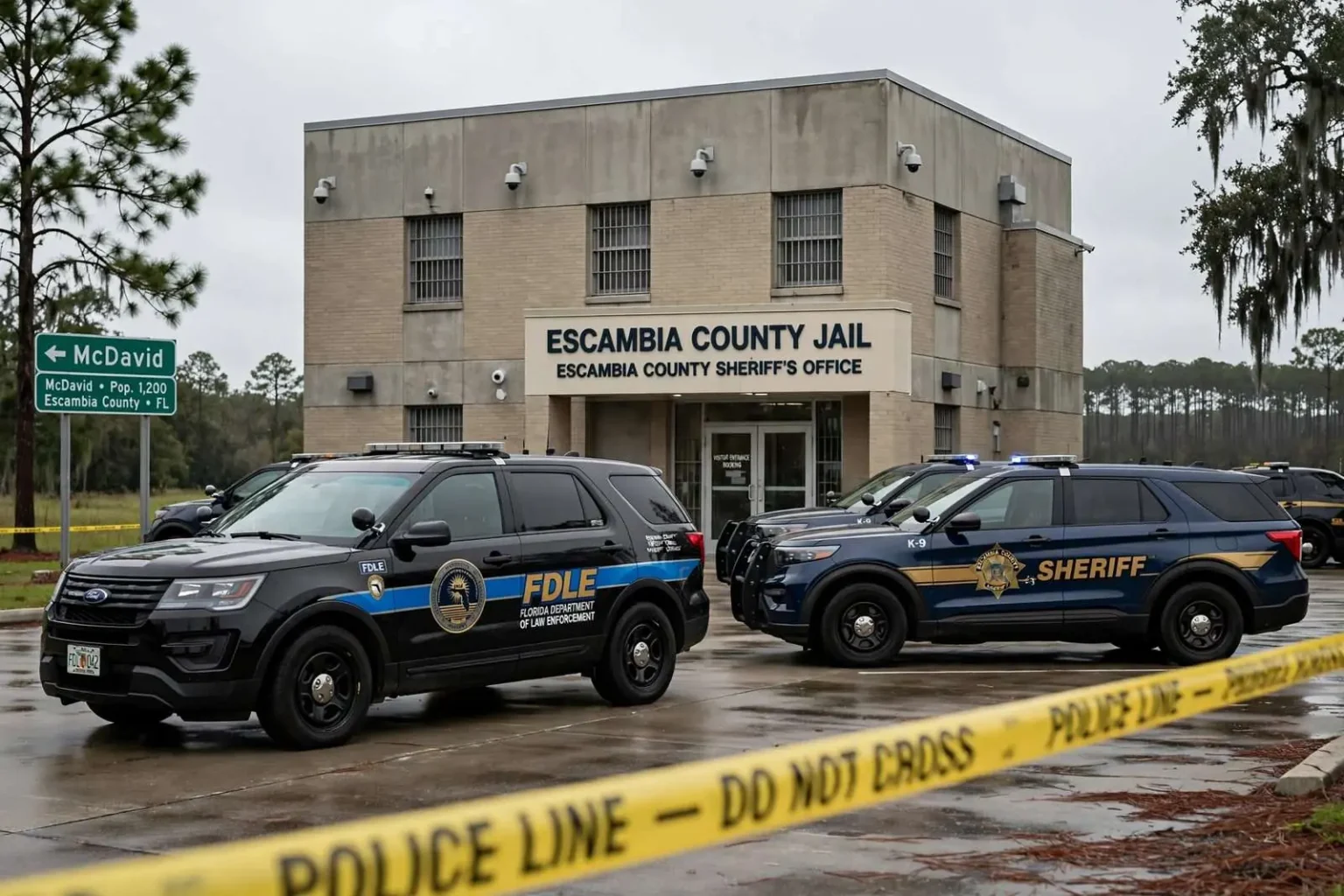
A McDavid man was arrested Monday on multiple felony charges related to child sexual exploitation following an investigation by the Florida Department of Law Enforcement. James Thomas McDuffie, 49, was booked into the Escambia County Jail at noon Monday on a series of FDLE charges, capping an investigation that unfolded largely out of public view, as such cases typically do.
McDavid is a rural community in western Escambia County, north of Pensacola near the Alabama line, an area of small farms, ranchettes and quiet two-lane roads where neighbors know one another and major news is rare. An arrest of this kind, carried out by state agents rather than county deputies, signals an investigation that reached beyond the immediate area, and the sight of FDLE activity in the community drew attention from residents long before the charges became public record.
Multiple felony charges filed
According to jail records, McDuffie faces two counts of creating, producing, or possessing computer-generated or altered child sexual abuse material, 20 counts of possessing, promoting, or distributing child sexual abuse material or child pornography, and one count of using a two-way communication device to facilitate a felony. The tally of 23 felony counts reflects the way digital evidence is charged: each file, transmission or act can support a separate count, and prosecutors build indictments or complaints that mirror the volume of what investigators recover.
McDuffie remained in the Escambia County Jail following his arrest, with bond set at $301,000. The bond amount, set by a judge at first appearance, reflects the combined severity of the counts and standard practices for offenses involving child exploitation, where courts weigh both flight risk and public safety. Defendants in such cases frequently remain in custody through the pretrial period when bond is set beyond their ability to pay.
Complete details on the specific charges and the allegations against McDuffie were not immediately available as of Monday. FDLE has not released additional information about how the investigation was initiated or what led authorities to McDuffie, and agency practice in ongoing cases is to limit public comment until charging documents are finalized and any related investigations are protected.
Arrests on child sexual abuse material charges typically follow lengthy digital investigations conducted by state or federal law enforcement agencies, often in coordination with multiple jurisdictions. Cases begin in a variety of ways: a tip from a technology company, a referral from the National Center for Missing and Exploited Children, an undercover operation, or evidence surfacing in an unrelated case. From there, investigators trace accounts, devices and online activity for months, applying for search warrants that let them examine phones, computers and cloud storage before an arrest is made.
Florida law enforcement has invested heavily in that capability. FDLE operates dedicated cyber and crimes-against-children units, and the state participates in regional Internet Crimes Against Children task forces that connect local deputies and city detectives with state and federal partners. Escambia County agencies work those cases alongside FDLE’s Pensacola field office, and the coordination matters because evidence in these cases crosses county, state and national boundaries almost by definition.
Charges of this nature are prosecuted at the state level in Florida and can carry significant prison sentences upon conviction. Possession counts are typically ranked as third-degree felonies, while promoting, distributing or producing such material carries far higher maximum sentences, and each count is punished separately. Judges in Florida also impose sex offender registration and supervision requirements on convictions of this kind, consequences that follow a defendant for decades after any prison term ends.
The charging structure matters for readers trying to understand the case. The two counts involving computer-generated or altered material reflect relatively recent additions to Florida law, written as artificial intelligence and image-editing tools made it possible to produce synthetic depictions of child sexual abuse. Legislators updated the statutes to ensure such material is treated the same as photographic depictions, and FDLE agents are trained to identify and document it during forensic examinations of seized devices.
The single count of using a two-way communication device to facilitate a felony is a common companion charge in Florida digital crime cases. It targets the means of the offense, the app, messaging platform or website used to carry it out, and it reflects how much of this activity now occurs through online platforms rather than physical exchanges. That count, stacked with the possession and distribution counts, shows investigators documenting both what was on the devices and how it moved.
What happens next follows a familiar path. The state attorney’s office for the local circuit will review the evidence FDLE presents and file formal charges, and the case will move through first appearance, arraignment and discovery. Defense attorneys will examine the digital forensics, including how warrants were obtained and executed, since challenges to search and seizure are common in cases built on device data. Cases of this volume can take many months to resolve, whether by plea or by trial.
The Escambia County Jail, located in Pensacola, houses pretrial detainees from across the county, and jail records in Florida are public, which is how the charges and bond amount became available within hours of booking. Those records, along with the eventual court file, will be the primary public accounting of the case unless prosecutors or FDLE release more information as it proceeds.
For residents of McDavid and surrounding communities, the arrest is a reminder that these investigations reach every kind of neighborhood, and that the agents who work them operate with patience that can span years. This story will be updated as more details are released, and the court file will ultimately provide the fullest public record of what investigators found and what the defendant is alleged to have done.
The scale of the problem explains the infrastructure behind cases like this one. The National Center for Missing and Exploited Children receives millions of reports each year from technology companies and the public, and those reports are routed to the appropriate law enforcement agencies, including FDLE’s units and local task forces. Agents and analysts then work through the referrals, prioritizing cases involving direct production of material, contact with minors or distribution to others, which is why some investigations take longer than others to reach an arrest.
Forensic examiners are the quiet specialists in these cases. When devices are seized, they are imaged and searched with specialized tools, and examiners document what they find in reports that will be scrutinized by defense experts later. The process can take weeks or months when a case involves large volumes of files, multiple devices and cloud accounts, and the thoroughness of that work often determines whether a case ends in conviction. Examiners also look for evidence of who used a device and when, since proving who was behind the keyboard is central to any prosecution.
The first appearance before a judge, held within 24 hours of booking in Florida, is where bond conditions are set and defendants are formally advised of the charges. In cases involving child exploitation, judges routinely impose conditions beyond bond itself, including no contact with minors and no access to the internet, pending trial. Violations of those conditions can result in additional charges and revocation of bond, so they function as a continuing constraint on defendants who do post bond.
Victim advocacy organizations note that every distribution count in a case like this represents images shared beyond their original context, prolonging harm to the children depicted. That is one reason sentencing law treats distribution more harshly than possession, and why prosecutors emphasize the movement of files in court. The effects reach across jurisdictions, since material recovered in one state often depicts children identified in another, and investigations frequently become joint operations once the evidence is traced.
FDLE’s role in Northwest Florida continues between arrests as well. The agency maintains field operations in Pensacola and works with school resource officers, probation officers and local police on prevention and reporting, encouraging residents to report suspected exploitation rather than assume someone else already has. Tips can be filed through FDLE directly or through national reporting channels, and authorities say early reports are frequently what shortens an investigation.
One more element worth understanding is how these cases intersect with federal law. The same conduct charged by FDLE can also be prosecuted federally, and prosecutors in the two systems coordinate to decide which venue is appropriate, sometimes charging both and dismissing one. State prosecution in Florida keeps the case in the local circuit court, where proceedings are easier for area residents to follow, while federal prosecution brings the resources of national agencies. The decision has real consequences for sentencing, registration requirements and where any prison term is served.
For now, the case rests where FDLE left it Monday: a 49-year-old McDavid man in the Escambia County Jail on 23 felony counts, held on a $301,000 bond, with the details of the investigation still under seal. The next public steps will come through the courthouse, as formal charges are filed and the case moves toward resolution in the months ahead.