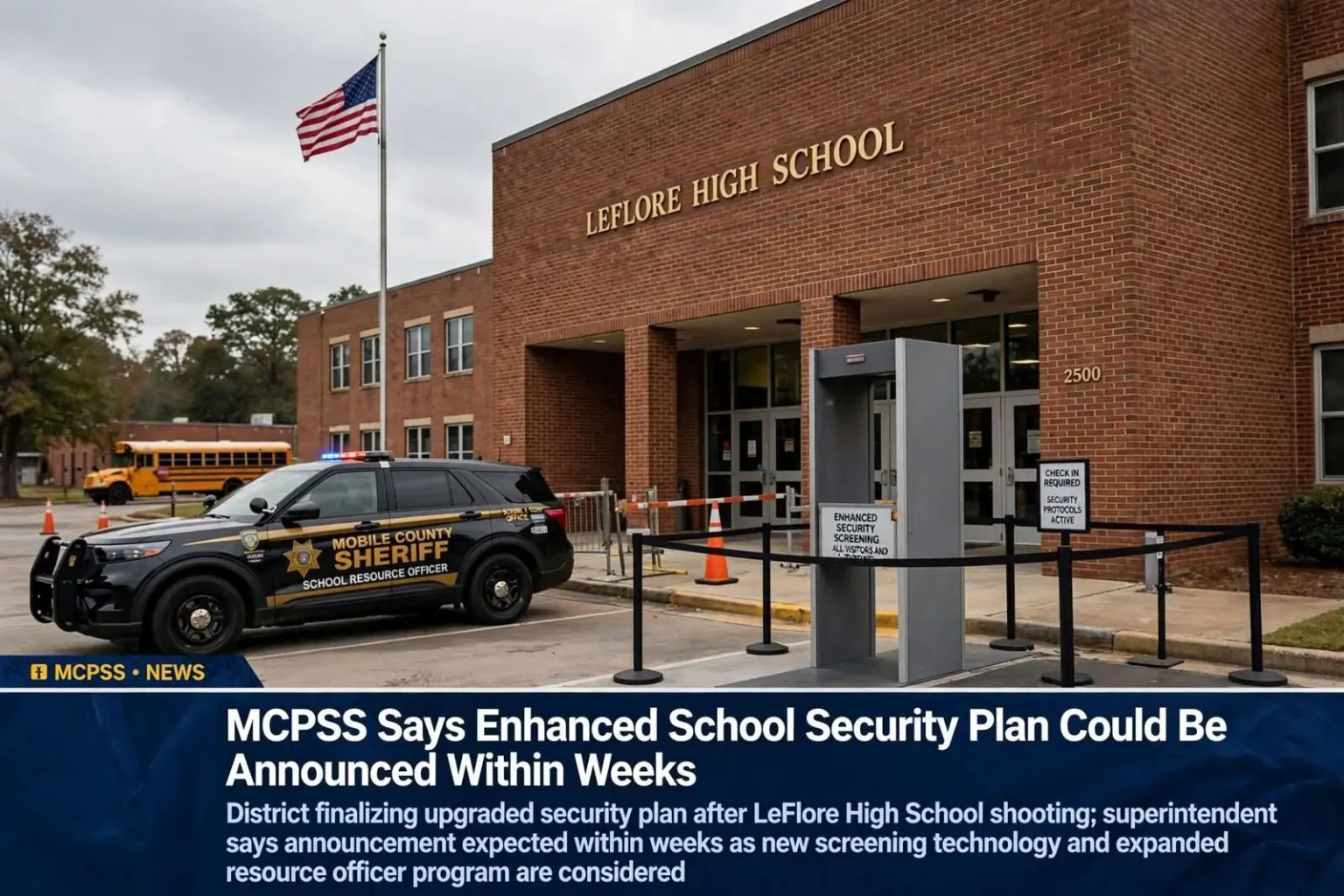
The Mobile County Public School System is finalizing an upgraded security plan in the wake of the shooting at LeFlore High School, with Superintendent Chresal Threadgill saying the district hopes to announce the plan within the next couple of weeks.
“We’re waiting on some equipment, and we also have some policy recommendations we’re planning to include in the comprehensive plan,” Threadgill said.
Threadgill did not detail the specific policy recommendations under consideration, but said the school system has reviewed every security option on the table, including metal detectors. “We know that some of the metal detectors are kind of old school with the way they’re set up,” Threadgill said. “So, we’re looking at some more innovative ways to make sure that we can target those kids that are entering or adults that are entering our buildings with weapons.”
District officials have also examined expanding the school resource officer program in partnership with the Mobile County Sheriff’s Office, though both Threadgill and Sheriff Paul Burch acknowledged that expansion would not be simple.
“There’s two challenges. One is capacity, finding enough resource officers for our schools, and the other is funding. When you talk about 90 resource officers to be fully outfitted it gets costly,” Threadgill said.
Currently, 12 sheriff’s deputies are assigned to the district’s high schools and their feeder patterns, at a cost of roughly $1.8 million. Burch said that price tag should ease over time as the bulk of the expense is tied to startup costs. “That’s a startup cost,” Burch said. “A vehicle is anywhere from $50,000 to $70,000 once you have it outfitted, and then all their startup equipment, uniforms, guns, radios.”
Both officials pointed to several potential funding sources for the expanded program, including the school system’s existing safety and security funds as well as possible support from the state legislature. In the short term, Burch said his priority is extending the current coverage model to as many campuses as funding allows.
What Prompted the Review
The shooting at LeFlore High School put school security at the center of public conversation across Mobile County, and district leaders have treated the response as more than a single-site fix. LeFlore, located in the Toulminville area of Mobile, is one of the district’s long-established high schools, and the incident there reverberated through a system that operates dozens of campuses across the county. Parents asked pointed questions at board meetings about entry procedures, and community leaders pressed for a visible, sustained safety presence rather than a short-term show of force.
Threadgill’s comments signaled that the district intends to answer with a comprehensive plan rather than a piecemeal reaction. By folding equipment purchases and policy changes into a single package, the district is aiming for a framework that applies consistently across its schools — from the largest high schools to small elementary campuses — instead of leaving each school to assemble its own approach.
The Metal Detector Question
Metal detectors are among the most frequently debated tools in school security. Walk-through units and wands can deter weapons from entering a building, but they come with real trade-offs: the expense of the equipment itself, the staffing needed to run screening points each morning, and the time it takes to move thousands of students through checkpoints before the first bell. Districts that use detectors typically station them at main entrances and athletic events and pair them with bag checks and supervision at secondary doors.
Threadgill’s remarks suggest Mobile County is weighing newer screening technology that promises faster processing and better targeting than the older generations of detectors many districts bought years ago. Whatever combination the district selects, officials have emphasized that hardware alone is not a security plan. Layered measures — controlled access points, visitor management, cameras, staff training and a strong relationship between schools and law enforcement — are what security professionals consider the backbone of campus safety.
Expanding the Resource Officer Program
The potential expansion of the school resource officer program would change the daily landscape of security at Mobile County schools. Resource officers do far more than stand guard: they mentor students, coach coaches and staff on emergency procedures, investigate threats, and serve as the familiar face students learn to trust with information about weapons or plots before they materialize. National school-safety practice has consistently found that a well-integrated officer program is one of the most effective deterrents a district can maintain.
The scale of full coverage is what makes it expensive. Threadgill’s reference to 90 resource officers reflects the arithmetic of matching an officer to every high school, middle school and their feeder elementary campuses across a district the size of Mobile County’s, the largest school system in Alabama. Equipping each officer with a patrol vehicle, radio, uniform and duty gear carries a substantial upfront price — Burch’s figures put an outfitted vehicle alone at $50,000 to $70,000 — before ongoing salaries enter the equation.
The staffing challenge is just as real as the cost. Deputy sheriff recruitment is a competitive field across the Gulf Coast, and any district expansion must draw from a hiring pool that includes municipal police departments, other agencies and private employers. Burch has indicated the sheriff’s office can grow the program over time, but building toward full coverage will be a multi-year effort rather than a single budget cycle.
How the Current Partnership Works
The existing arrangement between the school system and the sheriff’s office places 12 deputies in the district’s high schools and their feeder patterns, an allocation of roughly $1.8 million that covers both personnel and the startup equipment those positions required. The feeder-pattern model means an officer’s presence extends beyond the high school itself to the middle and elementary schools that feed into it, giving students a consistent, familiar officer as they move up through the grades.
Officials on both sides have framed the partnership as one they want to deepen. The school system brings funding and facilities; the sheriff’s office brings trained, certified deputies who already know the county’s communities. Expanding that framework, rather than building something new from scratch, gives the district a tested model to scale and gives the sheriff’s office a defined role in the district’s comprehensive plan.
Paying for the Plan
Funding is the open question that will shape how much of the plan becomes reality, and how quickly. The district’s existing safety and security funds can absorb part of the cost, and Threadgill and Burch both pointed to the Legislature as a potential source of support. Lawmakers in recent sessions have shown growing interest in school safety funding statewide, and Mobile County’s legislative delegation — one of the largest in Montgomery — has historically taken a keen interest in district initiatives. Any state appropriation would ease pressure on the district’s general budget, where every dollar committed to security competes with classroom instruction, transportation and facilities.
In the meantime, district administrators are completing the final pieces of the plan, waiting on equipment deliveries and refining the policy recommendations that will accompany the hardware. The announcement expected within weeks will detail both, giving parents, employees and the public the first full look at how Mobile County intends to secure its schools — and setting the baseline against which the community will measure progress in the years ahead.
What the Plan Means for Parents and Students
For families across Mobile County, the plan’s practical effects will show up at the schoolhouse door. Controlled entry, updated screening and a steadier officer presence are meant to be felt in the everyday rhythm of arrival and dismissal, and district leaders have stressed that the goal is a safe environment that still feels welcoming. Parents can expect details about the announced measures to be shared through the school system’s usual channels, and school leaders will be responsible for explaining new procedures to students in age-appropriate ways.
Community involvement remains a piece of the effort as well. District officials have repeatedly pointed out that the students who bring weapons to school, or the conflicts that spill onto campuses, come from the wider community — and that prevention depends on families, churches, neighborhood groups and mentors reporting concerns before they become incidents. The comprehensive plan is expected to reflect that reality by pairing physical security with the human networks that keep schools safe.
As the announcement approaches, the LeFlore community and the rest of the district will be watching for specifics: which campuses receive new equipment first, how many officers are added and where, and how the district plans to sustain the program financially. Those answers will determine whether the plan becomes the lasting upgrade officials describe or another round of measures that fade as attention moves on. For now, Threadgill and Burch have committed to a direction — better screening technology, more officers and a single systemwide standard — with the details to follow within weeks.