Medical Marijuana Bill Clears House Health Committee, Advances in Alabama Legislature
Sen. Tim Melson's medical cannabis bill passed the Alabama House Health Committee on a voice vote, creating a seed-to-sale system and cannabis cards for.
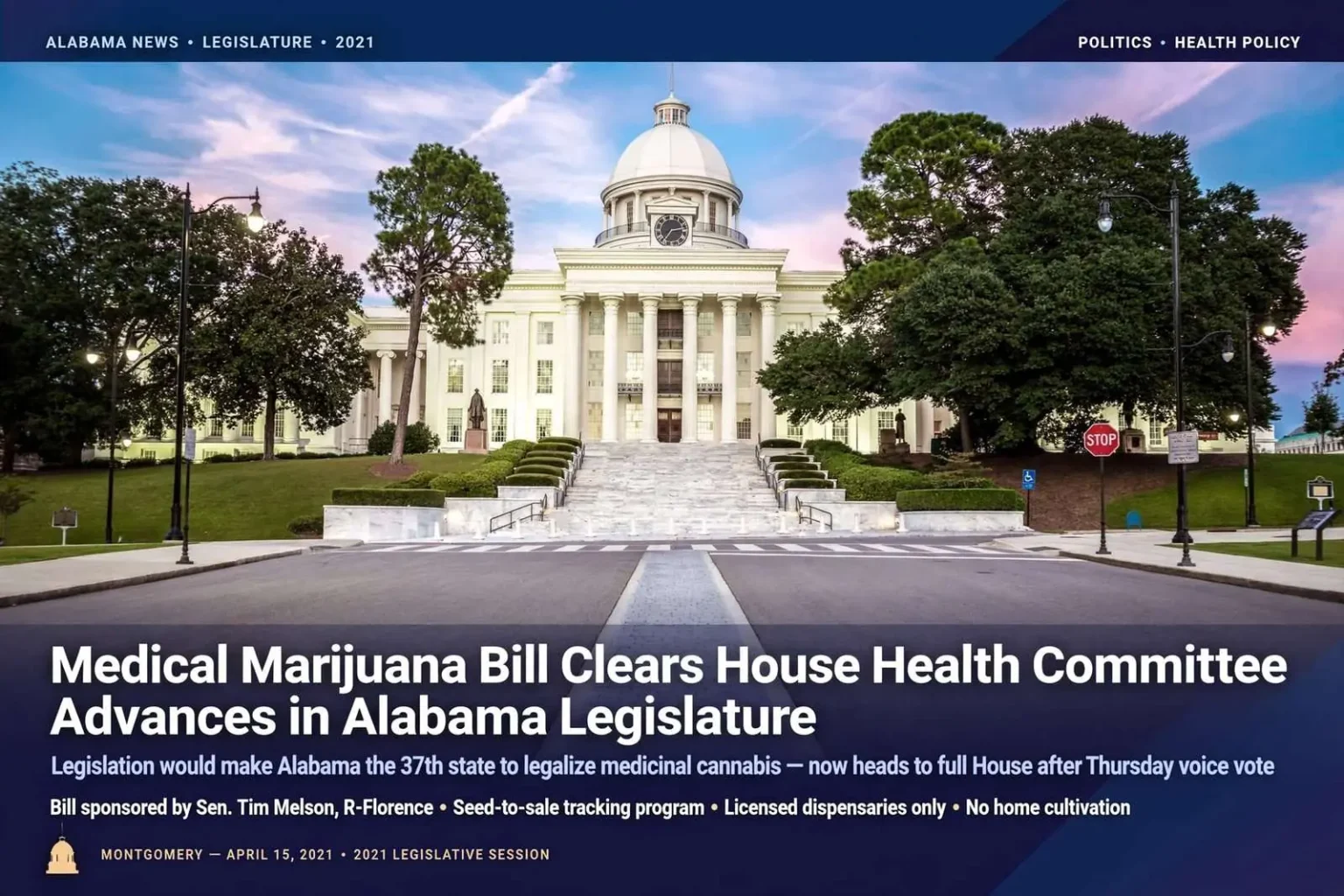
Legislation that would make Alabama the 37th state to legalize medicinal cannabis cleared the House Health Committee on a voice vote Thursday morning, sending the bill to the full Alabama House of Representatives. The vote, taken without a recorded roll call, ended years of committee-room inertia on the question and marked the furthest the idea has traveled in the Legislature, where proposals to allow medical marijuana have been introduced, studied, and shelved across multiple sessions. With the committee’s blessing, the measure now heads to the chamber floor, where it will require the support of a majority of the House’s 105 members to keep moving.
The bill is sponsored by Sen. Tim Melson, R-Florence, who has carried medical cannabis legislation in the Statehouse for several sessions. Melson, a physician by training and profession, has been the Senate’s most persistent advocate for a regulated medical program, arguing from his own practice experience that patients with serious, chronic conditions deserve a legal alternative when conventional treatments fail. His sponsorship has given the measure unusual credibility in a conservative body, and his willingness to accept tight regulatory limits — and to rebuild the bill after earlier versions stalled — has kept it alive where similar proposals died quietly.
What the bill would do
Melson’s legislation would establish a regulated seed-to-sale system for medical cannabis, closely monitoring every step from cultivation through sales at licensed dispensaries. Under that model, the state would license and track growers, processors, transporters, testing laboratories, and retail dispensaries, with each plant and each product traced through a centralized inventory system from the moment it is planted to the moment it is dispensed to a certified patient. Seed-to-sale tracking is the strictest form of oversight used by states with medical programs, and its inclusion in the Alabama bill is a deliberate answer to lawmakers who have worried about diversion into the black market.
Under the proposal, doctors could certify patients for medical cannabis cards covering a range of qualifying conditions, including depression, chronic pain, nausea from cancer treatment and Parkinson’s disease, among others. The qualifying-condition list sits at the heart of the debate: a broader list means more patients can participate, while a narrower one keeps the program limited to conditions with the strongest support in the medical literature. The bill’s list spans debilitating physical and psychological conditions, and certification would be limited to physicians who are licensed in Alabama and who have a bona fide doctor-patient relationship with the person they are certifying.
Patients who receive cards would be able to obtain cannabis products only from licensed dispensaries, and the bill as drafted does not authorize patients to smoke plant material, sticking instead to oils, tinctures, capsules, topical products, and other forms the state can standardize and dose. Home cultivation would remain prohibited, and products would be required to carry lab-tested labels showing cannabinoid content. Those restrictions place the Alabama proposal on the conservative end of the national spectrum, closer in spirit to the tightly controlled programs of states like New York and Pennsylvania than to the permissive markets of the West Coast.
A long road through the Statehouse
The committee vote came after years of groundwork. In 2019, the Legislature created a state study commission to examine medical cannabis and recommend a framework, and the commission’s months of hearings — featuring patients, physicians, law enforcement officials, and representatives of other states’ programs — produced the template that much of the current bill follows. Previous medical cannabis measures reached the Senate floor in earlier sessions only to fall short or run out of time, making this year’s committee approval in the House a genuine milestone rather than a procedural formality.
The committee’s approval moves the measure one step closer to a floor vote as the 2021 legislative session continues in Montgomery. The session’s compressed calendar, a legacy of pandemic-era scheduling, leaves less room for the kind of extended negotiations the bill has historically required, and supporters know a floor vote cannot be delayed indefinitely without risking the clock. After the House, the measure must return to the Senate — which has previously passed versions of Melson’s legislation — to resolve any differences between the chambers before anything reaches the governor’s desk.
Advocates for the bill frame it first as a medical question. Cannabis or its components have been shown to help certain patients manage chronic pain, control chemotherapy-related nausea, and reduce seizures, and physician organizations have increasingly urged a regulated framework in place of the informal, unregulated market that already exists. Patients in Alabama who currently benefit from cannabis must either travel to another state, risk products of unknown quality and potency from illicit sources, or go without. A licensed, lab-tested in-state program, supporters argue, addresses all three problems at once.
The arguments against
Opposition in the committee and across the Statehouse has come from several directions. Some lawmakers argue that marijuana remains illegal under federal law and that Alabama should not build a state industry atop a schedule that Washington has not changed. Others, including some in law enforcement, worry that a medical program inevitably loosens attitudes toward recreational use and complicates enforcement of existing drug laws, particularly driving-under-the-influence cases where impairment testing is harder than with alcohol. Faith-based groups, historically influential in Alabama politics, have also weighed in against expansion.
The bill’s supporters have responded by emphasizing the limits built into the legislation: no smoking, no home growing, no recreational sales, no dispensary on every corner. They point out that neighboring states have already moved — Mississippi voters approved a medical marijuana initiative in November, and Florida has operated a highly regulated medical program for years — without the kind of collapse opponents describe. Thirty-six states had already legalized medical cannabis before Alabama’s bill advanced, giving lawmakers a deep library of other states’ rules, mistakes, and fixes to draw from.
What happens next
A floor vote in the full House is the immediate test. Bills of this profile typically draw extended debate, amendments, and procedural maneuvering, and any change the House makes must be reconciled with the Senate version before final passage. If the chambers agree, the question of implementation begins: state agencies would need to write licensing rules, set fees, stand up the tracking system, and screen applicants, a process that in most states takes a year or more between legalization and the first dispensary opening.
For patients and their families, the timeline is the frustration. Every session that ends without a law is another year of travel, uncertainty, or untreated symptoms for people whose conditions the bill names directly. For lawmakers, the calculus is different: a voice vote in committee allowed members to advance a controversial measure without putting their names on a tally, but a floor vote will demand a public position from every member of the House. Alabama’s place as either the 37th state to legalize medical cannabis or another late entry on the list will be decided in that chamber in the weeks ahead.
Why it matters locally
Whatever the House decides, the debate has already reshaped expectations in Montgomery. Medical cannabis legislation that once couldn’t get a committee hearing has now cleared one, with a physician-senator’s bill standing as the vehicle. Counties and municipalities across the state, including communities along the Gulf Coast, are watching closely because any licensing framework would decide where cultivation sites, processing centers, and dispensaries may open, and because local governments would have a role in zoning them. The next moves — floor debate, a conference of the two chambers, and possibly a signature in the governor’s office — will determine whether Alabama joins the growing majority of states that treat medical cannabis as a regulated part of the health care system rather than an open question.
The economics of the proposal have also figured in the debate. A licensed program would create new agricultural opportunities for Alabama growers, laboratory and security jobs, and tax revenue that the bill’s sponsors have suggested directing toward enforcement and health programs. Rural counties looking for investment have taken note, since cultivation and processing facilities tend to locate where land and labor are available. Opponents counter that any revenue estimate should be weighed against regulatory costs, arguing that the agencies overseeing the program will need sustained funding to police licensees and keep the seed-to-sale system honest. Those arguments are likely to surface again as the bill moves toward a floor vote, where amendments on fees, licensing caps, and revenue allocation are expected.
For now, the legislation stands where few of its predecessors have: out of committee and waiting on the House floor. Supporters have spent years assembling the coalition of patients’ advocates, physicians, and suburban Republicans that any medical cannabis bill in Alabama requires, and they argue the compromise is finally balanced enough to hold. The voice vote in the House Health Committee was quiet, but it was a signal — the first time the chamber’s health leadership has allowed the question to advance rather than die in a drawer. Whether that signal becomes law will be evident by the time the 2021 session ends in Montgomery.