Meet the 2010 Greater Mobile Arts Awards Honorees, From the Blind Mule to Wanda Sullivan
The 2010 Greater Mobile Arts Awards honored Wanda Sullivan, The Blind Mule, Jane Shaw, the GCEH Jazz Festival, Herndon Inge III and Laureen Lynn.
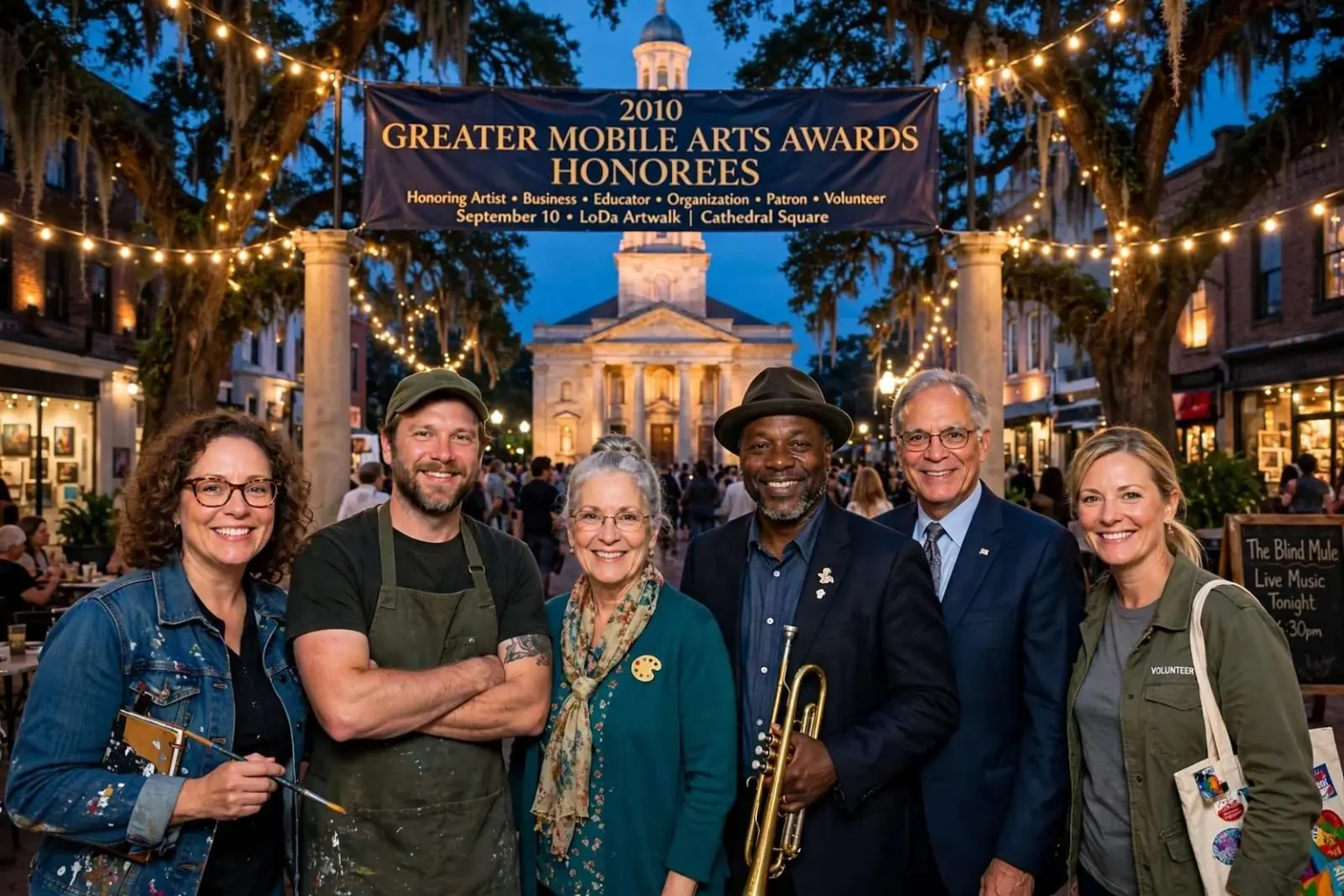
Mobile’s arts community took center stage this fall as the Greater Mobile Arts Awards prepared to honor six of the people and organizations that have shaped the city’s creative life. The awards were presented at 6:30 p.m. on September 10 during the LoDa Artwalk in Cathedral Square, placing the ceremony in the heart of the downtown entertainment district on the very night when the largest crowds of the month already fill its streets and galleries.
The LoDa Artwalk — the monthly celebration that turns Dauphin Street’s lower blocks into an open-house evening of gallery shows, street performers, and restaurant crowds — provided a fitting backdrop for the honors. The awards program was conceived as a way to formally recognize the artists, businesses, educators, organizations, patrons, and volunteers whose behind-the-scenes work sustains Mobile’s cultural infrastructure, and the public ceremony format meant the honorees were celebrated by the same downtown crowd their work has served.
The honorees spanned every corner of the local arts scene, from a painter-turned-gallery-director to a downtown bar that became an unlikely cultural incubator. The six categories — artist, business, educator, organization, patron, and volunteer — mapped the full ecosystem that a city needs to sustain a creative community: people who make the work, venues that show it, teachers who train the next generation, institutions that organize it, donors who fund it, and volunteers who keep it all running.
Artist: Wanda Sullivan
Painter Wanda Sullivan holds a B.F.A. in painting from the University of South Alabama and an M.F.A. from the University of Mississippi. She has taught at Spring Hill College since 2007 and serves as director of the college’s Eichold Gallery. Her career traces the path many Gulf Coast artists follow — trained at the region’s own institutions, then returning to build the scene that trained them — and her dual role as working painter and gallery director has made her one of the connective figures in Mobile’s art world, mounting exhibitions for others while sustaining her own studio practice.
Spring Hill College, the Jesuit liberal arts college on Mobile’s western edge, has long played an outsized role in the city’s cultural life for an institution its size, and the Eichold Gallery functions as one of the few dedicated exhibition spaces in the area that mounts contemporary work on a rotating schedule. Under Sullivan’s direction the gallery has served both the college community and the wider public, giving regional artists a professional venue and students a working model of how the art world operates. The artist award recognized a career spent producing work and building the platforms on which other artists’ work appears.
Business: The Blind Mule
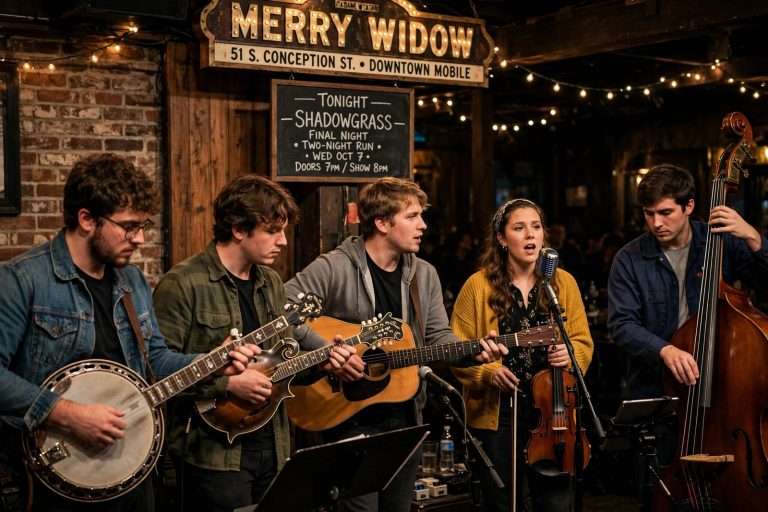
The Blind Mule earned the business award for its role in championing young local artists and musicians at a time when few other venues would book them. Supporters credit the restaurant and music spot with playing a large part in what has been called Mobile’s cultural revival downtown. In the years after the city’s downtown had emptied out at nightfall, the stretch of Dauphin Street around the restaurant became one of the proving grounds for the revival — a block where a curious crowd could hear a songwriter’s original material rather than a cover set, and where the walls carried work by painters who had nowhere else to hang it.
The venue’s model was simple but consequential: give emerging talent a stage, a paying audience, and the benefit of the doubt. Every established music scene depends on rooms like that — businesses willing to lose a little money on a Tuesday night show so that a scene can exist at all — and Mobile’s downtown renaissance, which transformed LoDa from a cautionary tale into the city’s entertainment anchor, drew heavily on the artists and audiences those rooms cultivated. The business award honored that patient, unglamorous contribution to the city’s cultural life.
Educator: Jane Shaw
Long-time art teacher Jane Shaw founded the Cathedral Square Gallery for her students, modeling it after the cooperative galleries of Taos, New Mexico, so that working artists could show and sell their work collectively. The Taos model — artists pooling resources to run their own exhibition space, sharing costs and staffing rather than waiting for a commercial dealer to discover them — translated naturally to Mobile’s scale, where the market for original art is real but too small to support many conventional galleries.
Shaw’s decades in Mobile-area classrooms gave her an intimate view of what happens to talented students after graduation: without a local infrastructure of exhibition and sales, most drifted away from serious artmaking entirely. The cooperative gallery she founded answered that problem directly, giving artists a stake in their own venue and keeping creative careers alive in the city where they began. The educator award recognized not only her teaching but the institution she built to extend it — a school that never stops at the classroom door.
Cathedral Square itself is one of Mobile’s most evocative public spaces, framed by the Columns and live oaks of the historic district beside the Cathedral-Basilica of the Immaculate Conception, and it serves as the natural gathering point for downtown cultural events. Hosting a cooperative gallery within sight of that square tied the artist community to the historic core that visitors and locals alike associate with the city’s identity.
Organization: Gulf Coast Ethnic & Heritage Jazz Festival
The Gulf Coast Ethnic & Heritage Jazz Festival had just completed its twelfth year keeping alive one of Mobile’s most important musical traditions. The festival’s centerpiece free concert, long held in Bienville Square, may move to a new venue or date to escape the summer heat — a logistics question familiar to every Gulf Coast festival organizer, where August and September afternoons can send even the most devoted crowds indoors.
Beyond the main concert, the organization runs a youth workshop, a poetry slam and a pro-am jam session, with plans to expand its calendar of events throughout the year. That structure reflects the festival’s founding mission: Mobile is the birthplace of jazz’s most famous trombonist and singer, and the city’s role in early jazz history runs through the vaudeville circuits, social aid societies, and riverfront clubs that shaped a century of Gulf Coast music. The festival carries that inheritance forward not as nostalgia but as living practice — putting working musicians in front of young players, giving poets a stage, and keeping professional and amateur musicians jamming side by side.
Free admission to the main concert is central to its purpose. Festivals that charge gate fees filter their audiences; the jazz festival’s open square format puts the music in front of the whole city, including families and young people who might never buy a ticket to a club show. The organization award honored a dozen years of that quiet, consistent institution-building.
Patron: Herndon Inge III
Attorney Herndon Inge III has devoted years of service to downtown Mobile and its arts institutions, sitting on numerous boards including Playhouse in the Park. He was instrumental in founding the Crescent Theater Film Society and serves as its president, helping keep the independent downtown cinema alive. The Crescent, a small single-screen house tucked into the LoDa district, became an unlikely cultural anchor — showing independent and art-house films that no multiplex would book — and the film society formed around it gave the theater a membership base and a programming mission beyond commercial survival.
The patron category exists because every arts ecosystem depends on people whose contributions are legal expertise, board governance, fundraising, and institutional memory rather than public performance. Inge’s portfolio — a historic playhouse, an independent cinema, and service across downtown organizations — represents the civic infrastructure layer that rarely wins applause but determines whether venues survive their difficult early years.
Volunteer: Laureen Lynn
Rounding out the class of honorees, volunteer Laureen Lynn received recognition for her behind-the-scenes work supporting arts organizations across the city. Every award program needs its category for the people whose names appear in program credits and volunteer lists rather than headlines, and Lynn’s honor acknowledged the daily labor — event staffing, organization, coordination — that keeps Mobile’s cultural calendar functioning between the marquee moments.
Together, the six honorees sketched a portrait of how a mid-sized Southern city actually builds and sustains an arts scene: a painter who runs a gallery, a bar that takes chances on unknown musicians, a teacher who founds a cooperative, a festival that turns a downtown square into a concert hall, a lawyer who keeps small institutions solvent, and a volunteer who does the work no one sees. Presented in Cathedral Square on a September evening amid the Artwalk crowds, the awards were as much a map of Mobile’s creative community as a ceremony celebrating it.