Mehmet Oz Again Cites University of Mobile Athlete Kaiden Francis in Medical Fraud Crackdown Argument
CMS Administrator Mehmet Oz described the 2024 death of University of Mobile freshman Kaiden Francis as the result of a 'predatory scheme,' alleging a physician spent 11 seconds reviewing 63 cardiovascular images. No charges tied to the death have been announced.
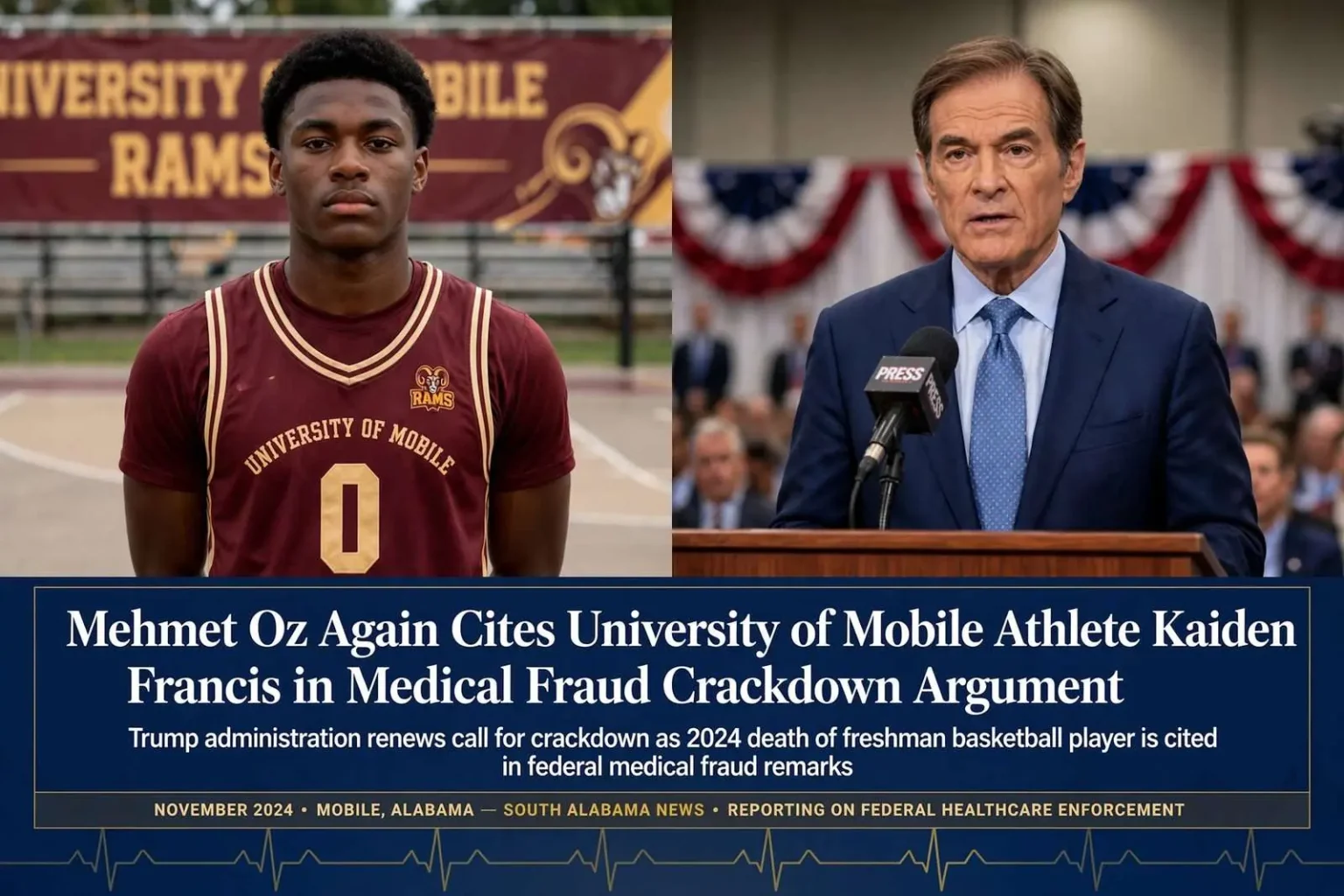
The death of a University of Mobile basketball player two years ago continues to be cited by the Trump administration as an example of why federal officials say they must crack down on medical fraud.
Dr. Mehmet Oz, administrator of the Centers for Medicare and Medicaid Services, referenced the November 2024 death of Kaiden Francis, a freshman basketball player at the University of Mobile, during remarks at the Republican Midterm Convention in Dallas.
Oz described the case as a “predatory scheme dressed up in medical clothing.”
“He died from sudden cardiac arrest,” Oz said. “A (Department of Justice) investigation found a fraudster doctor spent roughly 11 seconds reviewing 63 cardiovascular images, pictures of his heart, that Kaiden got from his screening. The scans indicated that his heart was significantly enlarged. But the fraudulent doctor signed the results as normal.”
“That clear Kaiden to keep playing sports and that is how he died,” Oz continued.
What Happened in Mobile
Francis, who was from Fort Lauderdale, was found unresponsive shortly after a weekly skills workout with the University of Mobile’s coaching staff and trainers. Students and medical professionals attempted to render aid, but he was later pronounced dead.
At the time, no cause of death was publicly released.
Francis had passed multiple health screenings before arriving at the university, including heart and lung evaluations.
“I’m a heart specialist and I can assure you that a trained professional should not have missed these results,” said Oz, a cardiothoracic surgeon and former television host.
What Oz Has Said Before
This was not the first time Oz has raised the case. Federal officials have described an enforcement effort targeting people accused of stealing billions of taxpayer dollars through healthcare schemes, including administering diagnostic tests such as echocardiograms that produced inaccurate results.
During remarks in June, Oz held up a photograph of Francis and alleged that he died as a result of a scheme involving a cardiovascular testing company. He said an EKG had been performed in October 2024, about a month before Francis died.
“They shared the autopsy,” Oz said at that June news conference, referring to the family. “The son’s heart was 2-1/2 times larger than normal. There was no way you can miss that other than they do not care. This is not a diagnostic company, but a predatory scheme. We’ll treat it as such.”
Oz said he has personally spoken with Francis’ mother, describing her as grieving and relaying her assessment that the doctor who reviewed her son’s screening “is as bad as any greedy criminal killing who is killing people in the streets,” along with her statement that her son will never come back.
What Has Not Been Established
Several elements of the account remain unconfirmed publicly, and they are significant.
Neither during the June news conference nor in the remarks at the GOP convention did Oz identify the company or the physicians involved.
There also has been no public announcement of criminal charges filed by the Department of Justice directly in connection with Francis’ death.
The University of Mobile could not be immediately reached for comment.
Those gaps do not establish that the account is inaccurate. Federal investigations frequently proceed for extended periods before charges are announced, and prosecutors do not typically confirm the existence of ongoing investigations. But the absence of an identified defendant, an identified company or a filed charge means the allegations described have not been tested in any legal proceeding, and the parties Oz describes have had no opportunity to respond.
The Condition Involved
The description Oz gives — a significantly enlarged heart in a young athlete who died of sudden cardiac arrest — corresponds to a category of condition that is the leading cause of sudden cardiac death in young athletes.
Cardiomyopathies, which involve abnormal thickening or enlargement of the heart muscle, frequently produce no symptoms until a catastrophic event. They are typically detectable on imaging by a reader who knows what to look for, which is the premise underlying cardiac screening programs for athletes.
Sudden cardiac arrest in young athletes is rare in absolute terms but is the leading medical cause of death during exercise in that population. It has driven the widespread placement of automated external defibrillators at athletic facilities and the adoption of emergency action plans by athletic departments.
The Screening Debate
The case touches a long-running disagreement in sports medicine about how athletes should be screened.
American practice, reflected in guidance from major cardiology organizations, has historically centered on a personal and family history questionnaire combined with a physical examination. Routine electrocardiographic screening of all athletes has not been universally recommended in the United States, in part because of concerns about false positives, cost and the availability of physicians trained to interpret athlete ECGs, which differ from those of the general population.
Other countries have taken a different approach. Italy has required ECG screening for competitive athletes for decades, and research from that program has been central to arguments in favor of broader screening.
What the account Oz describes highlights is a dimension of that debate that is easy to overlook: screening is only as good as the interpretation. A test performed and read carelessly does not merely fail to detect a condition. It generates a document stating that the athlete is normal — and that document then justifies clearance to compete.
Eleven seconds for 63 images, as alleged, would be a matter of fractions of a second per image.
The Enforcement Context
Oz used the case to argue for more aggressive action against medical fraud, framing the stakes as extending past financial loss.
“We must challenge this evil corruption,” he said. “Not only stop the loss of taxpayers’ dollars but prevent American from dying at the hands of these thieves.”
He urged federal and state agencies to take medical fraud seriously, saying Francis’ story “should not be the story of anyone’s future in America.”
Healthcare fraud enforcement has traditionally been framed in financial terms, measured by dollars recovered and losses prevented. The argument being advanced here reframes it as a patient safety matter: that fraudulent diagnostic operations do not simply bill for tests that were not properly performed, but produce results that patients and physicians then rely upon.
Whether the specific allegations in this case are borne out by a legal proceeding remains to be seen. No charges connected to Francis’ death have been publicly announced.
A Family and a Campus
Behind the enforcement argument is a 2024 death that a Mobile campus experienced directly.
Kaiden Francis was a freshman who had traveled from Fort Lauderdale to play basketball at the University of Mobile. He collapsed after a routine workout, in a facility where teammates, coaches and trainers were present and attempted to help him.
His death is now being described from a convention stage in Dallas as an argument for federal policy. His family, according to Oz’s account, shared the autopsy that underlies it.
South Alabama News will report if charges are filed or if additional details become public.