
Microchip Shortage Leaves Mobile’s Curbside Trash Pickup Running Behind
Mobile's curbside trash pickup is behind schedule due to microchip shortages and truck repairs; no citations issued while crews work extended hours.
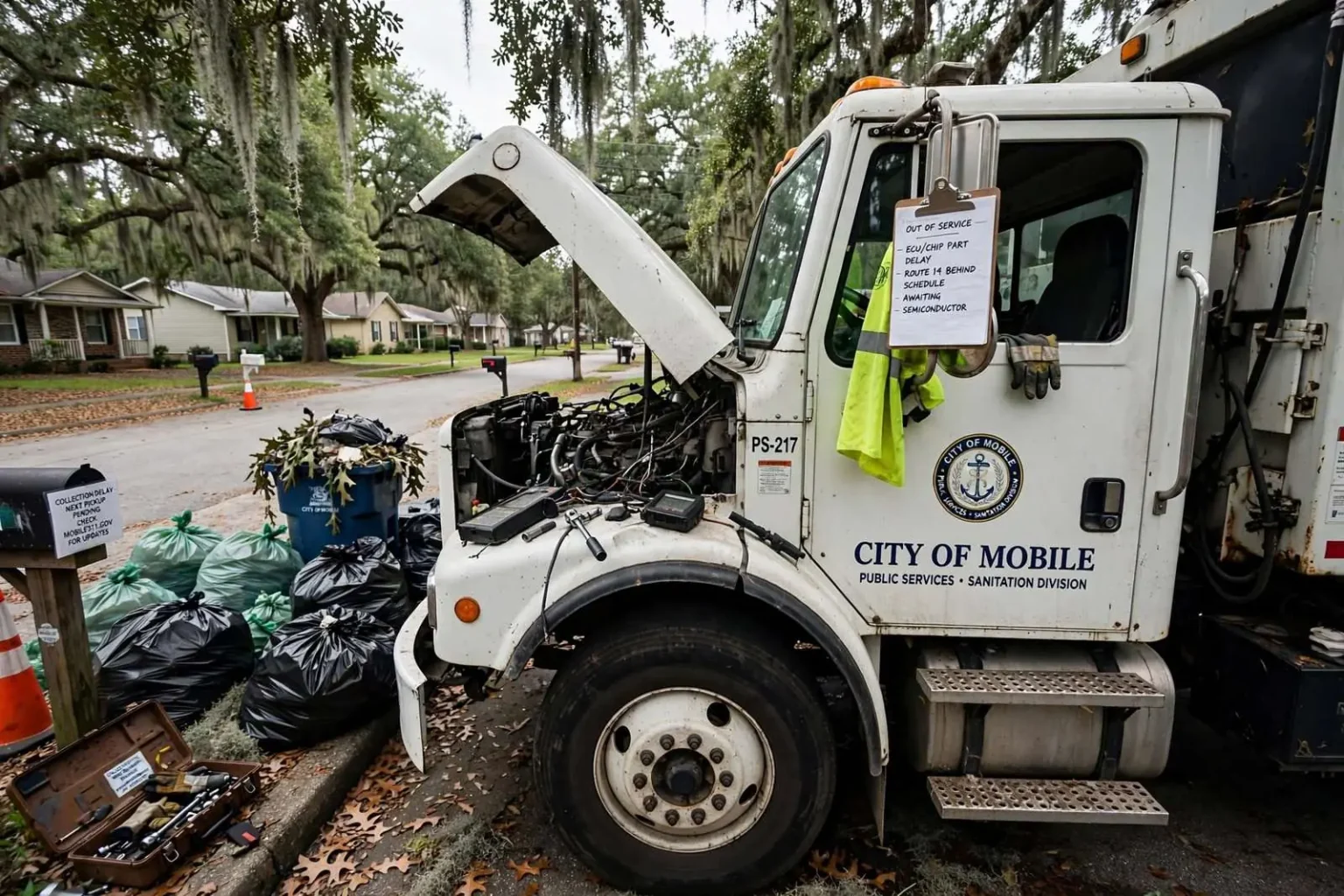
A global microchip shortage and manufacturing delays have kept the City of Mobile from adding new garbage trucks, leaving curbside trash collection running behind schedule in several neighborhoods, city officials said. The problem is compounded by a number of trucks in the city’s normal fleet sitting offline for maintenance and repairs, squeezing a collection system that depends on a reliable rotation of vehicles to cover residential routes across Alabama’s fourth-largest city. Residents in the affected areas have reported pickups arriving days after their scheduled collection, and city crews have been racing to close the gap one route at a time.
Why a Chip Shortage Stalls a Garbage Fleet
Modern refuse trucks are sophisticated vehicles, relying on electronic controls for engines, hydraulic lifting systems, and route management equipment. When semiconductor production slowed worldwide in 2021, automakers of every kind — from passenger cars to heavy trucks — lost access to the chips needed to finish new vehicles, and chassis orders that Mobile had placed with manufacturers languished. The same shortage idled assembly lines across the heavy equipment industry, and municipal buyers found themselves waiting months or longer for delivery of vehicles that once arrived in standard timeframes. Industry analysts traced the shortage to pandemic-era factory shutdowns, surging electronics demand, and a fragile supplier base concentrated in a handful of overseas fabs, a combination that left little slack anywhere in the supply chain.
For Public Services Department crews, the math is unforgiving: fewer trucks on the road means fewer routes completed each day, and the backlog compounds when existing trucks age out of service or sit in the shop awaiting parts. In response, crews have been putting in nine-to-ten-hour days, six days a week to keep collections moving, and the city is bringing in short-term rental equipment to fill the gap. Rental refuse trucks are in short supply nationwide for the same reasons as new ones, making each rental a costly stopgap. The overtime push has added labor costs on top of the rental fees, a double burden on the city’s sanitation budget that officials say is unavoidable if service is to continue.
No Citations During the Backlog
While crews catch up, the city is suspending enforcement of its rule against placing trash at the curb more than 48 hours ahead of scheduled pickup. No citations will be issued until collections return to their regular schedule, an acknowledgment that residents cannot be penalized for setting out garbage early when pickup crews are running days late in some neighborhoods. The 48-hour rule exists to keep curbside piles from becoming nuisances, but enforcement during a backlog would only compound frustration. Code enforcement officers who normally work the trash rules have been redirected to other duties while the suspension lasts.
City officials expect six additional collection trucks to be in operation by the end of May, which should let crews close the gap with normal routes. Until then, residents can check the city’s website and social media accounts for daily updates on where crews will be working next, a communication push aimed at reducing calls to the city’s 311 line and helping households know when to expect service. Officials have urged patience as crews work extended shifts through the backlog, noting that route recovery is gradual: each truck that returns to service lets crews reclaim another set of streets, and a day’s progress can be erased by a single mechanical failure in the aging fleet.
Drop-Off Options for Yard Debris
In the meantime, four drop-off sites are open for bagged yard debris only: Medal of Honor Park on Hillcrest Road, Langan Park on Zeigler Boulevard, Seals Park and Community Center on Texas Street, and Trimmier Park on Alba Club Road. The sites give residents an alternative to waiting for curbside pickup of limbs, leaves, and grass clippings, material that makes up a substantial share of Mobile’s collection volume, especially during the long Gulf Coast growing season and after storms. Only bagged debris is accepted so that crews can handle loads efficiently and keep the parks usable. City staff have asked residents not to use the sites for construction debris, appliances, or household garbage, which the sites are not equipped to process.
The episode is a small but vivid illustration of how the global supply chain reached into everyday municipal services. Cities across the Gulf Coast and the country reported similar delays in garbage collection, vehicle purchases, and equipment repairs during the shortage, prompting some governments to keep vehicles longer, buy used, or redesign maintenance schedules. For Mobile, the recovery plan hinges on those six new trucks arriving and staying in service — and on a fleet maintenance program that can keep the older vehicles running until the shortage fully fades. Officials have said they will reevaluate the enforcement suspension once collections return to normal schedule, and residents are being asked to follow the 48-hour guidance voluntarily in the meantime.
The shortage’s effect on refuse fleets has been national in scope, with sanitation directors trading notes through municipal associations on which chassis makers could still deliver and how long the waits were running. A single heavy truck combines a chassis from one manufacturer with a compactor body and lifting equipment from others, so a delay at any link in that chain strands the whole vehicle. Cities that had planned fleet rotations around routine five-to-seven-year replacement cycles suddenly found themselves stretching trucks well past their intended service lives, which in turn drove up maintenance costs and downtime — the exact problem Mobile is now managing.
How Mobile’s Collection System Works
Mobile’s curbside system assigns households regular weekly collection days for household garbage, with separate handling for yard debris and bulk items. The routes are planned around fleet capacity: the city schedules trucks and crews so that every residential route in the rotation is covered within its scheduled week. When the available truck count drops, the department’s options narrow — extend hours, add Saturday work, delay some routes, or skip areas temporarily and circle back. Officials chose overtime and rentals rather than skipped collections where possible, which is why some neighborhoods saw pickups late rather than not at all.
The 311 line and the city’s online tools have become the primary way residents track their street’s status, and the department has encouraged households to report missed collections through the same channels so crews can verify and clear them. During recovery phases, missed-route reports tend to spike, and officials have said the fastest way to resolve an individual miss is to log it while the truck shortage backlog works through the map. The city has also reminded residents that holiday weeks shift collection schedules by a day, a frequent source of confusion independent of the current backlog.
What began as a story about semiconductors ends, for most residents, as a story about when the truck comes. City officials have pledged to update the public as each of the six new trucks enters service, and to restore normal enforcement — and normal expectations — once the routes are whole again. Until then, the advice remains: bag the yard debris, take it to one of the four park drop-off sites if curbside lags, and check the city’s daily updates before assuming a missed pickup is a skipped one.
Fleet maintenance has emerged as the quieter half of the crisis. Refuse trucks operate in punishing conditions — constant stopping, heavy compaction cycles, and corrosive loads — and an aging fleet requires more shop time per vehicle. Mobile’s Public Services mechanics have been prioritizing repairs that return trucks to routes fastest, sometimes deferring preventive work on marginal vehicles to keep the maximum number of trucks rolling each day. The strategy carries risks of its own, since deferred maintenance tends to produce bigger failures later, and officials have acknowledged that the city will be paying down the maintenance backlog even after new trucks arrive.
What Residents Can Expect Next
The city’s recovery timeline hinges on delivery and commissioning of the six trucks expected by the end of May. New refuse trucks are not simply driven into service; they must be equipped, inspected, and assigned to routes, and crews need time to adapt to the vehicles. Officials have said the additions should restore the department’s ability to cover all residential routes on schedule, at which point the 48-hour curb rule returns to normal enforcement and the rental equipment goes back to its suppliers. The extended six-day workweeks for collection crews are also expected to taper as routes normalize, something department leaders have said matters for both budgets and staff fatigue.
The broader lesson cities are drawing from the shortage is about resilience: longer-term contracts for rental equipment, spare-parts stockpiles, and staggered fleet replacement schedules are all under discussion in municipal fleets nationwide. Mobile’s experience — a global chip fab slowdown visible as uncollected trash on a neighborhood curb — has given local officials a concrete case for investing in fleet redundancy. For now, the city’s message to residents is straightforward: the trucks are coming, the crews are working six days a week to catch up, and the drop-off parks remain open for bagged yard debris until every route is back on schedule.


