Minnesota Gay Men’s Chorus to Make First Mobile Stop for Bay Area Inclusion Benefit
The Twin City Gay Men's Chorus, a Minnesota-based ensemble making its first visit to Mobile, will perform at Bishop State Community College in a benefit concert for the local nonprofit Bay Area Inclusion.
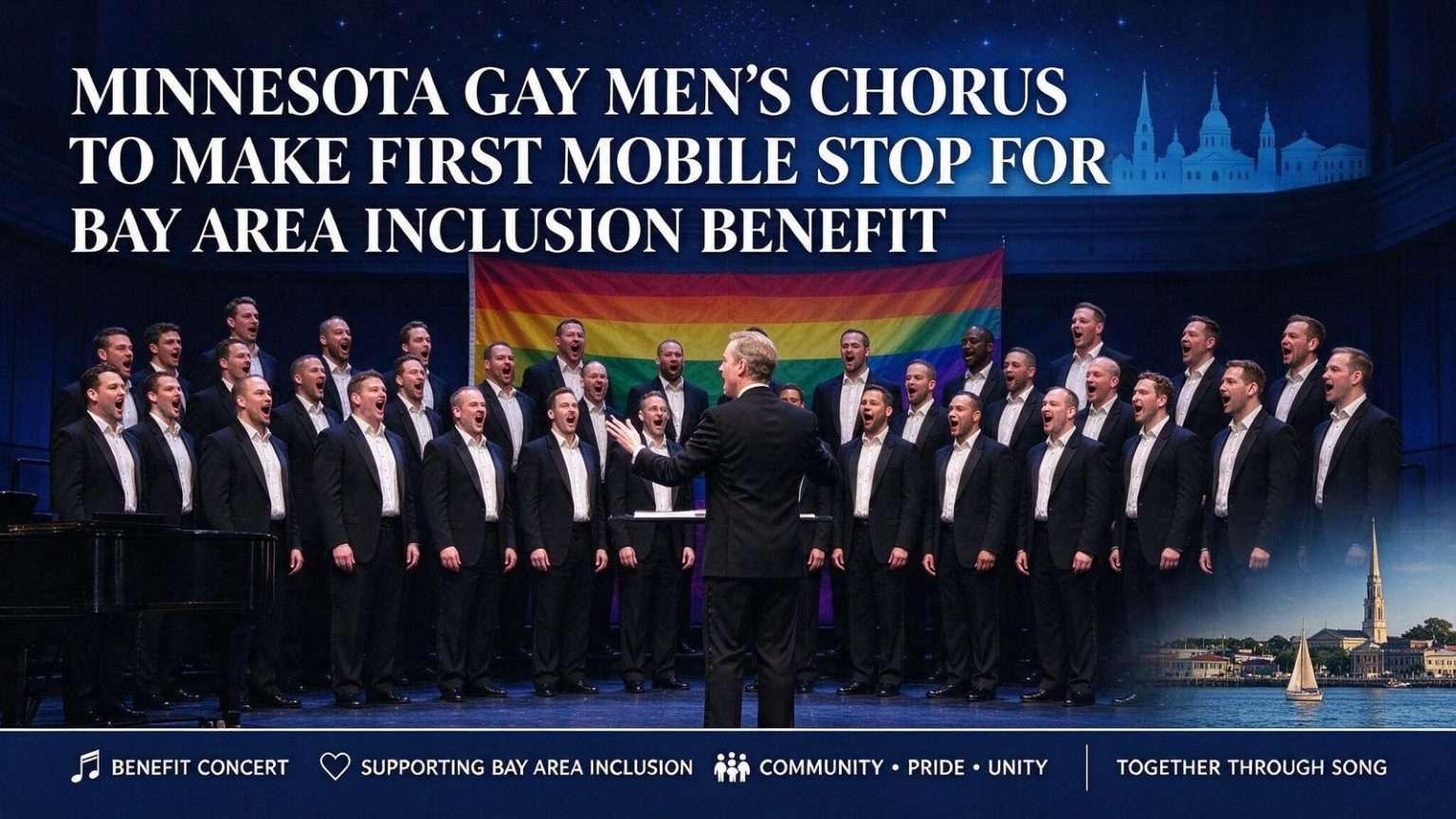
A Minnesota-based singing group with roots stretching back a quarter century is set to make its first appearance in Mobile this summer, bringing a two-hour benefit concert to Bishop State Community College in support of a local charity.
The Twin City Gay Men’s Chorus, one of the oldest ensembles of its kind in the country, will perform in Mobile as part of a multi-city Southern tour that also includes stops in Nashville, Birmingham, Jackson, Miss., Biloxi and New Orleans. The Mobile concert will serve as a fundraiser for Bay Area Inclusion, a local nonprofit that supports the area’s LGBTQ community.
Dr. Stan Hill, who has served as the chorus’s artistic director for six years, said the group hopes to do more than just raise money during its stop in the Azalea City. “We’re trying to get some similar groups started in the towns we visit,” Hill said. “We were started 25 years ago when the San Francisco Gay Men’s Chorus came through Minneapolis. We want to kind of do the same thing.”
The chorus has grown considerably since its founding, expanding from about 70 original members to roughly 150 singers today, though only 104 members are making the trip south for the tour.
Richard Perez, the Mobile resident coordinating the local event and a board member of Bay Area Inclusion, said audiences should expect a polished, wide-ranging show. “It’ll be really professional,” Perez said. “It’ll be a really varied program.”
Hill offered a preview of some of the concert’s featured numbers, including a tribute to Patsy Cline tied to the group’s upcoming performance at the Ryman Auditorium in Nashville, historic home of the Grand Ole Opry — a show that will mark the first appearance by a gay men’s chorus at that venue. “Part of it is going to be a tribute to Patsy Cline,” Hill said. “We’re playing the Grand Ole Opry so we just had to, but we’re going to throw some country dancing in there.”
The program will also include “Not in Our Town,” a piece inspired by an incident in Billings, Mont., in which residents responded to an attempted act of intimidation targeting a Jewish family that had displayed a menorah during Hanukkah by placing menorahs in windows throughout the town in a show of solidarity. Another selection, titled “Marry Us,” addresses marriage equality directly.
Organizing the tour has not been without its challenges. Hill said several venues initially considered for tour stops backed out, including one that offered to host the chorus only if the group agreed to remove the word “gay” from its name — a condition the chorus declined.
Perez said he hopes the visit will help energize Mobile’s own arts and advocacy community. “We’ve got the talent here,” he said. “We just need to coalesce. It’s ripe right now.” He also praised the visiting singers for using their vacation time to make the trip. “A lot of these guys are taking their vacations from work to do this,” Perez said. “They could be anywhere but they’re coming down here to entertain us.”
Hill, who has visited Mobile before, said he has come to appreciate the city’s charm. “It’s a beautiful city, and the people seem really nice,” he said. The chorus will hold a public reception at the Mobile Arts Council ahead of the performance, along with a meet-and-greet at the auditorium afterward, and members will take a tour of the historic city the following morning.
The tour will also carry personal significance for at least one chorus member. Hill said a Black chorus member in his 60s, who served in the Army and was once stationed near Biloxi, was barred from joining his fellow soldiers on the area’s beaches because of his race. During the stop in Mississippi, Hill said, the group plans to accompany the singer, Richard Long, to the beach so that he can walk onto the sand and step into the water — something he was denied the chance to do decades ago.
The chorus’s tour will also bring it into contact with a similar singing group in New Orleans that has performed for about 15 years but has struggled in the years since Hurricane Katrina. “They had about 26 members,” Hill said, “but I think they’re down to about 15 now. They’ve just been scattered everywhere.”
Background on the Program
“Not in Our Town” refers to events in Billings in December 1993. After someone threw a brick through the window of a Jewish family’s home where a menorah was displayed, the Billings Gazette printed a full-page paper menorah. Thousands of residents then hung it in their windows.
The Ryman Auditorium in downtown Nashville opened in 1892. It was the home of the Grand Ole Opry radio show from 1943 to 1974.