
Missing Theodore 12-Year-Old Ian Lee Clark Found Safe in Florida
Ian Lee Clark, a 12-year-old from Theodore last seen on Creel Road, has been found safe in Escambia County, Florida, according to Mobile police.
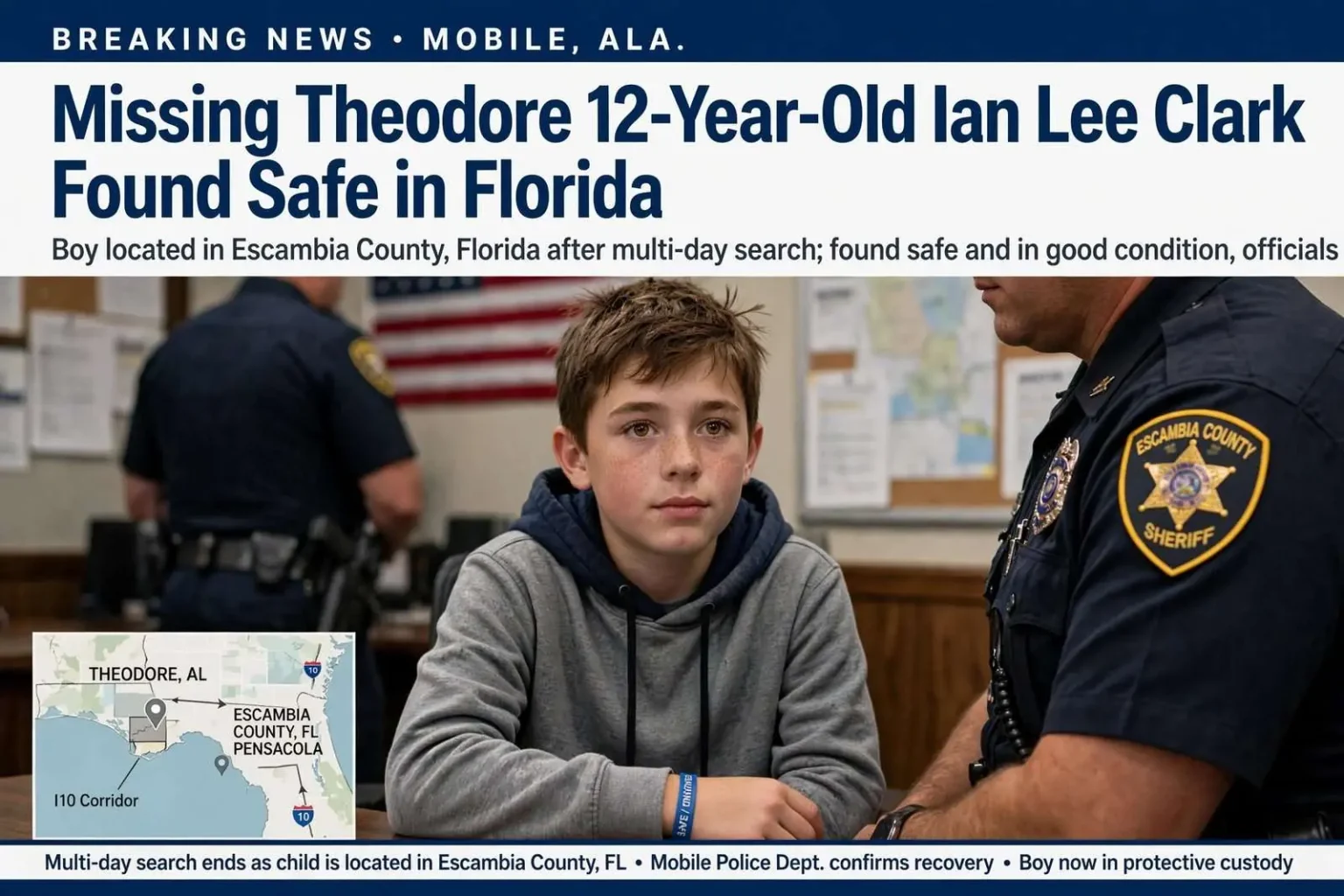
MOBILE, Ala. — A missing 12-year-old boy from Theodore has been found and is safe, the Mobile Police Department said, bringing a multi-day search that stretched across two states to a close.
Ian Lee Clark, who was last seen Saturday on Creel Road in the Theodore community, was located in Escambia County, Florida, according to police. The discovery ended a search that began over the weekend and drew in law enforcement agencies on both sides of the Alabama-Florida line as sightings of the vehicle he was believed to be in moved steadily east.
The search began after the boy’s grandparents realized that both he and their vehicle were gone. His mother said she believed he may have been a passenger in a stolen 2009 black Chevy Trailblazer taken from his grandparents, though she did not believe he was driving. The distinction mattered for how investigators approached the case: rather than a vehicle theft with an unknown driver, the working picture was a missing child traveling in a family vehicle taken without permission, and agencies along the Gulf Coast were asked to keep watch for the SUV as it moved.
That watch produced a key sighting on Monday afternoon, when the vehicle was spotted heading east on I-10 through the George Wallace Tunnel toward Baldwin County. The Baldwin County Sheriff’s Office had been watching for the SUV after that sighting, keeping the search alive along the interstate corridor that runs from Mobile through Baldwin County and into the Florida panhandle — the corridor that ultimately led to Escambia County, where the boy was found.
How the Search Unfolded
The timeline of the case stretched over several days. According to his mother, the boy got in trouble Saturday morning and went outside upset, and he was not seen again after that. The grandparents’ discovery that both the child and their vehicle were missing set off the initial report, but the stolen vehicle report did not come in until about 2:30 a.m. Monday, according to Mobile police, who considered him a runaway in the early stages of the case.
That classification shaped the response. Runaway cases are among the most common missing-child reports police handle, and they are typically worked as welfare concerns rather than abductions: officers document the child’s description, check with friends and family, and enter the child into the national missing-persons database so that any law enforcement contact anywhere in the country flags the record. The multi-day gap between when the boy was last seen and when the vehicle report reached police meant the search was still in its early phase when the SUV was already moving east.
Once the vehicle sighting put the case on the map along the I-10 corridor, the search became a moving one. The George Wallace Tunnel, which carries Interstate 10 beneath the Mobile River, funnels all eastbound interstate traffic through a single choke point, and a vehicle spotted there heading toward Baldwin County gave downstream agencies a concrete description to watch for. The Baldwin County Sheriff’s Office took on the watch for the SUV as it moved through the county, with the same interstate continuing into Escambia County, Florida, and the Pensacola area.
Theodore and the Geography of the Search
Theodore is an unincorporated community in southern Mobile County, and Creel Road sits within its mix of residential neighborhoods and rural lots. The community lies well south of Interstate 10, meaning whoever was driving the Trailblazer traveled north from Theodore before reaching the interstate system — a route consistent with the vehicle’s later appearance at the tunnel and its continued movement east.
Escambia County, Florida, where the boy was ultimately found, is the first Florida county east of the Alabama line, home to Pensacola and directly connected to Baldwin County by the interstate. The distance between Theodore and the Pensacola area is roughly an hour’s drive under normal conditions, close enough that a single vehicle can cross the state line unnoticed without an agency-level watch in place.
Police did not release details about the circumstances of the recovery in Escambia County or the condition of the vehicle, saying only that the boy was found and is safe. No charges or further enforcement action were announced in connection with the case in the initial reports.
Runaway Cases and the Multi-Agency Response
The distinction between a runaway and an abduction drives nearly every decision in a missing-child investigation, from the urgency of public alerts to the way agencies allocate personnel. In a runaway case, the working assumption is that the child left voluntarily, which shifts the priority toward locating the child quickly for their own safety while avoiding the kind of alarm that can send a young person further into hiding. In this case, police considered the boy a runaway in the early going, while his mother’s belief that he was a passenger in the family’s stolen SUV added a parallel concern — a 12-year-old traveling without an adult-approved plan, in a vehicle being used without permission.
The agencies involved followed the standard division of labor for a Gulf Coast search. Mobile Police Department, as the agency of the jurisdiction where the boy went missing, owned the case and the entries in the missing-person systems. The Baldwin County Sheriff’s Office picked up the watch for the vehicle once it was seen crossing the county line on I-10. Agencies in Florida then handled the final piece, locating the child in Escambia County. No single department could have covered that ground alone, and the vehicle sighting at the tunnel was the thread that tied the jurisdictions together.
For families, cases like this one highlight both the value and the limits of the system. The vehicle’s identification — a 2009 black Chevy Trailblazer with a family connection — gave every agency along the route something specific to look for, and the interstate corridor gave the search a predictable shape. But the hours that passed between Saturday morning, when the boy was last seen, and the early-morning hours of Monday, when the vehicle report reached police, underscore how much of a missing-child search comes down to the earliest possible reporting.
The Boy’s Whereabouts and Condition
The confirmation that Ian Lee Clark had been found safe brought an end to a search that had drawn attention across the Gulf Coast, with family members asking the public for help and agencies passing along sightings as the Trailblazer moved east. The Mobile Police Department announced the recovery, closing out the case with the outcome every search hopes for.
With the boy found safe in Escambia County, the immediate safety concern that drove the multi-day search is resolved. Police did not say whether he was with anyone when he was found, how he traveled the final stretch into Florida, or what arrangements were being made to return him home to the Theodore area. In runaway cases that end across state lines, the standard practice is for the child to be taken into protective custody by the agency that locates them while family and home-state authorities coordinate the return.
The recovery also answered the question that hung over the search from the start: whether the 12-year-old was alone in the Trailblazer or traveling with someone else. His mother had said from the beginning that she did not believe he was driving, a concern for any vehicle taken from a family driveway when the child at the center of the case is years below driving age. Police did not address the question of who was behind the wheel in the reports announcing the recovery.
Searches that cross state lines along the Gulf Coast benefit from the short distances involved. Mobile County and Escambia County, Florida, sit an hour apart along a single interstate, connected by the tunnel in downtown Mobile and the bridge spans across Mobile Bay. That same convenience works in both directions — it lets a missing child move quickly between jurisdictions, but it also lets agencies that communicate routinely share a vehicle description and pick up a watch within minutes of a sighting.
What remains of the case is administrative: the status of the stolen vehicle report, any decisions about how the episode is handled with respect to the child, and the account the boy gives of the days he was gone. None of those details were included in the initial reports from police, and no further announcements had been made by the time the recovery was confirmed.
For the family, the outcome closes out the worst stretch of a weekend that began with a boy leaving home upset on a Saturday morning and ended with word that he had been found, safe, more than a hundred miles away in Florida. For the agencies that tracked a single black SUV along a corridor running from the George Wallace Tunnel through Baldwin County and across the state line, the case stands as a routine outcome for a search that never looked routine to the people living it.


