Mississippi, Louisiana child exploitation charges linked across state lines
Mississippi and Louisiana authorities say child exploitation charges against suspects in Lucedale and Harvey are connected.
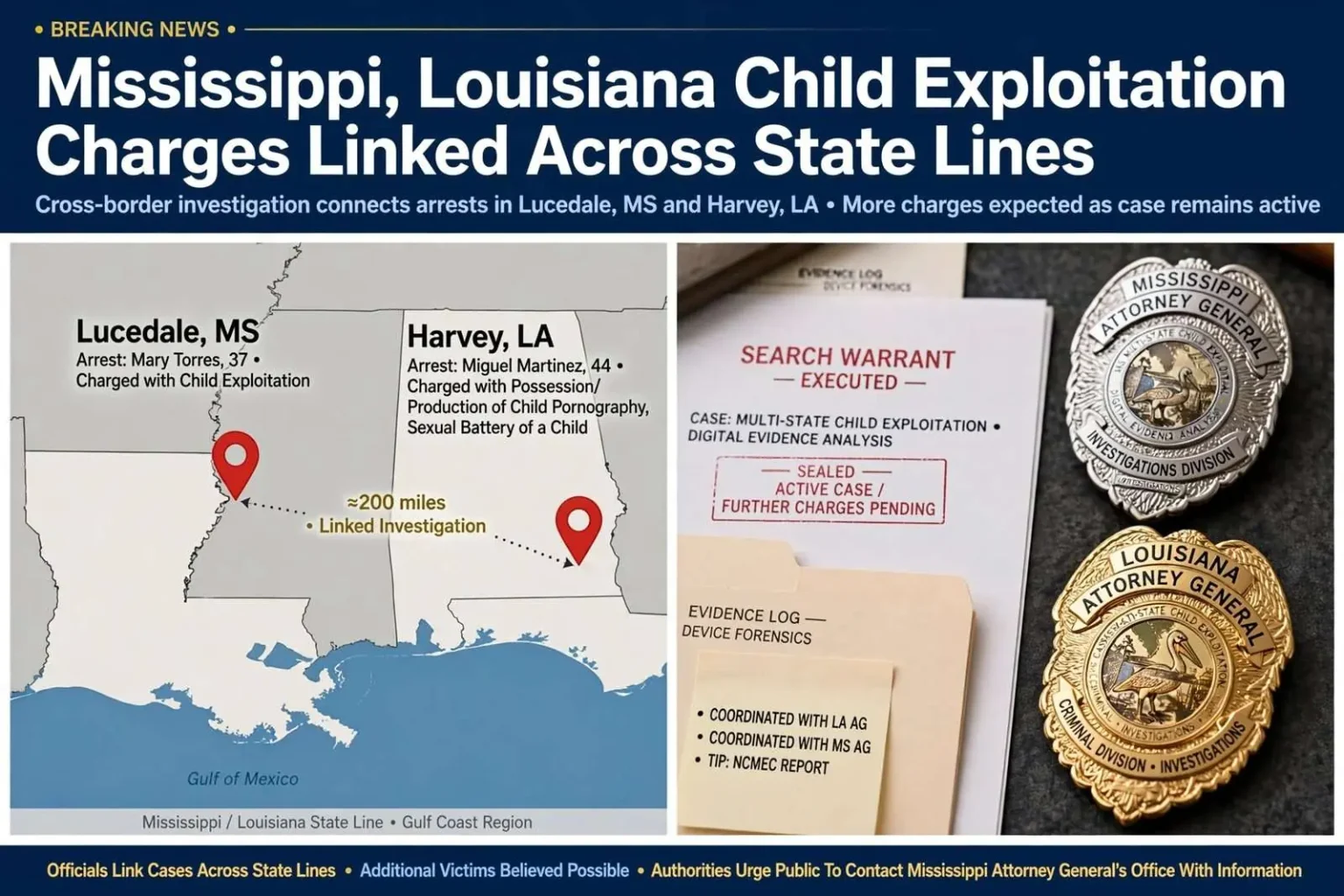
Authorities in Mississippi and Louisiana say child exploitation charges against suspects in the two states are connected, a cross-border link that has put investigators from both attorneys general offices on the same case. The arrests, announced within days of each other last week, span roughly two hundred miles of the Gulf Coast — from Lucedale, Mississippi, to Harvey, Louisiana — and officials on both sides of the state line describe the matter as very much still active, with more charges and possibly more arrests ahead.
According to the Sun Herald, 37-year-old Mary Torres of Lucedale was arrested last week on one count of child exploitation following an investigation by agents with the Mississippi Attorney General’s office. Officials said additional charges are expected as the case develops. Lucedale is the county seat of George County, a rural community in the state’s far southeast corner, and cases of this kind are typically worked quietly for months before an arrest is ever made public.
The Mississippi Attorney General’s office is handling the prosecution of the Torres case, a responsibility that falls to the state’s top legal office when investigations span jurisdictions or involve specialized units. Attorney general investigators in Mississippi routinely work alongside local sheriffs’ departments, district attorneys, and federal partners on child exploitation matters, which often cross county and state boundaries because of how such crimes are committed and how evidence travels.
The Louisiana Arrest
In Louisiana, 44-year-old Miguel Martinez of Harvey was also arrested last week. He was booked on counts related to possession and production of child pornography and a charge of sexual battery of a child, according to authorities. Harvey sits in Jefferson Parish on the west bank of the Mississippi River, just across from New Orleans, and falls under the jurisdiction of the Jefferson Parish Sheriff’s Office and the Louisiana Attorney General’s office in matters of this type.
Officials said the Mississippi and Louisiana cases are linked, meaning evidence developed in one state directly informed the arrest in the other. Multi-state coordination of this kind has become a defining feature of modern child exploitation work, as digital evidence, communications, and victim contacts routinely cross jurisdictional lines and require investigators in different states to share records, execute companion warrants, and align their charging decisions.
Martinez’s history adds a further layer to the case. He had previously been convicted of rape in California and, according to the National Sex Offender Registry, was deported in 2005 before returning to the United States, authorities said. That history — a serious prior conviction, removal from the country, and re-entry — is precisely the profile that sex offender registries and multi-state background systems are designed to flag, and it is now part of the record both prosecutions will contend with.
Landry Points to the Border
Louisiana Attorney General Jeff Landry pointed to the arrest in calling on Congress to support stronger border security measures. “This arrest should serve as a wake-up call to Congress,” Landry said. His office has made violent and sexual offenses a central focus, and the case offered him a concrete example to cite in the broader policy debate over how people with prior criminal convictions enter and remain in the country after removal.
Beyond the policy argument, the case underscores the practical work of the Louisiana Attorney General’s criminal division, which investigates and prosecutes offenses that local agencies may lack the resources or jurisdictional reach to handle alone. Cases involving out-of-state records, registry tracking, and prior deportations depend on that state-level capacity — investigators who can pull records from other states, verify registry entries, and coordinate with counterparts across lines that once divided investigations cleanly but no longer do.
How These Investigations Work
Child exploitation cases rarely move at the speed of the public’s attention. Investigators with the Mississippi Attorney General’s office typically begin with digital evidence — reports from internet service providers, tips from the National Center for Missing and Exploited Children, or referrals from local law enforcement — and spend months securing search warrants, imaging devices, and tracing communications before they ever knock on a door. The arrest of Torres followed exactly that pattern, with agents building the case piece by piece until they had enough for the initial charge of child exploitation.
Prosecutors then make deliberate choices about how much to charge at first. Filing a single count and holding additional charges in reserve lets investigators keep working the case while a defendant is in custody, and officials in Mississippi have already said more charges are expected against Torres. That sequencing is common in multi-victim cases, where each new count may depend on identifying a victim, corroborating a timeline, or matching digital evidence to a specific act — all of which takes time that prosecutors are willing to spend for accuracy’s sake.
The production and possession counts filed against Martinez in Louisiana represent the two halves of most pornography prosecutions: possession covers the material found in a suspect’s control, while production charges attach to the creation of imagery itself, an offense that carries substantially heavier penalties because it implies the abuse of an actual child. The added sexual battery charge indicates investigators believe they have evidence of direct hands-on abuse, not just imagery, which is what elevates such cases from digital crimes to violent ones.
What the Registry Trail Shows
The National Sex Offender Registry referenced by authorities is a public, searchable database that compiles records from all fifty states, allowing any resident to see where registered offenders live and what they were convicted of. Martinez’s entry — a California rape conviction followed by a 2005 deportation and a later return to the country — is exactly the kind of record trail that registries are meant to expose. Compliance requirements for registered offenders include regular address verification, and failures to verify or re-register are themselves crimes that often become the first thread investigators pull when a suspect surfaces in a new jurisdiction.
For Gulf Coast communities, the case is a reminder that such records do not respect state lines. A conviction in California, a removal from the country, and a subsequent arrest in Louisiana all became relevant to a Mississippi case. The databases that link them — registry systems, criminal history repositories, and interagency task force channels — are the invisible infrastructure behind an announcement like the one that connected these two arrests across two hundred miles.
Additional Victims Believed Possible
Investigators believe there may be additional victims in the case, and that expectation is what drives the public appeal for information. In exploitation prosecutions, unaccounted-for victims are identified in a predictable set of ways: through digital evidence recovered from devices, through the memories of witnesses who recognized behavior but never reported it, and through victims who come forward only once they learn an arrest has been made and someone will believe them.
Anyone with information is asked to contact the Mississippi Attorney General’s office, which is prosecuting the case. Tips do not need to be complete or certain to be useful — a partial recollection of a person, a place, a vehicle, or a time period can corroborate a timeline investigators are already assembling. For parents and caregivers in Lucedale, in Harvey, and in the communities between them, the clearest guidance investigators repeat in cases like this is simple: report what you saw, when you saw it, and let the specialists match it to what they already have.
The two cases will now move through the Mississippi and Louisiana justice systems separately, even though investigators say they remain connected. Additional charges in Mississippi and further evidence development in Louisiana mean the announced charges last week represent a beginning rather than an end — the moment a months-long investigation became public, and the point at which victims and witnesses across the Gulf Coast learned that someone was finally looking.
What Child Exploitation Charges Carry
Mississippi’s child exploitation statute is one of the heaviest tools in the state’s criminal code, carrying substantial prison time for each count and stacking consecutive sentences when multiple counts are proven. That is why prosecutors file the offense so deliberately and why the announcement of one count should be read alongside the officials’ statement that additional charges are expected — each count represents evidence that has been fully documented and is ready to withstand challenge in court. A first charge gets the defendant into custody; the rest of the indictment follows as the investigation consolidates.
Louisiana’s framework is similarly punishing. Possession of child pornography, production of child pornography, and sexual battery of a child each carry their own sentencing ranges, and the combination of all three in a single booking reflects the scope of what investigators say they found. Production charges in particular signal that authorities believe they can prove the creation of illicit imagery, and when paired with a sexual battery count they typically indicate a case built on both digital forensics and victim testimony.
For the communities involved, the legal mechanics matter less than the practical reality: two Gulf Coast households’ worth of allegations, months of investigative work, and a network of victims and families whose names will never appear in the reporting. Child exploitation prosecutions are conducted with those families in mind, with courts offering protections that keep victims’ identities sealed and prosecutors coordinating testimony so that children are not required to relive events repeatedly across proceedings.
When States Share a Case
The coordination between the Mississippi and Louisiana attorneys general offices is a quiet but essential feature of Gulf Coast law enforcement. The two states share a porous boundary of highways, waterways, and commuter flows — the same corridors that move commerce between Mobile, New Orleans, and the small towns in between also move the evidence and suspects in cases like this one. Formal channels such as interstate compacts, joint task forces, and simple working relationships between agents make it routine for a search executed in Harvey to inform an arrest in Lucedale within the same week.
Attorneys general offices occupy a specific niche in that system. Local sheriffs and police departments handle the bulk of everyday crime, but cases involving multi-jurisdiction evidence, out-of-state records, and specialized digital forensics benefit from the statewide reach and dedicated resources of the AG’s office. Mississippi’s prosecution of the Torres case and Louisiana’s handling of the Martinez arrest show that division of labor in action: each office took charge of the offenses committed within its borders while sharing what investigators learned.
That structure is also why cases like this resolve slowly and publicly. Every charge must survive scrutiny in a different courthouse, before different judges, under two states’ distinct criminal codes. The link between the cases is investigative, not procedural — and as officials on both sides have made clear, the work of identifying additional victims and filing the remaining charges is still underway from Lucedale to Harvey.