
Mixed-Use Shoppes at Midtown Planned Next to Mobile’s Dew Drop Inn
A three-story retail and loft project called The Shoppes at Midtown is planned on Old Shell Road next to Mobile's historic Dew Drop Inn.
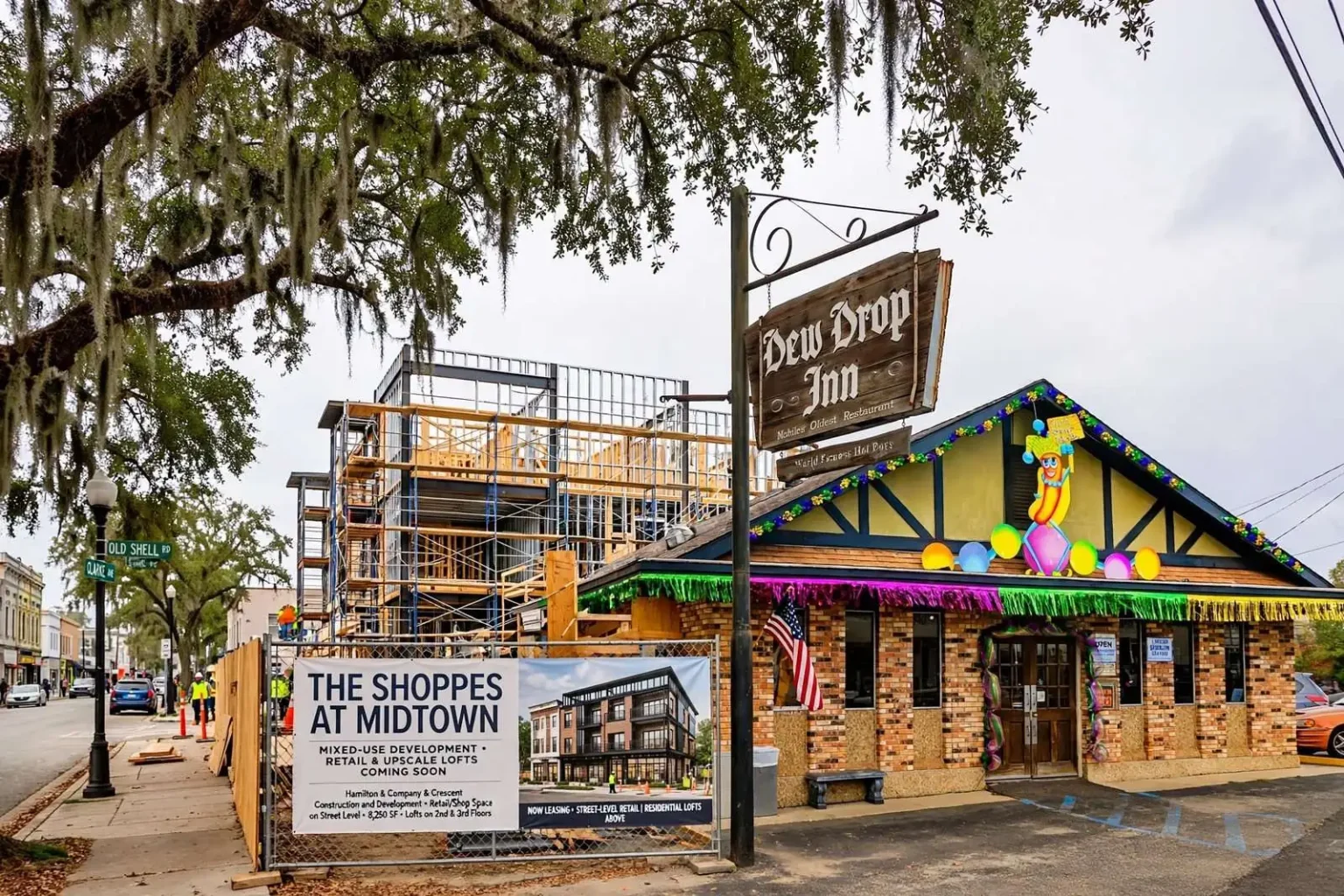
A new retail and residential building is in the works for Old Shell Road in Midtown Mobile, on property directly beside one of the city’s best-known restaurants. Hamilton & Company and Crescent Construction and Development are partnering on the project, called The Shoppes at Midtown, which would rise on an L-shaped parcel sitting to the west and north of the Dew Drop Inn, the landmark burger-and-hot-dog stand that has anchored the corner for decades.
The plan calls for a three-story, roughly 8,250-square-foot building. Restaurant and retail space would occupy the street level, with upscale lofts filling the two floors above — a format that mirrors the mixed-use infill projects that have gradually reshaped Midtown corridors in recent years. No completion date or tenant lineup has been announced.
The project adds to a stretch of Old Shell Road that has drawn renewed developer interest thanks to its walkability and proximity to Spring Hill College and the Midtown business district. For a neighborhood that spent decades watching retail drift west toward the suburbs, the steady appearance of new mixed-use construction along Old Shell Road marks a reversal — developers betting that people want to live, eat and shop on the same walkable street again.
Midtown’s Infill Boom
Midtown Mobile is the city’s historic close-in district, stretching west from downtown along Old Shell Road and the parallel corridors of Government Boulevard and Springhill Avenue. Its grid of early-20th-century bungalows, sidewalk-lined commercial blocks and mature oaks has made it one of the city’s most desirable neighborhoods, and in the past decade it has become the focal point of Mobile’s urbanist revival. Restaurants, coffee shops and specialty retailers have filled long-vacant storefronts along Old Shell Road, and infill projects — small-scale buildings slipped onto underused lots between older structures — have become the neighborhood’s dominant development pattern.
The Shoppes at Midtown fits that pattern precisely. Rather than a standalone suburban-style building with a parking field, the project stacks uses vertically: commerce at the sidewalk, residences above. That arrangement, common in older American neighborhoods and new ones alike, generates pedestrian activity throughout the day and evening, puts eyes on the street and supports the adjacent businesses by placing residents within walking distance. The lofts above street-level restaurants and shops have become the signature housing product of Midtown’s revival, appealing to young professionals, empty-nesters and others who want proximity to the neighborhood’s restaurants without a yard to maintain.
The L-shaped parcel to the west and north of the Dew Drop Inn gives the project an unusual footprint. Assemblages like this — formed from multiple small lots, often including former parking or transitional parcels — are how developers find buildable ground in a fully developed neighborhood. The shape of the site will shape the building, and three stories at roughly 8,250 square feet keeps the project at a scale that fits comfortably among Midtown’s existing commercial blocks rather than looming over them.
Next to a Landmark
The Dew Drop Inn, on Old Shell Road near the corner with Clarke Avenue, is one of Mobile’s oldest continuously operating eating places — a tiny burger-and-hot-dog stand whose history runs back more than half a century and whose simple menu and counter service have made it a civic institution. Generations of Mobilians have eaten there, and its survival as a small independent business amid the corridor’s redevelopment is precisely the kind of continuity that new projects tend to advertise: a new development beside a beloved landmark inherits some of that landmark’s draw, and adds traffic that helps keep the old business alive in turn.
The project’s developers are no strangers to the corridor’s dynamics. Hamilton & Company is a Mobile-based real estate firm with a portfolio of commercial property across the city, and Crescent Construction and Development brings the building side of the partnership. Local partnerships of this kind — a property firm that knows the market paired with a builder that can deliver — are the standard vehicle for Midtown infill, where projects are too small to attract national developers but too complex for occasional builders to execute well.
What the announcement leaves open is as notable as what it includes. No completion date has been set, no tenants named, and no details offered on the mix of restaurant and retail space that will occupy the street level. In the current Midtown market, ground-floor space along Old Shell Road has attracted a steady queue of food-and-beverage operators and boutique retailers, and developers frequently sign anchor tenants before breaking ground. The lofts above, meanwhile, would join a small but growing inventory of new rental housing in the neighborhood, where demand from Mobile’s downtown workforce and Spring Hill College’s orbit continues to outpace supply.
The Corridor’s Momentum
The stretch of Old Shell Road around the Dew Drop Inn sits at the crossroads of several of Midtown’s assets. Spring Hill College, the Jesuit liberal-arts college founded in 1830 and perched on the hill just to the south, brings students, faculty and events to the area. The Midtown business district along Government Boulevard and the surrounding medical offices provide daytime traffic. And the neighborhood’s residential blocks — among the most intact historic housing stock in Mobile — supply the walk-in customers that street-level businesses depend on. A three-story mixed-use building at this location sits directly in that current.
City policy has encouraged the pattern. Mobile’s zoning and planning emphasis in recent years has favored walkable, mixed-use development along the city’s traditional corridors, and public investment in sidewalks, street trees and lighting along Old Shell Road has reinforced the corridor’s pedestrian character. Developers have responded with a series of projects — apartments above shops, renovated storefronts, new buildings on parking lots — that have collectively changed how the street looks and functions. Each project makes the next one easier to finance, because lenders can point to a corridor with demonstrated demand.
The Shoppes at Midtown will be judged, in the end, by how it fits. Midtown residents have proven attentive to development: they have supported the projects that add life to the corridor and pushed back on those that would erase its character. A three-story building with lofts over shops, set beside a landmark burger stand on a walkable street, is the kind of project the neighborhood’s revival was built on. Until drawings, a timeline and tenants emerge, the announcement stands as one more sign of the demand rebuilding Midtown parcel by parcel — and of the confidence developers now have that Old Shell Road’s future is worth investing in.
What to Watch
Announcements like this one are also read closely by the small businesses already operating along the corridor. New construction brings construction-period disruption — lanes closed, parking lost, dust — but it also brings a larger customer base once the lofts fill and the street-level spaces open. Business owners in revitalizing districts generally come down on the side of more residents and more foot traffic, even during the months of noise, because the alternative they watched for years was vacancy and decline. A corridor where buildings are being improved, rather than boarded up, tends to lift the value of every storefront around it, which is the dynamic that has carried Midtown’s revival block by block.
Between announcement and construction, infill projects pass through predictable milestones: site plans and permits, zoning confirmation, financing and tenant pre-leasing. Each step will reveal more about The Shoppes at Midtown’s timeline and final form, and neighbors along Old Shell Road can expect the developers to appear before city review bodies if any variances or design approvals are needed. Parking is typically the sticking point for projects of this scale in established neighborhoods — the lofts and the ground-floor tenants all generate demand — and the L-shaped site will have to balance parking provision against the walkable, street-oriented design that makes the project appealing in the first place.
The loft units themselves will be watched as a test of Midtown’s rental market at its upper end. The neighborhood’s existing housing stock is dominated by single-family homes and small apartment buildings, and the upscale lofts that have appeared in recent infill projects lease quickly, according to area brokers. A pair of floors of new lofts adds to a rental inventory that remains tight across Mobile’s close-in districts, and it places residents directly above the kind of street-level businesses — restaurants and shops — that mixed-use living is designed to support.
For now, the corner stays what it has always been: the Dew Drop Inn holding its post, a landmark that outlasted the corridor’s decline and will now watch its next chapter go up next door. If the project follows the path of Midtown’s earlier infill, the empty parcel to the west and north will give way to a three-story building that puts restaurants and shops at the sidewalk, lofts above, and new foot traffic onto a stretch of Old Shell Road that already has what most American streets have spent decades trying to recover — a reason to walk.


