Georgia Woman Gets 15 Years and a Day in Mobile Acid Attack That Burned Friend Head to Toe
Quicheay Williams of Marietta, Georgia, was sentenced to 15 years and one day for throwing a heated chemical on Jasmine Clausell, a friend who had let her stay in her Mobile home. Clausell suffered third-degree burns from head to toe.
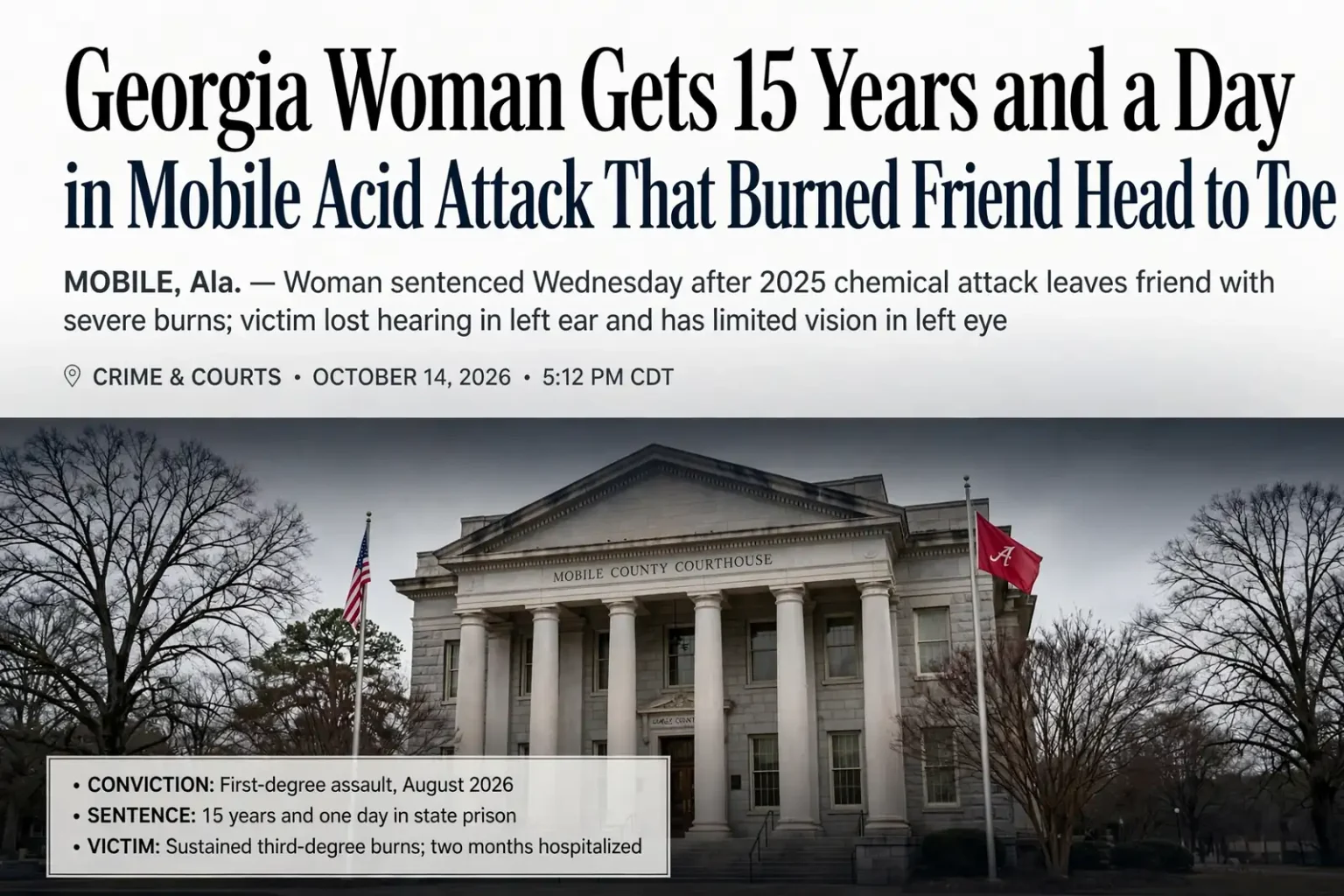
MOBILE, Ala. — A Georgia woman convicted of throwing a heated chemical on a friend who had let her stay in her home was sentenced Wednesday to 15 years and one day in prison. The Mobile acid attack left the victim with third-degree burns from head to toe. Quicheay Williams, 37, of Marietta, Georgia, was convicted of first-degree assault by a Mobile County jury in August. Prosecutors had asked for the maximum sentence of 20 years.
The victim, Jasmine Clausell, spent two months in the hospital. She lost the eardrum and hearing in her left ear, has limited vision in her left eye and has had multiple skin grafts, according to evidence presented in the case.
A place to stay, then an attack
Evidence at trial showed that in February 2025, Clausell let Williams, a friend who needed a place to live, move into her Mobile home. After about two weeks, Clausell asked Williams to leave.
Williams became angry, prosecutors said. Before she left, she heated a chemical substance in a microwave and threw it on Clausell, according to the evidence presented to jurors. The liquid caused third-degree burns over much of Clausell’s body.
Clausell’s grandfather testified that he saw the two women tussling, then heard Clausell scream that something had been thrown on her.
Prosecutors have not publicly identified the chemical. The case was widely described as an acid attack, and court records describe a chemical substance that was heated before it was thrown.
Months of treatment
Clausell’s injuries were most severe on her left side. During her two months in the hospital, she was treated for burns across much of her body. Since then, she has had multiple skin grafts and several laser treatments to reduce scarring.
The attack also caused lasting damage to her senses. She lost her left eardrum and the hearing in that ear, and the vision in her left eye is limited.
Third-degree burns, also called full-thickness burns, destroy the outer and inner layers of the skin and can damage the tissue underneath. Because the skin cannot regrow on its own over large areas of full-thickness injury, patients often need skin grafts, in which healthy skin is moved to cover the wound. Recovery can take months or years and often includes physical therapy and scar treatment.
What the district attorney said
Mobile County District Attorney Keith Blackwood said the sentence holds Williams responsible for the harm she caused.
“Jasmine Clausell opened her home to someone she considered a friend, and that kindness was met with a horrific act of violence,” Blackwood said. “Today’s sentence holds Williams accountable for the devastating harm she caused. Our thoughts remain with Jasmine as she continues to live with the effects of this attack.”
At Wednesday’s hearing, prosecutors with the Mobile County District Attorney’s Office asked the judge to impose the 20-year maximum. The court instead imposed 15 years and one day.
Case at a glance
- Defendant: Quicheay Williams, 37, of Marietta, Georgia
- Victim: Jasmine Clausell
- Date of attack: February 2025, about two weeks after Williams moved into Clausell’s Mobile home
- Conviction: First-degree assault, by a Mobile County jury in August 2026
- Prosecutors’ request: The 20-year maximum
- Sentence: 15 years and one day in prison, imposed Wednesday, Oct. 14, 2026
- Injuries: Third-degree burns from head to toe, two months in the hospital, loss of the left eardrum and hearing in that ear, limited vision in the left eye, multiple skin grafts
First-degree assault under Alabama law
First-degree assault is the most serious of Alabama’s assault charges. Under the state’s criminal code, a person commits the offense by, among other things, intentionally causing serious physical injury to another person with a deadly weapon or dangerous instrument, or by acting with intent to seriously and permanently disfigure someone. A substance that can cause severe burns can count as a dangerous instrument when it is used to injure someone.
First-degree assault is a Class B felony in Alabama, punishable by two to 20 years in prison. That is why prosecutors described 20 years as the maximum sentence available in this case.
Why “15 years and one day”
The extra day in Williams’ sentence matters under Alabama law. Alabama judges can generally suspend a sentence, order probation or impose a split sentence only when the prison term is 15 years or less. A sentence of 15 years and one day puts the defendant above that line, which generally rules out probation and a split sentence.
Prosecutors and judges across Alabama use this approach when a court wants a sentence below the statutory maximum but wants to make sure the defendant serves it in prison. When Williams becomes eligible for parole consideration is up to the Alabama Bureau of Pardons and Paroles under state law, and no parole date has been announced.
What happens next
Williams will be transferred to the custody of the Alabama Department of Corrections to serve her sentence. Alabama defendants who are convicted at trial have the right to appeal to the Alabama Court of Criminal Appeals. Under the state’s appellate rules, a notice of appeal in a criminal case is generally due within 42 days after sentencing. It was not immediately known whether Williams plans to appeal.
Alabama crime victims also have rights during the parole process. Victims and their families can register with the Alabama Bureau of Pardons and Paroles to be notified of hearings and to speak or submit statements when an inmate is considered for release.
Help for victims of violent crime
Alabama’s Crime Victims’ Compensation Commission can help pay some costs for victims of violent crime, including medical bills, counseling and lost wages, when those costs are not covered by insurance or other sources. Victims generally must report the crime to law enforcement and cooperate with the investigation and prosecution to qualify. The Mobile County District Attorney’s Office has victim service officers who help crime victims and their families through the court process, from the first hearing through sentencing.
Anyone who is in danger or has been attacked should call 911. Burn injuries, especially chemical burns, need emergency medical care right away. Medical guidance generally calls for removing contaminated clothing and flushing the affected skin with cool running water while help is on the way, unless a poison control center or medical provider says otherwise. The national Poison Help line, 1-800-222-1222, is available 24 hours a day for advice on chemical exposures.