
Mobile Aims to Break Ground on Africatown Welcome Center as Residents Shape the Design
With $6 million set aside, Mobile hopes to break ground on the Africatown Welcome Center by end of 2023 as residents help shape its design.
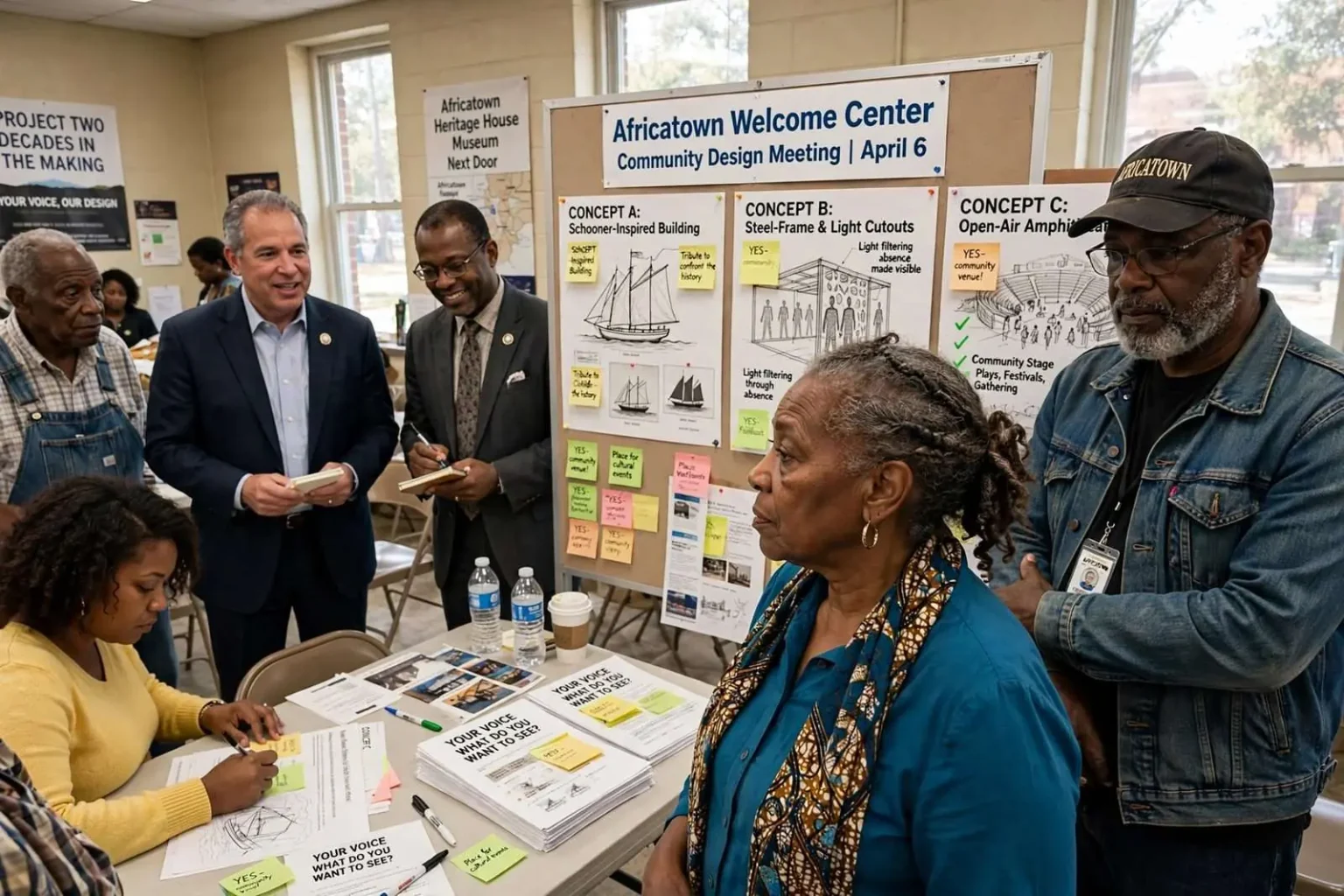
A Project Two Decades in the Making
Residents of Africatown got their first formal look at plans for a long-awaited Welcome Center, as the city of Mobile began collecting public input on a project more than two decades in the making. The first of several community meetings was held April 6 at the Robert Hope Community Center, where neighbors viewed mood boards and design inspiration and marked down the features they most wanted to see. For a community that has discussed and advocated for a proper gateway to its history for years, the meeting marked the transition from aspiration to design.
The Welcome Center is planned alongside the Africatown Heritage House Museum in telling the story of the community founded by survivors of the Clotilda, the last known illegal slave ship to reach America. Together, the two sites would give visitors a complete experience: the museum telling the documented history of the ship and the people it carried, and the Welcome Center orienting guests to the neighborhood those survivors built and to the historic sites that remain across it.
The city structured the input process to run across four meetings: designers would take feedback from the first session and return with potential designs, the community would then pick a favorite and suggest changes, a third meeting would review a nearly half-finished design, and by the fourth the team expected to present the finished plan. That schedule puts residents — not outside consultants — in the position of choosing what the gateway to their community looks like.
The Ideas on the Table
Among the ideas floated: a building shaped like the schooner itself as a tribute to those forced aboard, or a steel-frame structure with cutout designs that let light filter through figures. Each concept carries a different lesson — the schooner form confronting visitors with the vessel of their captivity, the steel-frame design using light and shadow to suggest the people whose story the center tells.
One early favorite was an open-air amphitheater-style concept that could host plays and festivals — an approach praised by Gary Autrey, a direct descendant of someone carried on the ship who has worked on the project for more than twenty years. An amphitheater would make the Welcome Center more than a stopping point for tourists; it would give the community a venue of its own, a place where Africatown’s story is performed and celebrated rather than merely displayed.
What Residents Want It to Feel Like
Attendee Yvette Chestang said she hoped the final building would capture the resilience and power of the community’s founders rather than serve as just another tour stop. Having visited the West African slave castles and walked through the “door of no return,” she said those experiences stay with a person, and she wanted the center to give visitors room to reflect on what they were taking in.
Her point goes to the heart of the design challenge. Sites of memory can be handled in ways that sensationalize or flatten them; the slave castles of West Africa endure in visitors’ memories precisely because they slow people down and demand reflection. A Welcome Center for Africatown, in that view, should not simply process tourists toward photographs — it should hold them in the story long enough to feel its weight, the way Chestang felt it at the sites where the captives’ journey began.
The mood boards and feedback sheets at the Robert Hope Community Center were the city’s instrument for capturing exactly those instincts. Whether residents wanted contemplative spaces, performance space, outdoor gathering areas or practical visitor amenities, the first meeting’s job was to surface them all before the designers drew a single final line.
City Leadership and the Money
Mayor Sandy Stimpson and District 2 City Councilman William Carroll addressed the crowd about the process. Stimpson said roughly $6 million is available for the project, with construction targeted to begin before the end of 2023. For a project that has been discussed for more than two decades, the presence of both the mayor and the district councilman — and a stated funding figure — gave residents the clearest signal yet that the Welcome Center is a funded commitment rather than another study.
Carroll’s role matters to the community’s trust. As the councilman representing the district that includes Africatown, he has been the neighborhood’s advocate inside City Hall, and his participation in the input process signals that the community’s preferences will be carried back to the council. The city’s four-meeting structure formalizes that connection: what emerges in the final design is expected to trace directly to what residents said in these rooms.
Why a Welcome Center Matters to Africatown
Africatown’s challenge as a destination has always been orientation. The community holds the graves of Clotilda survivors, the historic church they founded, and the landscape they settled after emancipation, but visitors arriving without guidance have often struggled to find and understand the sites. A Welcome Center solves that problem by giving the story a front door — a place where guests learn what happened here, where to go, and how to conduct themselves in a neighborhood that is a living community and not only a historic site.
Planned alongside the Heritage House museum, the center completes a visitor experience that residents have sought for decades. The museum interprets the Clotilda’s voyage and the confirmation of its wreck in the Mobile River; the Welcome Center extends that story into the streets, churches and homes where the survivors’ descendants have lived ever since. Together they anchor the broader push to develop Africatown into a major heritage destination — a push that community leaders have insisted must deliver its benefits to the neighborhood itself.
Lessons From Two Decades of Advocacy
The project’s more than twenty-year history is itself part of the story. Advocates like Autrey have carried the idea through changes in city leadership, shifts in public attention and the long years before the wreck’s confirmation made international headlines. Every generation of the effort has faced the same core question: whether Mobile’s institutions would invest in preserving and presenting the history of a community that has often been overlooked.
The current process — funded, scheduled and structured around resident input — represents the most concrete answer to that question yet. Roughly $6 million is available, construction is targeted before the end of 2023, and the design that emerges will be the one the community chose across four meetings. For residents who watched earlier proposals stall, the difference is process: this time, the community’s fingerprints are built into the plan from the first meeting.
The amphitheater concept’s early popularity captures what residents say they want most. Not a monument that treats Africatown’s story as finished, but a living place — a venue for the plays, festivals and gatherings that keep a community’s culture active. If the final design follows that instinct, the Welcome Center will function as Africatown’s stage as much as its front door, honoring the founders by hosting the community they created.
The Clotilda’s Shadow and Light
The design concepts under consideration each wrestle with the same difficult material: how to welcome visitors with a story that begins with a crime. A building shaped like the schooner makes the vessel itself the architecture — a form that cannot be ignored. A steel-frame structure with cutout designs works more subtly, filtering light through human figures so that visitors move through a space where absence is made visible. Both approaches treat the building as interpretation, not just shelter.
The amphitheater concept takes a third path: rather than confronting visitors with the ship, it creates space for the community’s ongoing life. Plays, festivals and public gatherings in an open-air venue would put descendants on the stage of their own history, presenting Africatown not only as the site of a tragedy but as a culture that endured and creates. Early meeting attendees’ enthusiasm for that concept suggests the community prefers a living landmark to a static one.
The Four-Meeting Road to a Design
By the time the fourth meeting arrives, the design team will have made two full passes through community feedback — first translating raw preferences into candidate designs, then refining the community’s chosen concept through a half-finished review. The structure is deliberately slower than a typical municipal design process, and that pace is the point: a project that tells this community’s story, on this community’s ground, with more than $6 million of public money, earns its legitimacy through resident authorship.
Construction targeted before the end of 2023 leaves a tight window between design completion and groundbreaking, which is common for public projects on funded timelines. For residents, the milestones to watch are practical: the fourth meeting’s presentation, permits, and the first work on the site. Each will be measured against the promises made in the room at the Robert Hope Community Center — that the building would reflect the founders’ resilience, honor the community’s wishes, and finally give Africatown’s story the front door it has waited more than two decades to open.


