Mobile Airport Authority to Take Over St. Elmo Airport as Frontier Flights Return Downtown
The Mobile Airport Authority has struck a deal with the state to manage St. Elmo Airport as a first step toward full ownership, while Frontier Airlines resumed commercial flights to Orlando from Mobile Downtown Airport amid a slow pandemic recovery.
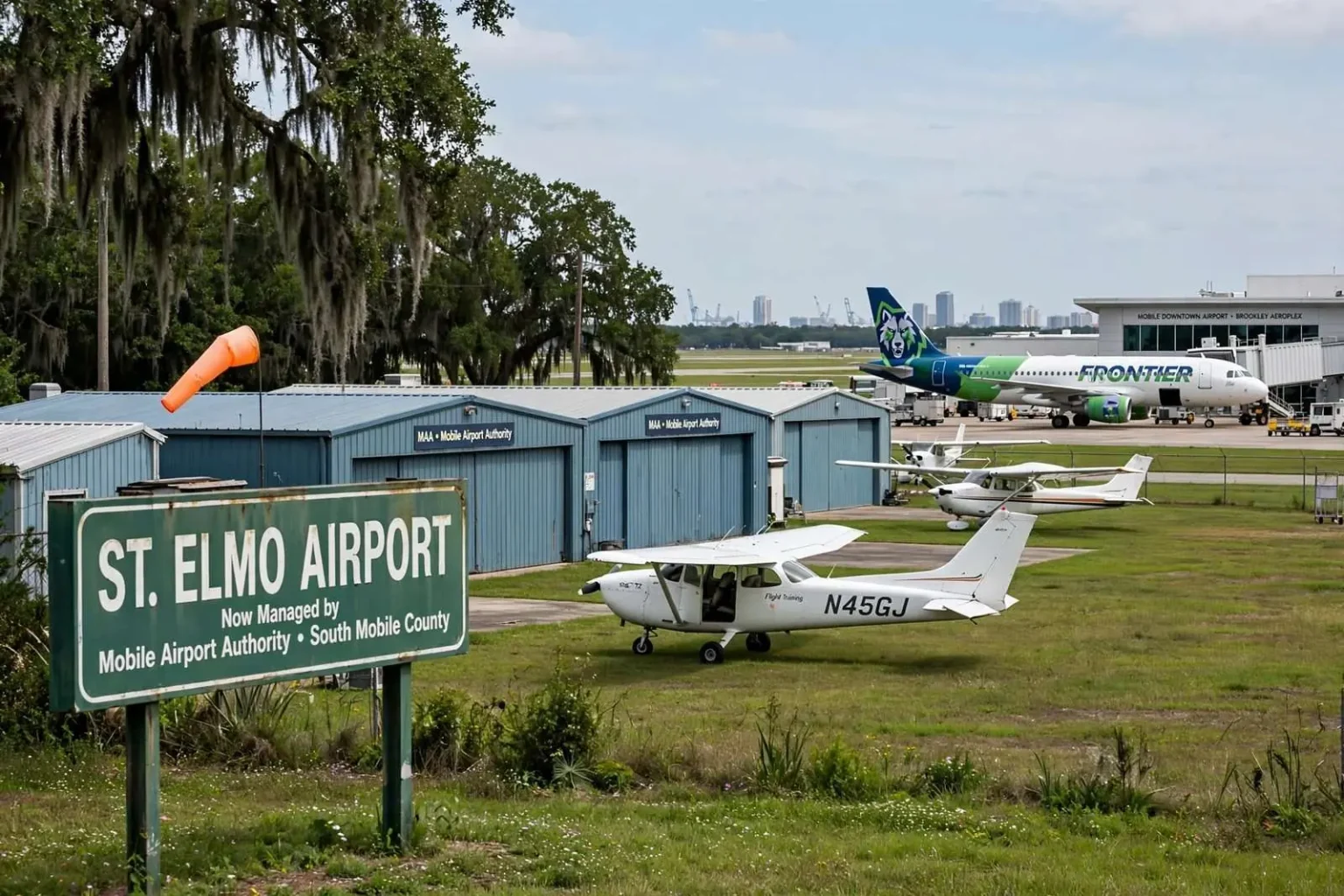
The Mobile Airport Authority has reached an agreement with the State of Alabama to take over management of St. Elmo Airport, a general aviation facility in south Mobile County, marking the first phase of a plan that will eventually transfer full ownership of the airport to the authority. The deal brings one of the county’s smaller airfields under the same organization that runs the region’s commercial aviation, a consolidation that officials describe as a long-term investment in the area’s aviation infrastructure. Under the arrangement, the Mobile Airport Authority will oversee day-to-day operations at the small airfield while a second phase, which still requires sign-off from the Federal Aviation Administration, moves toward completion.
Authority officials said they expect that federal approval within the next two months, clearing the way for an outright acquisition of the property. Until then, the authority operates the airport under the management agreement while the paperwork for full ownership advances through federal channels. The FAA’s role is a standard part of any airport ownership transfer, since federal approvals govern how property developed with public aviation funds changes hands.
Mobile Airport Authority President Chris Curry credited a coalition of state and federal officials for helping broker the deal, saying the authority worked closely with Governor Kay Ivey, Mobile Mayor Sandy Stimpson, U.S. Senator Richard Shelby, FAA regulators and leaders at the Alabama Department of Transportation, including John Cooper and Dr. John Eagerton, to reach the agreement. The breadth of that list reflects how many agencies touch even a small airport: state ownership, federal oversight, city leadership and the county’s transportation hierarchy all had a role in moving the transfer forward.
“We appreciate the confidence placed in MAA and pledge to the community that we will manage and we will grow this airport to serve our community,” Curry said, adding that the authority views St. Elmo Airport as a long-term asset for the surrounding area. Mayor Stimpson echoed that outlook, saying he expects the second phase of the transfer to be finalized soon and calling the property a valuable piece of infrastructure for the Mobile area going forward. “The St. Elmo Airport property will be a very meaningful asset for the Mobile area in the years to come,” he said.
What the Airport Does Today
St. Elmo Airport has long served small aircraft owners, flight training operations and other general aviation users in the southern part of Mobile County. Airfields like it function as the lower tiers of the aviation system: they host student pilots, crop dusters, business aircraft too small for the commercial terminals and private owners who keep hangars away from the congestion of a major airport. For communities in south Mobile County, the airport represents local access to the national aviation network without a drive into the city.
Bringing the facility under the Mobile Airport Authority’s umbrella would align its management with the authority’s other properties, including Mobile Regional Airport and Mobile Downtown Airport at the Brookley Aeroplex. That alignment gives the authority a three-tier portfolio — a commercial hub, a downtown airfield with growing airline service, and a south county general aviation base — and allows maintenance, management practices and development planning to be coordinated across all three. Authority officials have framed the acquisition as growth in exactly the direction the organization’s mission points.
Signs of a Travel Rebound
The announcement came as the Mobile Airport Authority also reported early signs of a rebound in air travel across its network following the sharp drop in passenger traffic caused by the COVID-19 pandemic. The pandemic had hollowed out schedules at airports across the country, and Mobile’s facilities were no exception, with carriers cutting routes and passengers staying home through the spring. The first readings of recovery are now showing up in the authority’s passenger counts.
Curry said Mobile Regional Airport has begun to see enplanements tick upward after the pandemic drove passenger volumes down by 80 percent to 85 percent earlier this spring. A climb back from a collapse of that size begins modestly, but the direction matters more than the slope at this stage: airlines schedule service based on demand, and rising enplanements are the signal they watch. Every point of recovery strengthens the case for carriers to restore the routes they suspended.
Frontier Returns Downtown
At Mobile Downtown Airport, Frontier Airlines resumed commercial service over the weekend with a flight to Orlando International Airport, the airport’s first major commercial flight since the discount carrier discontinued its nonstop route to Denver. The relaunch gives the downtown airfield, located at the Brookley Aeroplex, commercial airline service once again after a stretch in which pandemic-driven demand collapse silenced its terminal. For travelers in the eastern and downtown parts of the city, the airport offers an alternative to the drive out to Mobile Regional.
The Orlando flight had originally been scheduled to launch April 18, but Frontier canceled two earlier attempts to get the route off the ground because of weak demand tied to the pandemic. The repeated postponements reflected the airline’s struggle to fill planes during the worst of the travel shutdown, when even leisure routes to Florida destinations struggled to draw bookings. The successful weekend launch ended that run of false starts.
Curry said passenger loads on the inaugural Orlando flight were modest but represented a positive step for the airport’s commercial air service ambitions. He said he expects Frontier to keep the route flying at least through September, giving the airline a chance to capture demand during the summer travel season. Summer leisure traffic to central Florida is traditionally among the most resilient segments of the market, and a full season of operation will give both the airline and the airport a clearer read on whether the route can support a lasting schedule.
A Portfolio Taking Shape
The developments come as airports across the region continue to navigate the economic fallout of the pandemic, balancing efforts to restore commercial air service with plans for longer-term growth. Against that backdrop, the St. Elmo agreement stands out as a move that looks past the current crisis: while airlines rebuild routes, the authority is expanding its footprint into general aviation, acquiring assets at what officials acknowledge is a difficult moment for the industry. The two tracks — restoring passenger traffic downtown and absorbing a new airfield in the south county — are part of the same strategy of positioning the authority’s properties for the region’s recovery.
For residents of south Mobile County, the transfer means their local airfield now has an operator with the staff, funding channels and planning capacity of a major airport authority. General aviation airports live or die on maintenance — runway surfaces, lighting, fuel service and hangar availability — and an operator with regional resources can address those needs on a schedule a standalone facility often cannot. Local pilots and flight schools are the most immediate beneficiaries, but the surrounding communities gain too, since a well-kept airfield attracts the small business activity that clusters around active general aviation bases.
The federal approval expected within two months will determine the timetable for the second phase, when management gives way to outright ownership. Once the FAA signs off and the property changes hands, the authority will control the airport’s future development directly, from capital projects to lease agreements with the businesses based there. Officials on both the state and city level have framed that prospect as a matter of when, not whether, given the coalition that assembled behind the first phase.
The coming months will show whether the two recovery stories converge. If enplanements keep climbing at Mobile Regional and Frontier’s Orlando route holds through the summer, the authority will enter the St. Elmo ownership era with its commercial operations stabilizing at the same time its portfolio grows. For an organization whose holdings now span from a south county general aviation strip to a downtown terminal with airline service, that combination — expanded assets and recovering traffic — is the outcome officials like Curry have promised to deliver for the community.
General aviation facilities like St. Elmo also play a quiet role in emergency response and economic development across their regions. Small airfields serve as staging points for disaster relief flights after Gulf Coast hurricanes, bases for medical and charter flights, and landing options for corporate aircraft whose passengers are scouting industrial sites. An airport authority that can maintain and promote those functions across south Mobile County extends the region’s appeal to exactly the kind of businesses civic leaders spend their time recruiting.
The agreement also closes out a long-running question about who would ultimately steward the property. State ownership with local management had left the airport’s future dependent on arrangements that could change from one administration to the next. Full transfer to the authority puts the runway, hangars and grounds under an organization with a permanent stake in Mobile County’s aviation network and a track record at its two larger facilities — the combination local officials say convinced them the airport would grow rather than simply survive.