
Mobile Animal Shelter Seeks Barns and Businesses for Working Cat Adoptions
The City of Mobile Animal Shelter held a barn cat adoption event placing about 20 working cats with barns, warehouses and businesses.
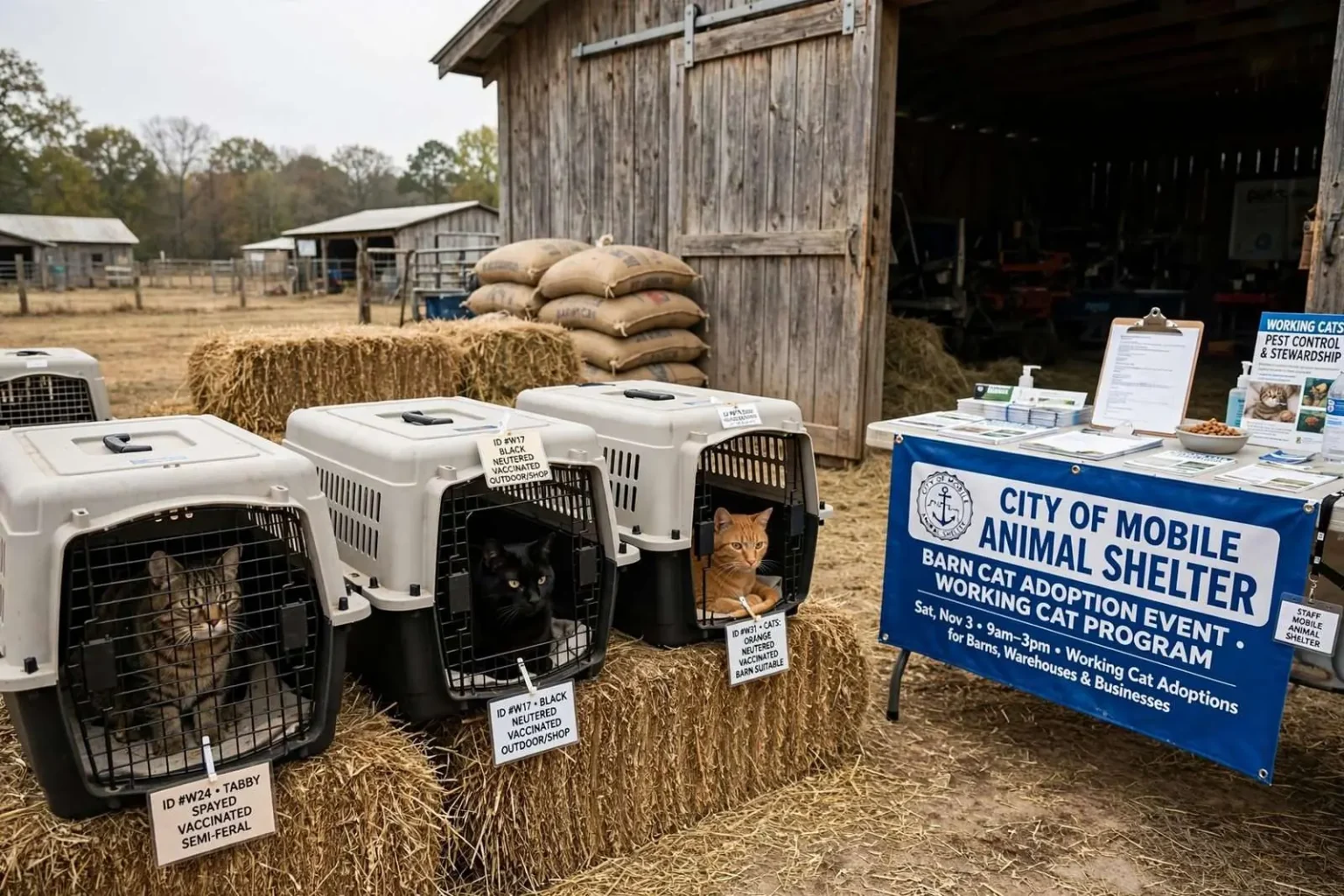
The City of Mobile Animal Shelter planned a special adoption event aimed at an unusual set of adopters: barn, warehouse, and business owners willing to take in a working cat. The event flipped the usual adoption script. Instead of appealing to families looking for a lap cat, the shelter sought property owners with a practical problem — rodents in the feed room, mice in the warehouse, vermin around the shop — and a willingness to house and feed a cat whose job description mattered more than its cuddliness. For the animals involved, the program offered something the shelter’s kennels could not: a life outdoors with a purpose and a person responsible for it.
Roughly 20 cats were slated to be available at the Barn Cat Adoption event, held Saturday, Nov. 3 from 9 a.m. to 3 p.m. in Mobile. The number reflected the population the program was designed to serve — cats in the shelter whose temperament made them poor candidates for indoor adoption. Shelters across the country face the same reality: feral and semi-feral cats, or simply cats that never acclimate to indoor life, can wait in kennels indefinitely, stressed by confinement and passed over by adopters looking for a companion. Programs like Mobile’s give those cats a working home instead of a waiting list.
Not Your Typical House Pet
Shelter officials noted that barn cats are not traditional indoor pets, but they still deserve a home and a caretaker. The distinction is the heart of the working cat concept. A barn cat is not expected to sit in laps or tolerate being handled; many are effectively semi-wild, happiest at a distance, and miserable in a house. What they are expected to do is live on a property, patrol it, and receive basic care — food, water, shelter and any needed veterinary attention — from the owner who takes them in. Adoption, in this model, is less about affection than about stewardship: the adopter takes responsibility for an animal that will never be a conventional pet.
The animals are well suited to life outdoors, where they help discourage rodents around barns and storage areas and can provide companionship for horses and other farm animals. The rodent control is as much deterrence as hunting: the presence of a cat on a property changes rodent behavior, pushing populations away from feed stores, barn aisles and equipment areas. Horse owners in particular have long kept barn cats as part of the working population of a stable, and the animals’ presence around livestock is a centuries-old arrangement on Southern farms — the cat earns its keep in the feed room and dozes the afternoons away in the tack room.
Why the Shelter Runs the Program
The program gives less-socialized shelter cats an alternative to remaining in kennels while giving property owners a natural form of pest control. The two halves of that equation are what make working cat programs succeed where traditional adoption fails. Municipal shelters receive a steady stream of unsocialized cats — born outdoors, never handled, untouchable by adopter standards — and euthanizing them for temperament alone is the outcome programs like this exist to avoid. Every working cat placed is a life saved and a kennel opened, and the adopter gets pest management without poisons or traps, a trade that barn and business owners in an agricultural port city have appreciated for generations.
What Adopters Were Asked to Provide
Working cat placements come with expectations that differ from a household adoption, and shelter officials were upfront about them. A suitable adopter provides the cat with shelter from the weather — a barn, outbuilding, warehouse office or enclosed area where the animal can get out of the elements — along with daily food and water, and ongoing veterinary care if the cat can be caught for it. Adopters were also asked to keep the cat confined on the property for an initial period after placement, a standard practice that lets the animal acclimate to its new surroundings before being released to roam; cats turned loose immediately are known to wander off in search of familiar territory, undoing the placement.
The event’s hours — 9 a.m. to 3 p.m. on a Saturday — were designed to let working property owners come by between chores. Shelter staff and volunteers typically walked interested adopters through the cats available, matching temperaments and needs: some animals were more tolerant of human presence than others, some better suited to busier properties, some requiring placements where no other cats would challenge them. Adoption fees and requirements for the working cats were set at the shelter’s discretion, and the animals were spayed, neutered and vaccinated before placement — standard practice that protects both the cats and the properties they join.
Mobile’s Shelter and Its Population
The City of Mobile Animal Shelter takes in thousands of animals a year from across the city, and cats make up a large share of that intake — driven by the Gulf Coast’s long breeding seasons and the region’s sizable outdoor cat population. Municipal shelters in the South face intake pressures that northern facilities rarely see, with kitten season stretching across much of the year and outdoor colonies reproducing faster than traditional adoption can place the animals. That arithmetic is what makes programs targeting hard-to-place cats practical: every alternative pathway — working cat placements, barn homes, managed colonies — reduces the shelter population and frees resources for the animals who can go the conventional route.
The November timing placed the event ahead of the holidays, when shelters traditionally push adoption drives, and in the middle of the season when rodent pressure around barns and feed storage peaks. For the business owners the shelter hoped to reach — feed stores, warehouses, nurseries, stables and the agricultural operations scattered across Mobile County — the pitch was straightforward: the shelter had working animals available, the animals needed the work, and the placement cost a fraction of extermination contracts while saving the cats’ lives.
The Working Cat Tradition
Working cat programs have become a fixture of animal sheltering across the United States, and Mobile’s event fit a model that shelters from coast to coast have embraced. The idea’s appeal lies in its honesty about the animals involved: rather than pretending every shelter cat can become a house pet, the program matches each animal to the life it can actually live. A semi-feral cat that would suffer in a living room can thrive on a forty-acre horse farm or behind a warehouse, doing instinctive work in exchange for room and board. Shelters that run such programs report that their hardest-to-place animals find homes, their euthanasia numbers drop and their adopters — farmers, shopkeepers, stable owners — often come back for a second cat once the first proves its worth.
What a Working Cat Costs — and Gives
The economics of a working cat favor everyone involved. The adopter’s outlay is modest: feed, water, a sheltered corner and occasional veterinary attention, weighed against the constant pressure rodents put on stored feed, wiring, insulation and inventory. The shelter’s cost per placement is a fraction of the cost of housing an unsocialized cat indefinitely. And the cat gets the only life available to it that is better than a kennel: territory to patrol, work to do, a human who feeds it and leaves it mostly alone. Longtime barn owners will attest that the arrangement, once established, tends to sustain itself — cats patrol, rodents relocate, and the barn’s feed room stays clean for the price of a scoop of kibble a day.
The companionship angle, noted in the shelter’s description of the animals around horses and other farm animals, should not be dismissed either. Barn cats and horses develop familiar routines — the cat that rides the hay cart, naps in the empty stall, greets the morning feeding — and farm families count them as part of the operation’s character. The animals placed through programs like Mobile’s may not seek out human affection, but they settle into properties and routines as firmly as any pedigreed barn dog.
How the Day Was Expected to Run
Staff and volunteers planned to use the event to move roughly two dozen animals into working homes in a single day — an outcome that conventional adoption channels could not achieve for this population. Each placement that day represented the end of a journey for a cat that had arrived at the shelter as a stray or a surrender, been assessed as unsuitable for indoor adoption, and waited while the shelter sought the alternative that working cat programs exist to provide. For the shelter’s staff, events of this kind are among the most satisfying on the calendar: the hard-to-place animals, the ones staff have quietly worried about, walking out the door to real homes.
The City of Mobile Animal Shelter’s outreach through events like the Barn Cat Adoption also reflected a broader shift in how municipal shelters operate. Beyond kennels and adoption floors, modern shelters run programs — working cats, foster networks, transfer partnerships, spay-and-neuter clinics — aimed at reducing intake and widening every animal’s path out. Mobile’s participation in that model placed its shelter alongside the municipal facilities nationwide that have redefined their mission from housing animals to placing them, by whatever placement each animal can sustain.
For the barn owners, warehouse operators and business people who took home a working cat that November Saturday, the bargain was simple and old as agriculture itself: food and shelter for a good mouser. For the cats, it was a second chance in the only form available to them — outdoors, employed, and out of the kennel for good.


