Mobile-Area Catholics Grieve, Rally in Prayer After Minneapolis Church Shooting
Mobile's Catholic community and Archbishop Thomas Rodi respond with prayer and reflection after a mass shooting at a Catholic church and school in Minneapolis leaves congregations nationwide shaken.
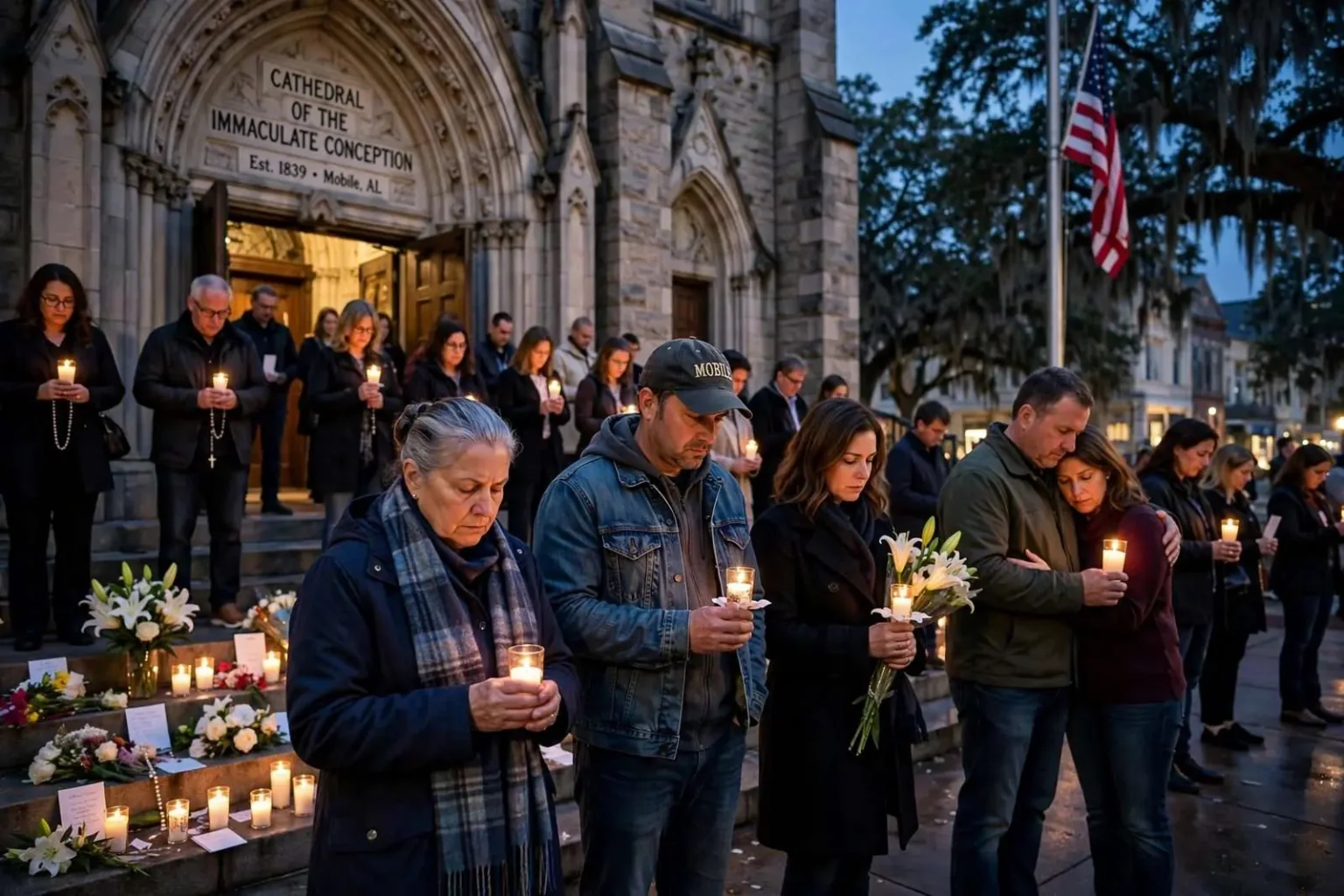
The mass shooting at a Catholic church and school in Minneapolis has reverberated across the country, and members of the Catholic community in the Mobile area say the tragedy has hit unusually close to home.
The shooting, which unfolded as students and worshippers gathered for Mass, has left congregations nationwide grappling with grief and anxiety. In Mobile, church leaders and parishioners alike said the news was difficult to process, especially given that children were caught up in the violence.
Archbishop of Mobile Thomas Rodi said the tragedy has weighed heavily on Catholics well beyond Minnesota’s borders. “Families sent their kids to school today, presuming they were going to be fine, and then to have this tragedy; it’s just hard to hear,” Rodi said.
According to accounts of the attack, the gunman opened fire through the church’s stained-glass windows during Mass. Rodi said the fact that the violence unfolded at a Catholic school made the loss resonate deeply within the broader faith community.
“When something like this happens, it affects everyone in the country, but particularly something like this, having happened at a Catholic school, it especially affects Catholics because we’re all part of one church and part of one family,” he said.
Prayer as the first response
Rodi urged the faithful to lean on prayer in the aftermath of the shooting. “Pray to God that they will realize that God is with them even in the darkest of moments,” he said.
That call set the tone for how Catholic communities across the Mobile area have processed the news. In parishes across south Alabama, the events in Minneapolis entered intercessory prayers at Masses in the days that followed, with congregations praying for the victims, their families, and the first responders and medical teams who treated the wounded.
For Catholic school communities in Mobile and Baldwin County, the attack struck at the heart of a familiar routine. Schools across the Archdiocese of Mobile hold regular Masses with students, and the image of a school congregation attacked mid-liturgy was one local educators and pastors recognized as their own worst fear. Parents dropping children at Catholic schools in the days after the news spoke quietly about it, and several pastors acknowledged the questions it raised in conversations with families.
The archbishop’s message emphasized solidarity across distance. The Catholic Church’s structure, one archdiocese joined to every other, means that an attack on a school parish in Minnesota is experienced, in a real sense, as an attack within the family, Rodi suggested, and the grieving in Mobile was therefore not sympathy at a remove but shared mourning.
‘This could happen here’
Even though the tragedy unfolded more than a thousand miles away, some Mobile-area Catholics said the shooting has left them uneasy about their own sense of safety during worship.
“Sometimes I think when I’m in church, that this could happen here,” one worshipper said. “It’s not good to be thinking about that during church, but you know, you can’t help it.”
That unease is a familiar residue of mass violence in America: an event in an unfamiliar city recalibrates the sense of vulnerability everywhere else. Houses of worship present particular security challenges, historically kept open and welcoming by design, with unlocked doors, regular public schedules and gatherings of predictable crowds at predictable times.
Several local parishioners said the shooting prompted them to notice, for the first time in years, details they had long taken for granted: the number of exits in their own church, where their children sit during school Masses, how quickly the congregation could move if something went wrong. Others said they refused to let the fear change how they worship, framing attendance as an act of quiet resolve.
Rodi acknowledged that such attacks are difficult to anticipate but said local parishes remain committed to protecting their congregations. “We continue to strive to protect everyone who comes to worship with us,” he said, pointing to the ongoing work parishes do to keep their facilities secure.
Churches across south Alabama, like congregations nationally, have spent the past decade quietly adapting to that responsibility. Many parishes have trained ushers and staff in emergency response, reviewed lockdown procedures, coordinated occasionally with local law enforcement, and made measured changes to doors and sight lines that do not compromise the openness that defines a church. School buildings on parish campuses operate under the same safety planning as other schools, with drills and controlled access.
Those measures rarely announce themselves to worshippers, which is by design. The challenge parish leaders describe is balancing two goods that pull against each other: the welcome that a church owes the stranger and the protection it owes the child. A sanctuary that feels like a fortress fails at its purpose; one that ignores the world’s dangers fails at another.
A community that has carried grief before
The Mobile area’s Catholic community is among the oldest in the United States, tracing its roots to the French colonial founding of the city, and it has a long institutional memory of loss and recovery. The Archdiocese of Mobile spans the southern half of Alabama, with parishes from the Mississippi line to the Florida line and schools spread across Mobile and Baldwin counties, and news of violence against a school parish anywhere in the country travels quickly through that network of pastors, teachers and families.
In the days after the Minneapolis shooting, local Catholic communication channels carried prayers, resources for parents on talking with children about tragedy, and reminders of the archbishop’s call to prayer. Clergy noted that the liturgical life of the Church is itself built for grief: the Mass gives sorrow a place to go, and communal prayer has always been the Catholic instinct in the face of events that defy explanation.
That instinct was visible in the responses of ordinary parishioners interviewed in the days after the attack. Many said they prayed for the Minneapolis families by name during personal devotions. Some said they made a point of attending daily Mass that week, a small act of solidarity. Others spoke of hugging their own children a little longer at the school door.
The question every community now asks
No specific threat touched any Mobile-area parish, and church officials were careful to keep the conversation centered on mourning and prayer rather than alarm. But the shooting has joined the list of national tragedies that permanently alter how American institutions think about safety, and houses of worship are no exception.
Security experts have long noted that the openness of religious communities makes them hard to harden without changing their character, which is why the emphasis in most dioceses has fallen on training, awareness and relationships with local police rather than on barriers. Rodi’s acknowledgment that such attacks are difficult to anticipate reflects that reality: no procedure can guarantee that a determined attacker never arrives, and the Church’s response therefore combines practical preparation with a refusal to live in fear.
For now, the work in Mobile is what the archbishop asked: prayer for the dead and wounded in Minneapolis, comfort for the anxious here at home, and a renewed commitment to the safety of everyone who walks through a parish door. The stained glass in Minnesota will be replaced in time. The harder repair, the restoration of a child’s sense that church is the safest room in the world, is the work that communities from Mobile to Minneapolis are now undertaking together.
Local reactions in the pews
Across the Mobile area, the shooting became a topic of conversation wherever Catholics gathered that week, at school pickups, parish festivals, and the coffee hours that follow Sunday Mass. Parishioners described a shared disbelief that a school liturgy, the most innocent of church occasions, could become the site of an attack.
Parents of Catholic school students in Mobile and Baldwin County said the news sharpened questions they had only asked abstractly before. Several said they had never thought about the security arrangements at their children’s schools until the Minneapolis tragedy forced the question, and a few contacted principals to ask what procedures were in place. School leaders, for their part, reminded families that emergency planning is ongoing and that student safety reviews happen regularly.
Other parishioners responded by doubling down on the routines of faith. Attendance at daily Masses held steady, and some worshippers said deliberately so: refusing to change how one prays is, for many Catholics, the most meaningful reply to violence aimed at the practice of prayer itself.
The archbishop’s role in a moment of crisis
As the leader of the Archdiocese of Mobile, Rodi speaks for a church community of tens of thousands of Catholics across southern Alabama, and moments of national tragedy call on him to be both pastor and public voice. His statements after the Minneapolis shooting blended the two, offering grief for the victims while giving local Catholics a vocabulary for their own fear and sadness.
His framing of the Church as one family resonated with many listeners. Catholics in Mobile may never have set foot in Minnesota, but they recognize the details of the tragedy as their own: a school Mass, children in pews, a parish community that will spend years rebuilding its sense of safety. That recognition, Rodi suggested, is not metaphor but reality within a communion that prays for its members everywhere.
Local priests took up the same themes at weekend Masses, and several described conversations after services that lasted longer than usual, as parishioners processed the news together. Grief expressed communally, clergy noted, is easier to carry than grief held privately, and the parish structure exists precisely for such moments.
Looking toward healing
The weeks ahead will test the resilience of both the Minneapolis community and the wider church watching it grieve. The parish at the center of the attack faces the long work of reopening, mourning and rebuilding trust, with Catholic communities across the country, including in south Alabama, praying for its success.
In Mobile, the immediate response remains what Rodi called for: prayer at every Mass for the victims and their families, attention to the safety of local congregations, and care for the children whose sense of security the news may have shaken. Counselors and pastors have encouraged parents to let children talk about their fears rather than shielding them from the conversation entirely.
The archbishop’s words distilled the community’s posture: sorrow for a family wounded far away, trust that God remains present even in the darkest of moments, and a quiet determination that the people of the Church in south Alabama will keep their doors open, their schools safe and their faith intact. That combination of mourning and resolve, parishioners say, is the Catholic answer to a tragedy like Minneapolis, offered a thousand miles from where it happened but felt as close as the parish next door.