Toyota Foundation Grants $150,300 to Mobile Area Education Foundation for STEM Push
The Toyota USA Foundation awarded the Mobile Area Education Foundation a $150,300 grant to support the EYE on STEM Leadership Academy, expanding science and engineering education across the region.
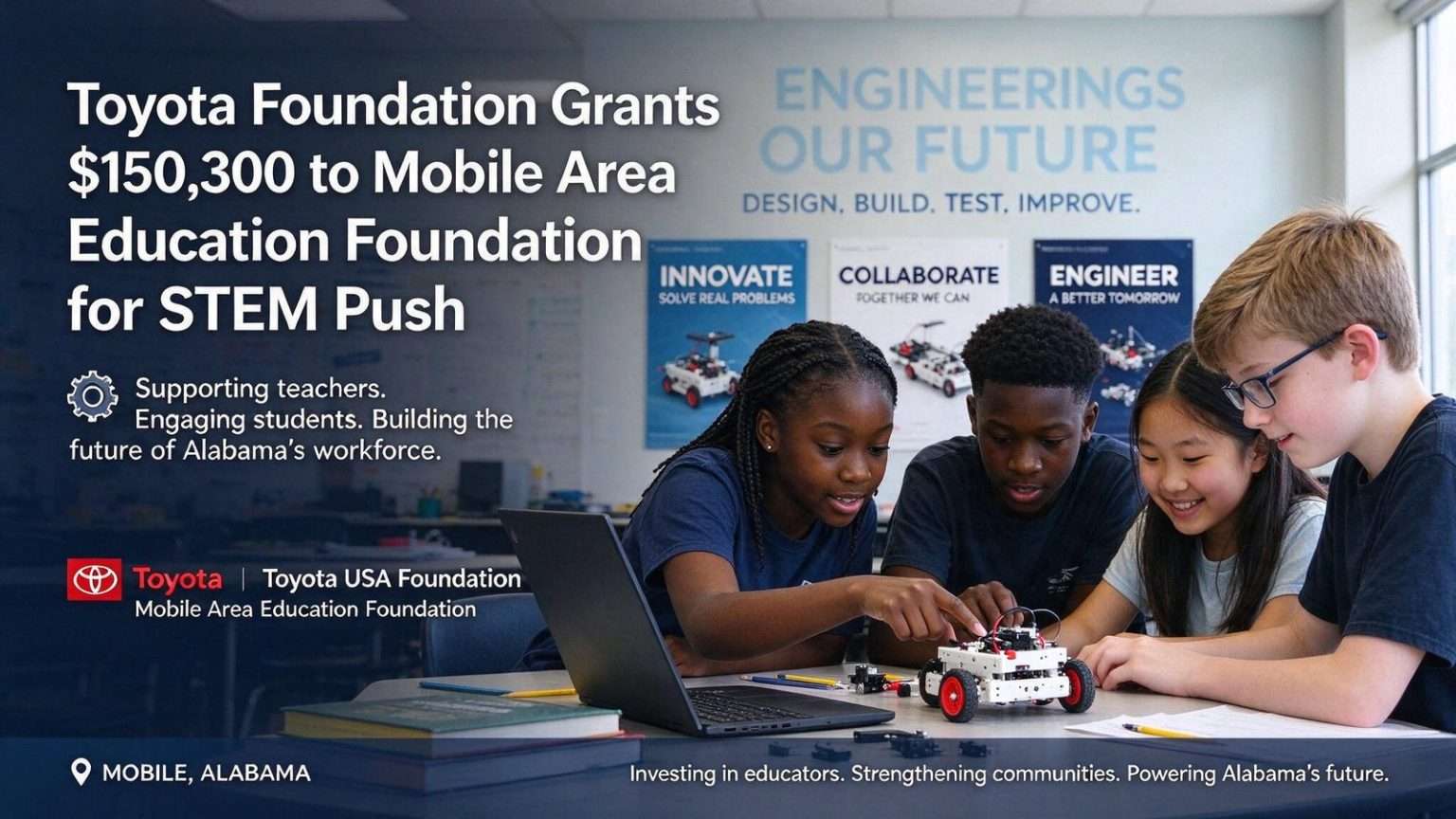
The Toyota USA Foundation awarded the Mobile Area Education Foundation a $150,300 grant to support its EYE on STEM Leadership Academy, an investment aimed at strengthening science, technology, engineering and mathematics education across Southwest Alabama.
The grant placed the Mobile education foundation among the recipients of a national philanthropy program that Toyota has used for decades to fund K-12 initiatives in communities where the company operates — and it arrived as Alabama was working to build the technically trained workforce its rapidly growing manufacturing sector demands.
Building a corps of STEM leaders
The academy’s full name — Engaging Youth through Engineering (EYE) on Science, Technology, Engineering and Mathematics (STEM) Leadership Academy — captures its approach. The program set out to develop a cadre of STEM leaders drawn from teachers, administrators, teacher educators and business and industry leaders, who would then expand the implementation of STEM curriculum into middle schools in the Mobile County Public School System and in rural counties across the southwest Alabama region.
The design reflects a strategy that education researchers have increasingly favored: rather than funding a single classroom program, the academy trains the people who train others. A teacher or administrator who completes the leadership academy can carry STEM methods to an entire school; a business leader who participates becomes a bridge between industry and the classroom. The multipliers compound across years, which is precisely the quality funders look for when they put money into professional development.
By focusing on middle schools, the initiative targeted a pivotal stage in students’ education, the years when many young people decide whether subjects like math and science feel like doors opening or closing. Research on STEM pathways consistently shows that students who lose interest in mathematics by eighth grade have largely closed off engineering and technical careers before they ever reach high school, making the middle grades the most efficient point of intervention.
For Mobile County, the middle-school focus also connected to an existing pipeline. The school district had been weaving engineering and design concepts into earlier grades through the EYE program’s curriculum work, giving elementary students hands-on exposure to engineering habits of mind and then extending that exposure as students matured. The leadership academy was built to deepen and spread that work.
A manufacturer’s stake in the classroom
For Toyota, the grant aligned corporate philanthropy with the company’s manufacturing footprint in Alabama. “Toyota believes in supporting programs with long-term sustainable results,” said Patricia Salas Pineda, group vice president of national philanthropy and the Toyota USA Foundation. “The Mobile Area Education Foundation has a successful history of providing educators and administrators with key resources in the areas of science, technology, engineering and mathematics.”
“Given Toyota’s manufacturing presence in Alabama and our commitment to this great community, we are incredibly proud to support this important program,” Pineda added. The remark underscored a link that had grown steadily stronger across the state: the connection between a skilled, technically trained workforce and the industries increasingly drawn to Alabama.
Toyota’s presence in the state dates to the company’s engine plant in Huntsville, which has grown into one of the automaker’s significant U.S. production operations and a cornerstone of north Alabama’s manufacturing economy. Companies of that scale depend on pipelines of technicians, engineers and skilled maintenance workers, and automakers nationwide have learned that those pipelines begin not in technical colleges but in middle school classrooms, where career perceptions form early.
The Toyota USA Foundation’s grant-making reflects that understanding. The foundation concentrates its giving on K-12 programs that improve science and math teaching and that reach students who might not otherwise encounter engineering concepts, favoring initiatives that promise to outlast the grant itself. The Mobile Area Education Foundation’s track record of curriculum work in the county’s schools fit the profile.
For the education foundation, the grant was the latest chapter in a relationship between Mobile’s business community and its public schools. The organization has long positioned itself as the district’s education fund partner, channeling corporate and philanthropic money into programs the school system’s own budget cannot carry — and using business leaders’ engagement to keep classroom work aligned with the skills local employers actually need.
A regional conference to kick things off
To launch the effort, the Mobile Area Education Foundation planned to host a STEM for ALL Leadership Conference for 140 STEM leaders from throughout the region on Aug. 6. The conference was designed to offer a range of speakers, lunch panelists and breakout session leaders representing national, state and local perspectives on STEM in kindergarten-through-12th-grade classrooms.
The keynote speaker was Elizabeth Parry, chair of the K-12 Division of the American Society for Engineering Education. Parry’s selection signaled the academy’s ambition: the ASEE’s K-12 division sits at the national center of the effort to bring engineering instruction into elementary and middle schools, and its leadership brings direct knowledge of which classroom models have proven durable across the country.
The timing of the award also gave the conference an added frame. With $150,300 committed to the academy, organizers could describe the Aug. 6 gathering not as a standalone event but as the opening session of a funded, multi-year effort — a distinction that shapes how districts assign staff time and how participants commit to the full program rather than a single day of sessions.
Conferences of this kind serve a second, less visible purpose for programs like the leadership academy: they build the network the program will rely on afterward. The 140 attendees — drawn from school districts, universities and industry across the region — become the cohort that carries the academy’s work into their home districts, and the sessions give them a shared vocabulary and a set of common models to implement.
Organizers described the conference as the first of many sessions scheduled for the EYE on STEM Leadership Academy, signaling that the grant was meant to seed an ongoing program rather than a one-time event. Subsequent sessions were to rotate through the training, collaboration and classroom-implementation phases that professional development programs of this design depend on.
Reach beyond the city
Notably, the initiative reached past the Mobile city limits to include rural counties in the region, an acknowledgment that opportunity in science and engineering should not stop at the county line. Southwest Alabama’s rural school districts — Washington, Clarke, Choctaw, Monroe and their neighbors — often lack the corporate partnerships and grant-writing capacity that urban districts like Mobile County can draw on, leaving their students with thinner exposure to STEM instruction and STEM careers.
By building rural counties into the academy from the start, organizers addressed a problem that plagues education philanthropy: programs funded in population centers tend to widen the gap they were meant to close. A leadership academy whose cohort includes rural teachers and administrators gives those districts a seat at the table and a pipeline of trained colleagues they would otherwise have to recruit or create from scratch.
The regional approach also mirrors the economy the program is preparing students for. Manufacturing, shipbuilding, aerospace and energy operations along the Gulf Coast draw workers from a wide radius, and technical careers in places like Mobile’s shipyards or the industrial corridor along the rivers recruit from small towns across south Alabama. A student in a rural county school who discovers engineering in middle school is, from an employer’s perspective, as much a part of the workforce pipeline as a student in midtown Mobile.
Why corporate funders bet on teachers
For the education foundation, the Toyota grant offered both resources and validation — a vote of confidence from a major manufacturer in the idea that investing in teachers and school leaders is one of the surest ways to prepare young people for the jobs of a changing economy.
The logic behind that bet is straightforward. Classroom technology grows obsolete; a well-trained teacher does not. Studies of professional development programs consistently find that sustained training — spread across a year or more, with follow-up in the classroom — changes instructional practice in ways one-day workshops cannot. The leadership academy’s cohort design, with its conferences, implementation phases and ongoing sessions, follows the template that research favors.
The grant’s arrival in Mobile also said something about the region’s trajectory. A generation ago, Alabama’s economy was dominated by textile mills, agriculture and heavy extraction; today, the state markets itself internationally on automotive, aerospace, shipbuilding and advanced manufacturing. Educating a workforce for that economy requires a school system that treats engineering as literacy, and programs like EYE on STEM are the mechanism by which that shift reaches everyday classrooms.
For the middle schoolers of Mobile County and the surrounding rural districts, the program’s effects will arrive indirectly — through a teacher with new training, a classroom unit built around a design challenge, a business volunteer who explains what an engineer actually does. That indirection is the point. The $150,300 grant was not buying equipment; it was building the people who will teach the next decade of Alabama’s workforce.