Mobile-Area Lawmakers Draft Twin Bills to Crack Down on Fentanyl Distribution
Reps. Chris Pringle and Matt Simpson propose separate bills to criminalize fentanyl distribution after deadly Mobile-area overdoses.
After overdose deaths claimed a 15-year-old girl in Semmes and a 21-year-old man in Theodore, two Mobile-area state representatives are pushing separate bills aimed at punishing those who distribute fentanyl in Alabama. The deaths of the two young people, in communities on opposite ends of Mobile County, put a local face on a crisis that has been building across the Gulf Coast for years, and they gave the legislation a sense of urgency that lawmakers say was impossible to ignore.
State Reps. Chris Pringle and Matt Simpson have each drafted legislation targeting the deadly synthetic opioid, which has been turning up in more of the illegal drug supply across the Gulf Coast. The two bills arrived at the same problem from different directions — one written broadly to cover any drug sale that kills, the other written narrowly to hit fentanyl trafficking itself — and both lawmakers said they would rather see overlapping coverage than a gap that lets a dealer escape serious consequences. The parallel filings reflect how quickly fentanyl has moved from a niche concern to a front-burner issue in the Alabama Legislature.
Two Different Approaches
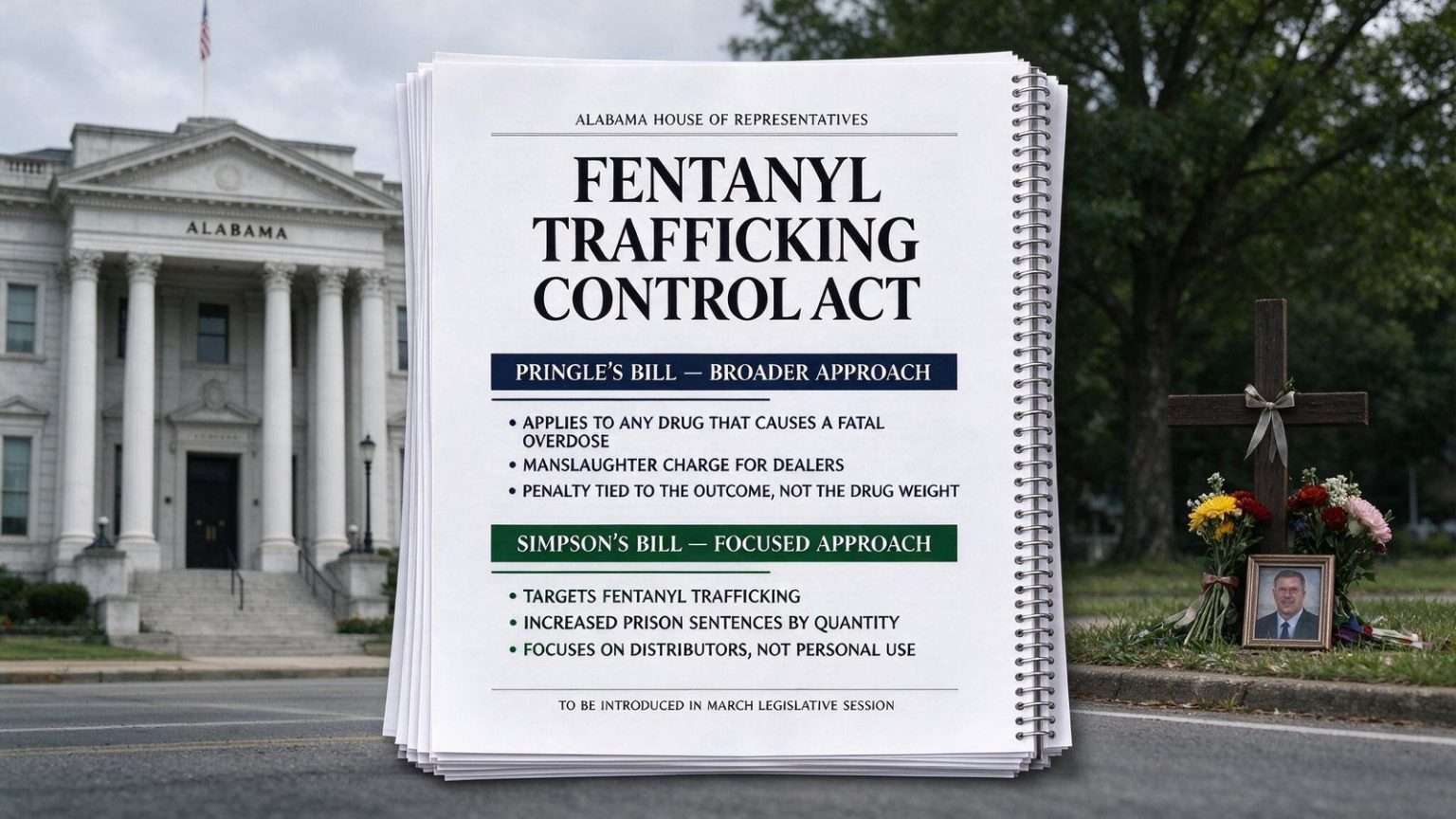
Pringle’s bill takes the broader approach, applying to any drugs that cause a fatal overdose. “If you’re selling drugs, and you cause somebody’s death, you will be charged with manslaughter,” Pringle said. Under his proposal, the charge would follow the death rather than the substance, so a dealer could not avoid the harshest exposure by claiming ignorance of what was in the product sold. The manslaughter framework also ties the penalty to the outcome, the way homicide laws do, rather than to the weight of the drugs involved.
Simpson’s bill zeroes in on fentanyl trafficking itself. It would increase prison sentences based on the quantity being trafficked, while aiming squarely at distributors rather than ordinary users who may not know their drugs are laced with the opioid. That distinction matters to the bill’s design: the escalating penalties attach to people moving the drug in quantity, not to the person at the end of the chain who bought what they believed to be something else. Lawmakers drafting fentanyl legislation across the country have wrestled with the same question of where to draw the line between trafficking and addiction, and Simpson’s bill resolves it by calibrating punishment to scale of distribution.
Lawmakers drafting fentanyl legislation across the country have wrestled with the same question of where to draw the line between trafficking and addiction, and Simpson’s bill resolves it by calibrating punishment to scale of distribution. The graduated structure mirrors the logic already used for other trafficking offenses: larger quantities indicate a commercial operation rather than personal use, and commercial operations are where the lethal doses originate. Prosecutors, for their part, gain a clearer charging tool — instead of relying on statutes written for different drugs and different quantities, they would have penalties designed for the way fentanyl is actually packaged and sold on the Gulf Coast.
According to both lawmakers, Alabama currently imposes mandatory prison sentences for heroin, methamphetamine and marijuana trafficking — but not for fentanyl. Their bills would close that gap. The state’s drug trafficking statutes have long set weight thresholds that trigger mandatory minimum prison terms for the major illicit drugs, a structure that dates to the era when heroin and methamphetamine dominated the supply. Fentanyl’s arrival changed the math: because the drug is measured in micrograms rather than grams of active dose, the existing thresholds do not map neatly onto it, and until now the state has lacked the trafficking-specific penalties that cover it.
Simpson stressed how little of the drug it takes to be lethal, holding up a sugar packet for scale: one gram, he said, could contain enough fentanyl to kill 500 people, since just two milligrams is a lethal dose. The visual was meant to make an abstraction concrete. A packet of the size found on any restaurant table, filled with a kilogram-scale quantity that fits in a pocket, represents a potential mass-casualty quantity of the drug. That potency is also what makes fentanyl different from the opioids it has displaced — a mismeasured dose, or one batch mixed unevenly, can turn a routine sale into a death.
Why the Drug Is Different
Fentanyl is a synthetic opioid developed for medical use as a painkiller, manufactured far more cheaply and in far greater potency than plant-derived drugs like heroin. Traffickers discovered that small amounts could be used to stretch or substitute for other drugs, and it has since worked its way into counterfeit pills, powder drugs and even marijuana supplies. A user who buys what looks like a prescription pill on the street cannot see, smell or taste whether it contains fentanyl, which is how deaths have spread far beyond the population of opioid users into every corner of the illegal market.
On the Gulf Coast, that shift has shown up in the caseloads of coroners, emergency rooms and drug task forces across south Alabama. The deaths in Semmes and Theodore that prompted the legislation are part of that larger pattern: teenagers and young adults who were not longtime opioid users, exposed to the drug through substances they did not know contained it. Mobile County families and school officials have watched the ripple effects of each death, and the lawmakers said constituent contact after those losses helped push the bills forward.
Support From Prevention Advocates
Virginia Guy, executive director of the Drug Education Council, called Alabama’s overdose deaths a huge problem and said the legislation is an important first step, though she emphasized that more work remains on the demand side. The Drug Education Council, a Mobile-based nonprofit, works on prevention, education and treatment referrals across the Gulf Coast, giving Guy a front-line view of how the drug supply has changed. “I support and applaud our lawmakers for doing everything they can to keep our communities safe,” Guy said.
Her caveat — that punishment alone will not end the crisis — reflects a consensus among prevention professionals that enforcement and treatment have to move together. Supply-side penalties like the ones in the two bills aim to raise the cost of distributing fentanyl, while demand-side programs address the addiction that keeps customers buying. Guy said both halves of the equation are necessary, and she welcomed the lawmakers’ attention to the trafficking side while pressing for continued investment in education, treatment access and community prevention work.
Prevention groups have responded to the contaminated supply with renewed emphasis on awareness campaigns aimed at young people and parents, warning that the old rules of thumb about which drugs are dangerous no longer apply. Schools across south Alabama have brought overdose education into their health programming, and mobile outreach teams now distribute the overdose-reversal drug naloxone at community events. Guy’s organization has been part of that network for decades, and its leaders say the bills’ emphasis on distributors complements rather than replaces that grassroots work — each death prevented upstream is a family that never has to learn the names Semmes and Theodore have come to represent in this debate.
She also warned that virtually all street drugs — pills, vapes, marijuana — now carry the potential to contain fentanyl. That warning is aimed squarely at parents and young people who assume the drug only threatens opioid users. In a contaminated supply, a counterfeit pill bought for recreation, or a vape cartridge or bag of marijuana that has been cut or laced, can deliver a lethal dose to someone who never intended to take an opioid at all.
The two bills move independently, so offenders could ultimately face stacked charges: trafficking time under Simpson’s bill, and a manslaughter charge under Pringle’s if a sale proves fatal. The layering is deliberate. A quantity-based trafficking conviction punishes the scale of the operation, while the manslaughter provision reaches the dealer whose product actually kills, even if the amounts involved were small. Together the two laws would let prosecutors match charges to the facts of each case rather than forcing a choice between them.
Both were set to be introduced when the Legislature convened in Montgomery in March. The Alabama Legislature meets in regular session each spring, and bills filed early in the session have the clearest path through committee, floor votes and final passage before the session ends. Each bill will need approval in the House, where both Pringle and Simpson serve, and in the Senate, before heading to the governor’s desk to become law — a process that will test how much support the twin approach can hold onto beyond Mobile County.
The path from filing to law is rarely smooth. Legislation introduced in one session carries over or must be reintroduced in the next, and criminal penalties bills routinely draw amendments that change thresholds and sentencing ranges as they move. Supporters of both measures said the local deaths give the proposals a moral clarity that generic drug bills often lack, and they plan to make the case in committee with the families’ stories attached. Mobile County’s legislative delegation, which spans both parties, has historically been able to move local priorities through the Statehouse when it unites behind them, and fentanyl penalties have emerged as exactly that kind of shared priority.
For the families in Semmes and Theodore whose losses started this conversation, the legislation represents the kind of response they have asked for: a state statute that treats fentanyl distribution as the lethal enterprise it is. Whether the bills pass as written, are merged, or emerge amended, the two Mobile-area representatives have made clear they intend to see Alabama’s drug laws finally catch up to the drug that is killing its residents.