Mobile area residents turn to CBD oil, but experts urge caution
Mobile area residents turn to CBD oil for pain and seizures, but the Drug Education Council and FDA caution that most products are unregulated.
From headaches and back pain to sleepless nights and anxiety, residents across the Mobile area are turning to CBD oil in growing numbers, and many say the hemp-derived product has eased symptoms that prescription medications never fully relieved. The boom in local demand, however, has arrived alongside a sobering caution from health professionals: CBD products remain largely unregulated, and the burden of finding a safe, trustworthy product falls on the consumer.
Jennifer Galloway of Fairhope is among the converts. Galloway, who has had surgeries on her head and neck, said she relies on CBD drops containing trace amounts of THC rather than the opioid medications she used before discovering the product. Her switch reflects a broader pattern across Alabama and the Gulf Coast, where chronic-pain patients have searched for alternatives to prescription painkillers amid national concern over opioid dependence and overdose.
In Saraland, Hailey Goodrum gives CBD to her 2-year-old son, who has cerebral palsy and epilepsy and previously suffered as many as 400 seizures a day. Families like Goodrum’s have been at the center of the push to broaden access to cannabidiol in Alabama, and parents of children with severe seizure disorders were among the earliest and most vocal advocates for letting families try the extract when conventional treatments fell short.
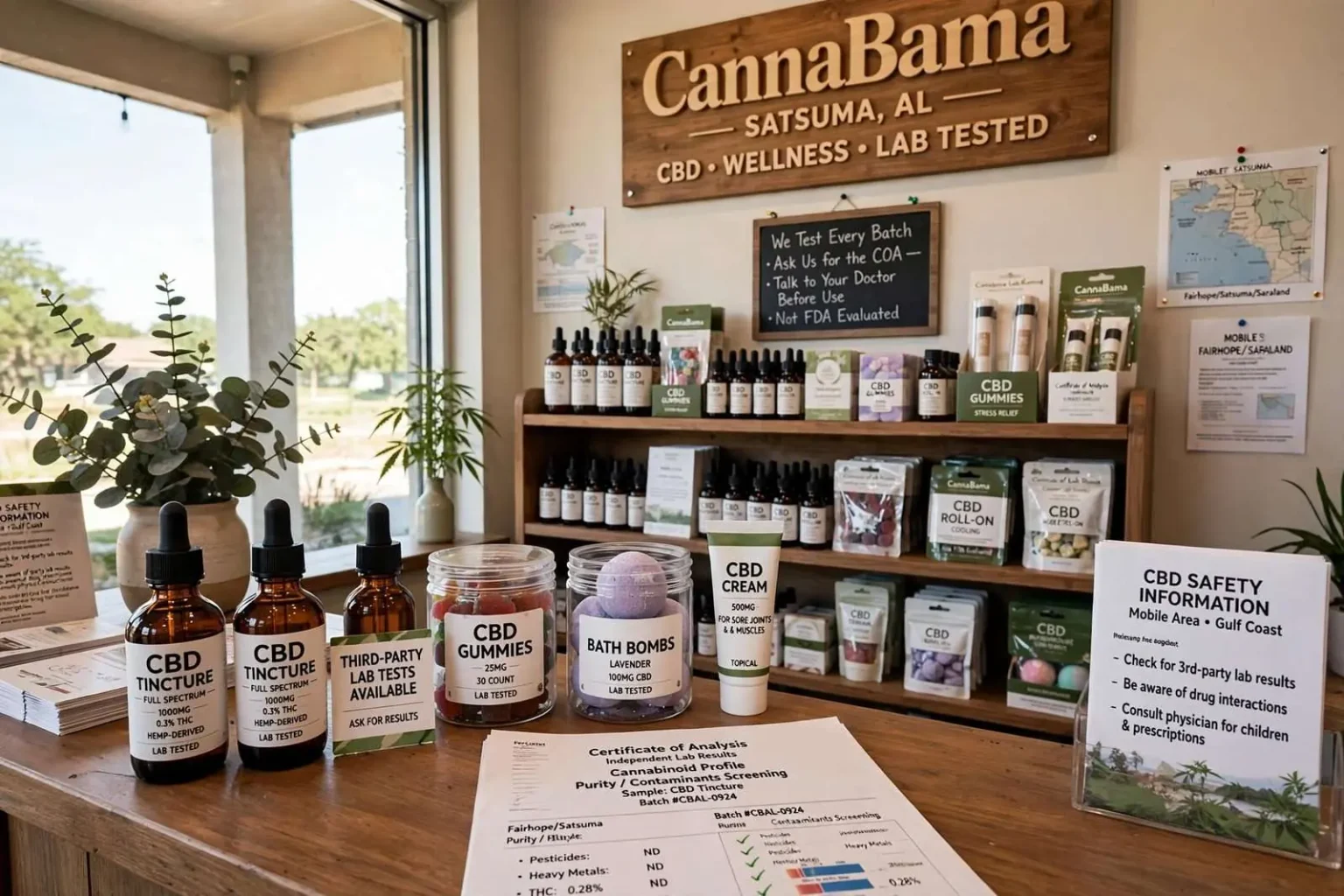
Both women buy their products from CannaBama in Satsuma, one of the dedicated CBD retailers that have opened across the region in recent years. Co-owner Jennifer Boozer said business is booming, a sign of how quickly cannabidiol has moved from a niche supplement to a routine purchase for shoppers across Mobile County.
From Tinctures to Bath Bombs
The Satsuma shop sells CBD with and without THC, the compound in marijuana that produces a high, and stocks it in forms that include gummies, creams, vapes and bath bombs. The range illustrates how far the market has traveled from the tincture bottles that once defined the industry, with infused edibles, topicals and wellness products now marketed for everything from sore joints to stress relief.
Boozer is straightforward with customers about the limits of oversight: CBD products are not regulated by the U.S. Food and Drug Administration. To help buyers verify what they are getting, she points them to third-party lab results for the products the shop carries. Independent testing has become a common practice among reputable retailers as the industry works to reassure consumers about potency, purity and the absence of contaminants.
The wider availability of CBD traces to the 2018 federal Farm Bill, which removed hemp — cannabis containing no more than 0.3 percent THC by dry weight — from the list of federally controlled substances. States, including Alabama, built their own frameworks for growing hemp and selling its extracts, and CBD products have since appeared on shelves at pharmacies, gas stations and wellness stores throughout the Gulf Coast region.
The pace of that expansion has occasionally outrun the science. Researchers are still working to establish how well cannabidiol performs for the long list of conditions it is marketed for, and regulators have repeatedly warned companies against making medical claims that studies do not yet support. In the meantime, the people buying these products locally are, in effect, participants in a vast uncontrolled experiment.
An Industry Operating Without a Rulebook
That lack of federal regulation means CBD products can reach store shelves without the testing, approval and manufacturing standards that apply to prescription and over-the-counter drugs. The FDA has approved only one CBD-based prescription medication, a drug used to treat certain severe forms of epilepsy, and regulators have sent warning letters to companies marketing supplements with unproven health claims. Everything else on the market exists in a gray zone where the label does not always match the contents of the bottle.
Virginia Guy, executive director of Mobile’s Drug Education Council, said pharmaceutical-grade CBD approved by the FDA is the safest route for consumers who want to use the product. The Mobile-based nonprofit has spent decades educating the community about substance use, and Guy said more research is needed on dosing, sourcing and manufacturing before firm recommendations can be made about over-the-counter CBD products.
Her advice to buyers is to be confident in their source before making a purchase. In practice, that means asking retailers where their products come from, checking whether the batch has been tested by an independent laboratory and reviewing those results for THC content and contaminants such as pesticides or heavy metals. Reputable shops make that documentation easy to find; products sold with no verifiable testing are a warning sign.
Alabama’s own path to CBD access was shaped largely by families of children with epilepsy. State lawmakers carved out early exemptions allowing limited medical use of cannabidiol for severe seizure disorders, and later legislation eased the restrictions further as public attitudes shifted. The retail market built on those changes now serves customers whose reasons range from serious medical conditions to everyday complaints like sore muscles and restless nights.
Local users describe a spectrum of results. Some, like Galloway, credit CBD with helping them step away from stronger medications. Others report more modest benefits, and researchers caution that part of the effect users feel may come from expectation rather than the compound itself — one more reason, advocates of study say, that rigorous clinical research matters before the industry’s claims can be taken at face value.
Pediatric use remains one of the most sensitive corners of the debate. Parents such as Goodrum, who manages her son’s severe epilepsy around his medical needs, describe the products as a lifeline, while pediatricians generally urge families to keep physicians informed about any supplement a child is taking, particularly one that can interact with prescription drugs.
The Drug Education Council’s position underscores a distinction that often gets lost in marketing: the difference between pharmaceutical-grade CBD and the wide universe of hemp-derived products sold over the counter. The former has been through clinical trials and federal review. The latter has not, no matter how polished the packaging or confident the sales pitch at the counter.
Drug Tests and Drug Interactions
Beyond questions of quality, buyers face two practical risks. First, products with trace amounts of THC can still trigger a failed drug test over time. Regular use allows small quantities of the compound to accumulate in the body, and users who work in fields with workplace screening — from law enforcement to transportation and health care — are often surprised to learn that a legally purchased product can cost them a job.
Second, doctors say CBD can interact with other medications. The compound is processed by the same liver enzymes that handle many common prescriptions, which means it can raise or lower the levels of those drugs in the bloodstream. Patients taking blood thinners, seizure medications or other long-term therapies are generally advised to talk with a physician or pharmacist before adding CBD to their routine.
Those cautions do not amount to a verdict against CBD, health educators stress, but they do argue for care. Consumers who choose to use the products are encouraged to start with low doses, watch for side effects and treat claims of dramatic cures with skepticism, since no over-the-counter CBD product has been proven to treat cancer, chronic pain, anxiety or most of the other conditions it is sometimes marketed for.
A Booming Market With Open Questions
For now, the market shows no sign of slowing. Shops like CannaBama continue to draw steady traffic from customers across Mobile County, Baldwin County and beyond, and product lines keep expanding as manufacturers roll out new formulations each season. Retailers who survive in a crowded field tend to be the ones who lean on transparency and third-party lab documentation to build repeat business.
Whether federal regulators eventually step in with formal rules for hemp-derived CBD remains an open question that industry and health officials alike are watching. Until they do, the guidance from professionals in the Mobile area is likely to stay the same: know what you are buying, know who you are buying it from, and loop in your doctor — especially for children, for regular users and for anyone taking prescription medications.
For users like Galloway and Goodrum, the calculation is simpler and far more personal. For them, the products have made a measurable difference in conditions that once dominated their daily lives, and they continue to buy from a source they trust. The challenge for the region’s fast-growing CBD market is making that kind of confidence the rule rather than the exception.
In the absence of a federal rulebook, the burden of judgment rests with individual families, and the choices they make are shaped by the people behind the counter. A shop that volunteers its lab results and explains the limits of what the products can do gives customers something more valuable than a sales pitch — a fair picture of both the promise and the risk. That, local health educators say, is exactly the standard the rest of the industry should be expected to meet.