
Mobile Arena Project to Host Matchmaker Meeting for Minority Contractors
The City of Mobile is hosting a Matchmaker Meeting to connect prime contractors with minority and disadvantaged business enterprise subcontractors interested in working on the Mobile Arena Project.
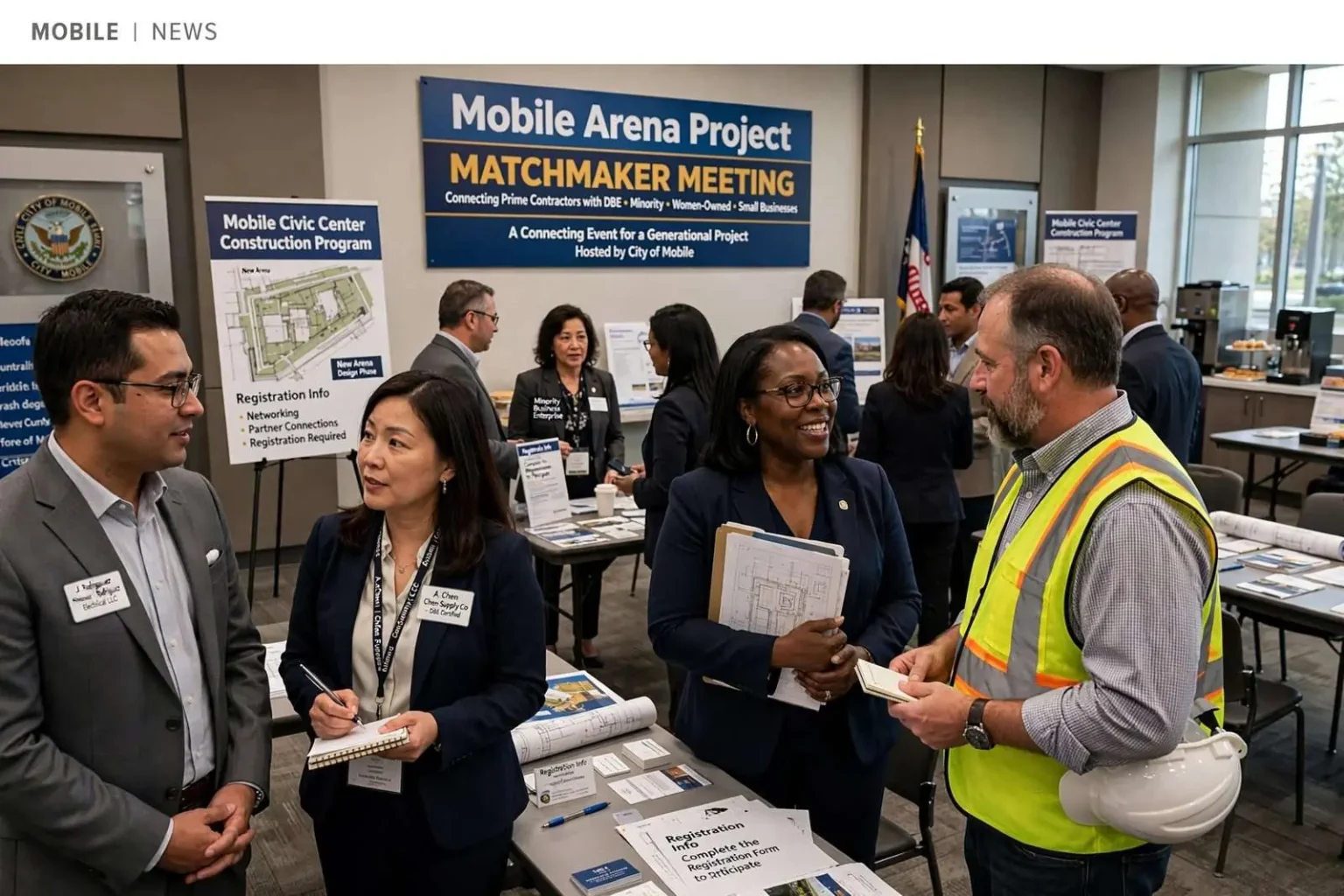
A Connecting Event for a Generational Project
The City of Mobile is inviting prime contractors, subcontractors and minority-owned businesses to a Matchmaker Meeting aimed at connecting companies interested in working on the Mobile Arena Project, part of the ongoing Mobile Civic Center construction program. The event is designed to give prime contractors an opportunity to network with disadvantaged business enterprise (DBE) subcontractors, minority-owned firms and other small businesses that could play a role in the arena’s construction. Registration is required for anyone who wants to attend.
Events of this kind have become a familiar feature of large public construction programs across Alabama and the Gulf Coast. A project the size of a new arena is built not by a single company but by a chain of prime contractors and the dozens of subcontractors and suppliers beneath them, and the relationships formed at events like this often determine which local firms end up on bid lists when the real work is advertised.
The Matchmaker format is also a response to a long-standing complaint in the contracting community: that smaller firms, and minority- and women-owned firms in particular, often learn about opportunities on major public projects too late, or never learn the right people to talk to. By putting primes and subs in the same room before bid packages are advertised, the city hopes to widen the pool of companies that are genuinely positioned to compete when the work goes out for bids.
Who Should Attend
City officials say the meeting is intended for a wide range of businesses, including prime contractors, subcontractors, DBE-certified contractors, potential DBE contractors, and small and minority business owners looking to get involved in the project. The goal is to create direct introductions between larger contractors who will oversee portions of the work and smaller firms that could serve as subcontractors or suppliers.
The invitation extends well beyond the construction trades themselves. Suppliers of building materials, equipment rental firms, site services companies, haulers and other businesses that support a large job site all have a stake in the program, and city officials have framed the meeting as an opportunity for any company that could plausibly contribute to the arena’s construction. Firms that hold current DBE certification are an obvious audience, but the city has been explicit that companies which have not yet sought certification are welcome as well, since interest expressed now can shape how firms prepare for future bid opportunities.
The meeting will be facilitated by Norman Hill Consulting Solutions, a firm that specializes in connecting minority and disadvantaged businesses with major construction projects. Businesses with questions about the event can contact Norman Hill at 205-482-5771 or Donell Hill at 650-619-6422.
Using an outside facilitator for an event like this is a deliberate choice. A third-party firm that specializes in DBE outreach can spend the time needed to recruit a broad cross-section of businesses, organize the introductions, and follow up afterward, freeing city staff from trying to run a networking event on top of managing a complex construction program. For participating firms, the facilitator also serves as a neutral convener, which can make the introductions feel less like a formal audition and more like a working conversation about capabilities and needs.
Where the Arena Project Stands
The Mobile Civic Center construction program, which includes the new arena, is currently in the design phase. As the project moves forward, individual bid packages will be developed and publicly advertised by the City of Mobile, giving contractors formal opportunities to compete for portions of the work.
The design phase is the period in which architects and engineers translate the city’s goals for the new arena into actual plans, drawings and specifications. It is also the stage at which the overall program gets broken down into the individual bid packages that will eventually be advertised. Each package typically covers a defined slice of the work, and each one represents a separate contracting opportunity that companies will be able to pursue once it is formally advertised.
For contractors and suppliers, that sequencing matters. Nothing can be bid yet, but the companies that have already registered their interest, met the primes who will lead major packages, and understand what the program will demand are the ones most likely to be invited into teams when the advertisements appear. Attending the Matchmaker Meeting is, in effect, a way of signing up early for a process that will unfold over several years.
The Mobile Civic Center program is part of a larger effort to rebuild and modernize the city’s central public facilities. The arena will join the existing civic center structures as a venue for concerts, sporting events, conventions and public gatherings, and the program is expected to be one of the most significant public construction undertakings in the city in recent memory. Projects of that scale carry correspondingly large opportunities for the regional contracting community, in both the value of the work itself and the years of sustained activity it represents.
How the Registration Process Works
City officials are asking interested contractors, subcontractors and suppliers not to contact City of Mobile departments or employees directly to solicit information or market their services regarding the project. Instead, companies interested in participating are encouraged to complete a registration form to provide their company information and express interest.
The instruction to use the registration form rather than approaching city staff directly is meant to keep the process orderly and fair. A project this visible inevitably draws a steady stream of calls and visits from companies hoping to get a foothold, and routing that interest through a single, standardized form gives every firm the same access point. It also protects city employees from the appearance of favoritism, since no company gains an advantage by knowing the right person to call.
Information submitted through the registration form will be made available for review by all other companies that complete the form, creating a shared pool of contacts for contractors, subcontractors and suppliers to use when identifying potential partners for bidding purposes.
That shared-pool structure is one of the most practical features of the process. A prime contractor preparing for a future bid package can search the pool for certified firms in the trades it will need, and a smaller firm can identify the primes that have registered and express interest directly to them. Because the information is visible to every participant, the pool functions as a common marketplace rather than a private list, which reduces the chance that capable companies are overlooked simply because they lacked the right contacts.
Companies completing the form should treat it as their first introduction to the participating community, since the completeness of the information they submit will shape how easily other companies can find and evaluate them when assembling teams.
Not a Prequalification Process
City officials emphasized that the registration is not a bidder prequalification process. The City of Mobile will not verify the accuracy or completeness of information submitted by individual companies, and businesses are responsible for vetting potential partners on their own.
The distinction matters for both sides of the table. Because the city is not screening or endorsing anyone in the pool, a prime contractor considering a potential subcontractor cannot assume that the city has checked the firm’s licensing, financial standing, safety record or past performance. Those checks fall to the companies themselves, and standard practice on public projects is to conduct them well before a bid is finalized, when discovering a partner’s problems is still inexpensive rather than career-defining.
For smaller firms, the same principle cuts the other way. Registering for the pool and attending the matchmaker event does not guarantee inclusion on any bid list. It signals interest and provides information, but the decision about whether a firm joins a team remains entirely with the primes. Firms that want to be taken seriously generally arrive prepared, with current certifications, an accurate description of the work they can self-perform, and references that primes can verify independently.
The city’s hands-off posture is also consistent with how formal procurement will eventually work. When bid packages are advertised, each will be governed by the city’s standard contracting requirements, and it is at that stage, not the registration stage, that qualifications will actually be evaluated. The registration pool and the matchmaker meeting exist to help companies find one another, not to determine who wins work.
Why Matchmaker Meetings Matter
For prime contractors, the matchmaker meeting provides access to a pool of potential subcontractors and suppliers who have expressed interest in the project. For smaller firms, the meeting offers a direct opportunity to present their capabilities to larger contractors and to learn about the specific requirements of the arena project.
The registration process creates a shared database of interested companies, which can be used by all participants to identify potential partners. The clarification that registration is not a bidder prequalification process is important: it means that businesses are not being evaluated or approved by the city at this stage, but rather are simply expressing interest and providing their contact information. The responsibility for vetting potential partners remains with each company, which is consistent with standard practice in public construction.
Disadvantaged business enterprise programs are a standard feature of large public construction projects, and the arena program is expected to rely on the same framework that governs DBE participation across federally assisted transportation and municipal work in Alabama. The underlying purpose is to ensure that minority-owned, women-owned and other disadvantaged businesses have genuine access to contracting opportunities on major public projects, rather than being crowded out by larger, more established firms that have historically dominated them.
In practice, DBE participation on a project of this scale is measured in millions of dollars of work across dozens of trades. Certified firms on a major arena program typically perform substantial portions of the sitework, concrete, electrical, mechanical, drywall, painting, glazing and specialty work, alongside suppliers who furnish materials. The city’s emphasis on starting DBE outreach during the design phase, rather than waiting until bids are advertised, reflects a lesson learned on many public programs: firms that are engaged early, before scopes are locked into bid documents, are far more likely to end up with real work.
The matchmaker format, facilitated by Norman Hill Consulting Solutions, is intended to create direct connections rather than to rely solely on formal bidding processes, which can sometimes be difficult for smaller firms to navigate. A written bid advertisement tells a company what work exists, but it does not tell the company which prime is assembling a team, what that prime needs, or how to make a persuasive case. Face-to-face meetings compress that discovery process into a single afternoon.
What Comes Next
The Matchmaker Meeting represents an early step in what is expected to be a lengthy construction process for the new arena, offering local and regional businesses, particularly minority-owned and disadvantaged enterprises, a chance to position themselves for future contracting opportunities as the project transitions from design into construction.
Once the design phase matures and individual bid packages are developed, the City of Mobile will advertise them publicly, and the competitive process will begin in earnest. Companies that used the registration pool and the matchmaker event to build relationships will enter that stage with introductions already made, while firms that wait for the advertisements may find that teams are already forming around established partners.
For business owners deciding whether to participate, the practical guidance from the process is simple: complete the registration form rather than contacting city staff directly, provide complete and accurate company information, and attend the meeting prepared to describe specifically what the firm can do.
The arena will ultimately serve as a venue for concerts, sporting events, conventions and public gatherings in downtown Mobile, and the construction program behind it will unfold over a period of years. For the region’s contracting community, the matchmaker meeting is the first, most accessible on-ramp to that work, and city officials have framed it as exactly that: an early, open invitation to every firm, large or small, that wants to be part of building Mobile’s next major public venue.


