Mobile artist paints bicentennial mural at Clark-Shaw Magnet School
Mobile artist Bobby 'BJ' Jiles painted a bicentennial mural celebrating Alabama history at Clark-Shaw Magnet School.
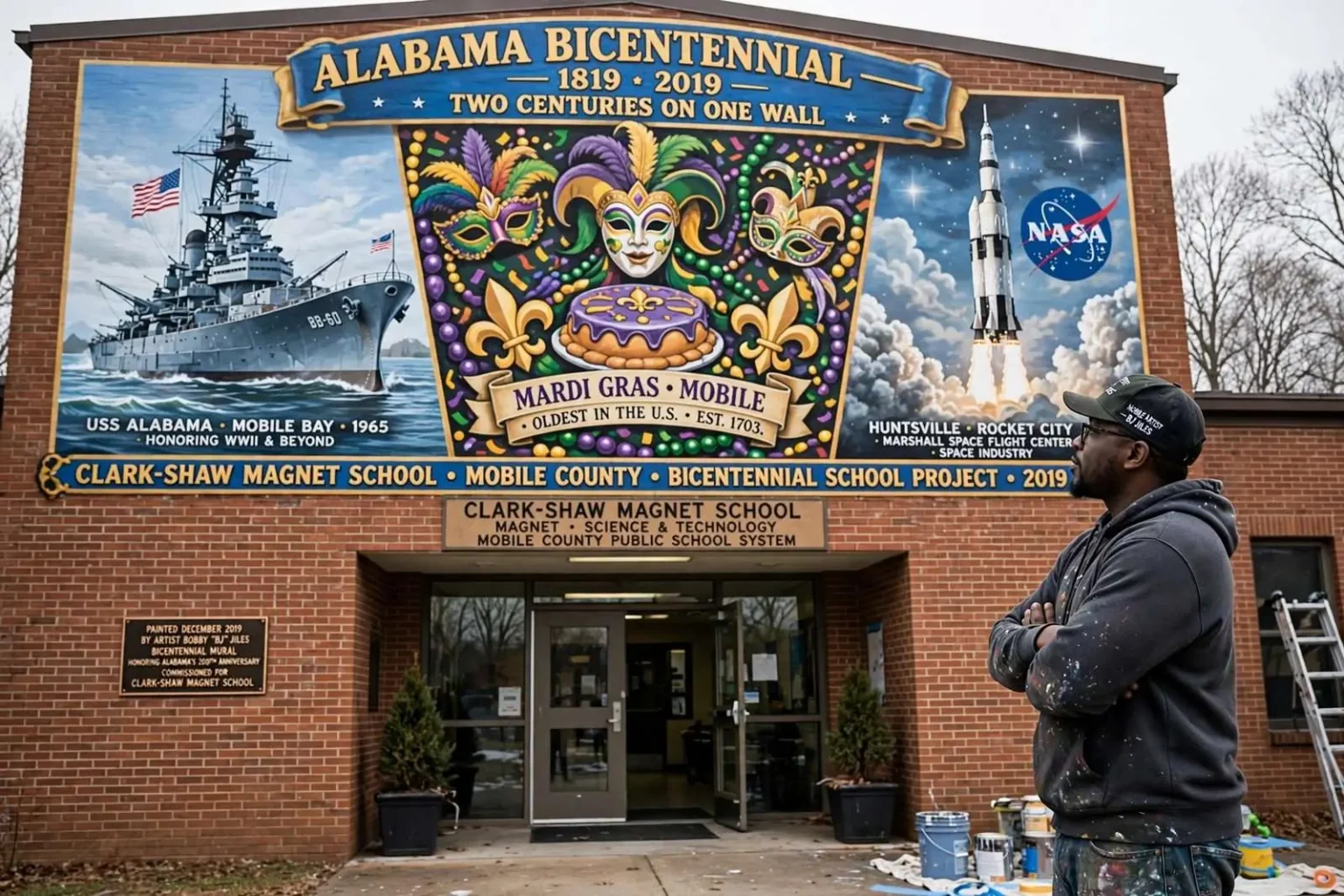
A Mobile artist has left a lasting mark at Clark-Shaw Magnet School with a mural celebrating 200 years of Alabama history, turning an ordinary entrance wall into a panoramic lesson in the state’s past. Bobby “BJ” Jiles painted the work on the wall of one of the school’s entrances over seven days while students were on Christmas break, working alone through the empty campus to complete the bicentennial tribute before classes resumed.
Clark-Shaw was among 200 schools selected as bicentennial schools after submitting grants and proposals, a designation that brought projects for students to mark Alabama’s 200th anniversary of statehood. The mural was one of those efforts, chosen by the school as a project that would both commemorate the milestone and give students a daily visual connection to the history they study. Schools across the state marked the anniversary with gardens, time capsules, exhibits and performances; at the midtown Mobile magnet campus, the celebration took the form of a full-scale painted wall.
Jiles said he was honored to take on the project, and he had a personal connection to the school that made the invitation mean more. Miranda Manley, who is helping coordinate the bicentennial projects at Clark-Shaw, was his sixth-grade teacher at Palmer Pillans Middle School and gave him his first art set. She asked Jiles to paint the mural, closing a circle that began years earlier when a teacher recognized a student’s talent and handed him the tools to develop it.
Two Centuries on One Wall
The artwork depicts familiar chapters of Alabama history, from the USS Alabama battleship and Mardi Gras in Mobile to the space industry in Huntsville. The selections trace the state’s identity across regions and eras: the battleship that has been moored in Mobile Bay since 1965 as one of the state’s most visited memorials; the Carnival traditions that make Mobile home to the oldest Mardi Gras celebration in the United States, predating New Orleans’; and the Huntsville rocket programs that put Alabama at the center of the American space effort, from the Saturn V to the work that continues at the Marshall Space Flight Center today.
It is now a permanent display at the magnet school, joining the campus landscape as a fixture students will pass every morning. For a school organized around academic excellence and science-and-technology themes, the mural adds an artistic dimension to the entry experience — a piece of public art in the tradition of the murals that have brightened Mobile’s buildings in recent years as part of broader downtown and neighborhood revitalization.
Painting during the holiday break gave Jiles uninterrupted access to the wall, but also meant working through the season alone, measuring, sketching and filling in the composition without an audience. The seven-day schedule reflects the discipline of a working artist: murals of this size demand layers of base color, detail work and finishing passes, and each day of the break counted toward having the entrance ready when students and faculty returned.
The Bicentennial in the Schools
Alabama’s bicentennial — marking statehood on Dec. 14, 1819 — was observed statewide with a multi-year commemoration that included festivals, historicalMarker installations, traveling exhibits and curriculum materials. The bicentennial schools program invited campuses to apply with proposals for their own commemorations, and the 200 selected schools received support to carry out projects that connected students to state history in a hands-on way.
For Clark-Shaw, a magnet school serving students from across Mobile County, the designation fit naturally into its mission. Magnet campuses draw families on the strength of specialized programming, and projects like the mural give the school community shared landmarks that build identity. Administrators have described the bicentennial efforts as a way to make history tangible — not just dates on a test, but images, artifacts and places students can see and touch.
The selection of a local artist with roots in Mobile’s public schools also carried its own message about where artistic careers begin. Jiles’s path — a teacher’s gift of a first art set, years of development, and eventually a commission to paint 200 years of state history on a school wall — is the kind of story educators cite when arguing for arts funding and for the early identification of talent. His return to paint at a Mobile school, at the invitation of the teacher who started him, made the mural a local story twice over.
Public Art in Mobile’s Schools
Murals have become an increasingly visible part of Mobile’s visual culture, appearing on downtown buildings, neighborhood businesses and public campuses as artists and property owners embrace large-scale work. School murals occupy a particular place in that movement: they live where children see them daily, and they often become the reference point — the “battleship picture in the hallway” — through which students remember what they learned about their state.
Art educators note that a mural like the one at Clark-Shaw does quiet curricular work. A student passing the USS Alabama each morning may later visit the ship in the bay and recognize it; an image of Huntsville’s rockets can spark the question of why Huntsville became “Rocket City,” leading to lessons on Wernher von Braun, the Saturn V and NASA’s presence in north Alabama. Mobile’s Mardi Gras imagery opens conversations about the city’s Carnaval societies, some founded in the 19th century, and the parade traditions that shut down downtown streets each winter.
The mural’s placement at an entrance makes it a greeting card for the campus as well. Visitors arriving for performances, awards ceremonies and tours encounter the historical panorama first, and school officials typically point with pride to student-made and student-facing art when showing off a campus. As a permanent installation, it will outlast the bicentennial commemoration that produced it, becoming part of the school’s physical identity for future classes with no memory of the anniversary itself.
An Artist’s Homecoming
The collaboration between Jiles and Manley adds a human footnote that educators hope will resonate with students: talent noticed early can become a career, and the relationship between a teacher and a sixth-grader with an art set can come full circle decades later. Palmer Pillans Middle School, where Manley taught Jiles, has served generations of west Mobile students, and stories of teachers who invested in individual children are a staple of the district’s history.
Jiles’s seven days of work during the break represent only the visible portion of such projects. Behind the painting lay design work — composing 200 years of history into a single readable wall, choosing the landmarks, balancing colors for an interior entrance — and coordination with the school over scale, surface preparation and timing. Artists who work on commission in public settings describe the logistics as half the job; the painting itself is the payoff.
With the mural complete, Clark-Shaw’s bicentennial project stands finished among the 200 schools selected statewide. Students returning from Christmas break found their entrance transformed, and the school now holds a permanent, locally painted tribute to the state’s two centuries — created by an artist who learned his first lessons with a set a teacher gave him, on a wall that will greet Mobile students for years to come.
The bicentennial schools designation also connected Clark-Shaw to a statewide network of campuses observing the anniversary at the same moment. Projects ranged from student research into local history to commemorative plantings and performances, and the shared timing gave schools a common occasion to celebrate even as their projects differed. Education leaders billed the effort as an investment in civic memory — an attempt to make sure that Alabama’s third century begins with students who know how the first two unfolded.
Clark-Shaw’s own history adds depth to the setting. The campus has long operated as a magnet school within the Mobile County Public School System, drawing high-achieving students from across the county through an application process and building a reputation for academics, science programming and fine arts. Schools of that kind often serve as showcase sites for the district, which made a polished, professionally executed mural a fitting addition to a campus already conscious of the impression it makes on visitors.
The imagery Jiles chose also reflects how Alabamians tell their own story. The USS Alabama, earned as a World War II battleship and preserved by schoolchildren’s pennies and citizen donations in the 1960s, represents the state’s patriotic memory. Mardi Gras represents Mobile’s claim as the Gulf Coast’s original Carnival city, with traditions dating to the early 18th century. Huntsville’s rockets represent the state’s modern technological ambition. Together, the three landmarks sketch an arc from military history to cultural tradition to scientific achievement — the shorthand by which the state introduces itself.
For now, the mural stands where it was meant to stand: on an entrance wall, where every arrival at Clark-Shaw passes it. Seven days of work during one Christmas break produced a permanent piece of Alabama’s bicentennial — and a Mobile artist’s thank-you note to the teacher who first put a paintbrush in his hand.