Mobile Arts Council Marks a Decade of Honoring the Region’s Creative Community
The Mobile Arts Council celebrated ten years of the Greater Mobile Art Awards with a special ceremony honoring artists, educators, organizations and volunteers who have shaped Mobile's cultural life.
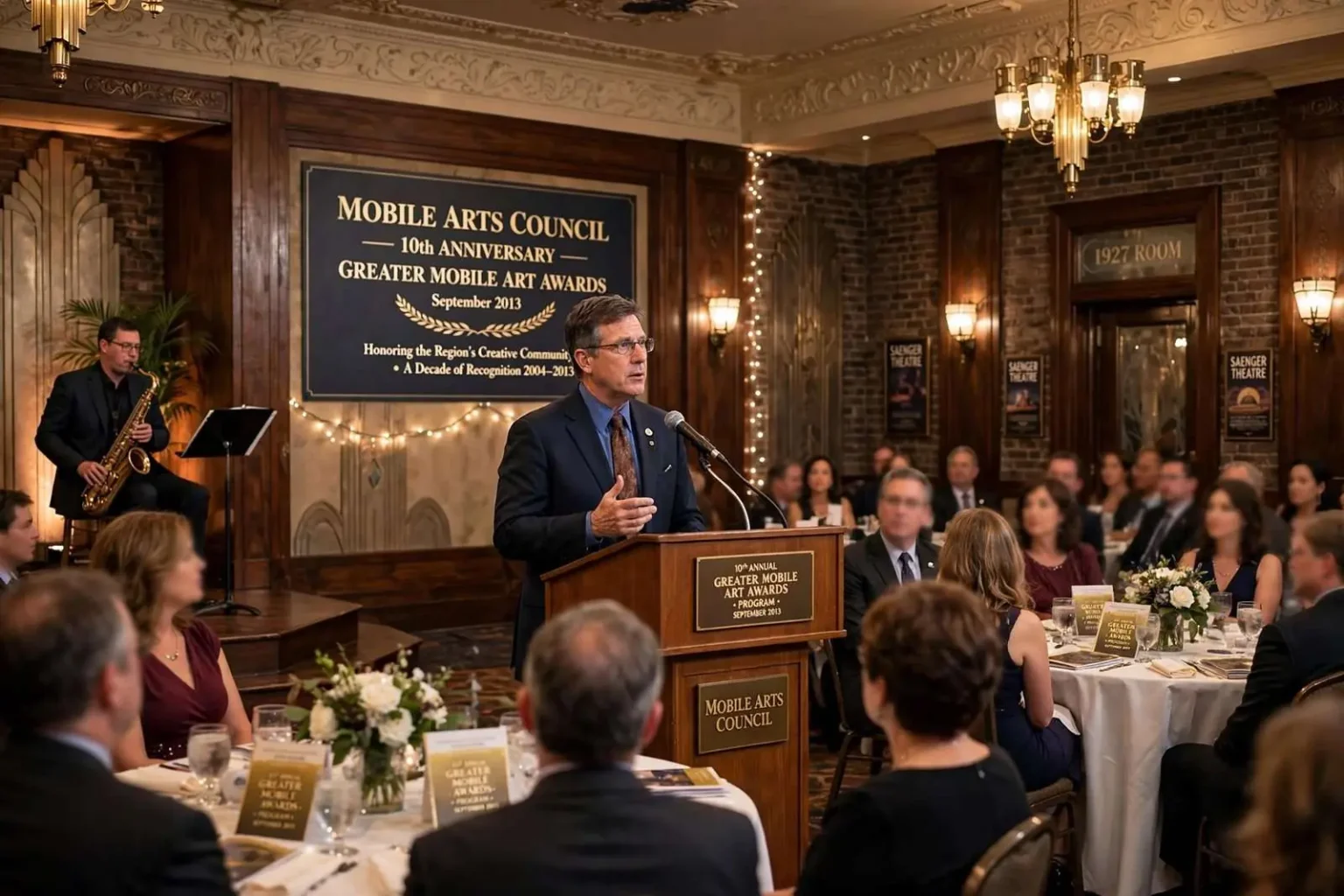
The Mobile Arts Council marked a milestone in September 2013, celebrating the tenth year of its Greater Mobile Art Awards with a ceremony honoring the artists, educators, organizations and volunteers who have shaped the region’s cultural life. For a decade, the awards have served as one of the primary ways Mobile’s creative community publicly recognizes the people working behind the scenes to keep local arts and culture thriving. To mark the anniversary, organizers made a few changes to the usual format. Rather than presenting the awards in Cathedral Square during the September LoDa Artwalk, as has been customary in years past, the ceremony moved indoors to the 1927 Room next to the Saenger Theatre on Joachim Street. Organizers also scheduled the event two weeks ahead of its normal date so that it would not compete with Artwalk responsibilities for the honorees and other cultural figures in attendance.
A Decade of Recognition
The shift appeared to pay off. Turnout was strong, and many guests dressed more formally than is typical for an Artwalk evening. A saxophonist playing softly from an elevated corner of the room added to the atmosphere, giving the celebration an unusually polished, big-city feel for a gathering built around recognizing hometown talent. Mobile Arts Council Executive Director Bob Burnett addressed the crowd from the podium, framing the evening as more than a formality. “These are the people that built our community and have made a huge difference in so many people’s lives,” Burnett told attendees, describing the awards as a small measure of thanks for individuals who have given part of themselves to enrich the community around them.
Mike McKee received the Artist Award for his work shaping the Mobile Theatre Guild into a company known for prioritizing quality over quantity, an approach reflected in the national recognition the guild has earned. McKee has also passed his passion for the stage on to students at Davidson and LeFlore high schools. The Business Award went to the Mobile Area Chamber of Commerce, recognized for its advocacy of arts funding and its role in connecting the creative sector with the broader business community. The Education Award honored Mary Elizabeth Kimbrough, a longtime art teacher in the Mobile County Public School System whose former students include working artists and arts administrators across the region.
Volunteer and Organizational Honors
The Volunteer Award recognized Joan Wortman, whose decades of service to the Mobile Museum of Art, the Mobile Symphony, and the Mobile International Festival exemplify the quiet dedication that sustains cultural institutions. The Organization Award went to the Centre for the Living Arts, now known as the Alabama Contemporary Art Center, for its transformation of a downtown warehouse into a venue for contemporary exhibitions and community programming. The Patrons Award honored Dr. and Mrs. William H. Cameron, whose philanthropic support has underwritten exhibitions, educational programs, and capital projects across multiple Mobile arts organizations.
The Lifetime Achievement Award, the evening’s highest honor, went to Dr. William “Bill” LeFleur, a retired University of South Alabama professor whose career spanned music education, arts administration, and advocacy. LeFleur founded the Mobile Youth Symphony, served as dean of the USA College of Arts and Sciences, and chaired the Alabama State Council on the Arts. In accepting the award, he emphasized the collective nature of cultural building. “No one person builds a cultural community,” he said. “It takes generations of people showing up, doing the work, and believing that what we do matters.”
The Mobile Arts Council’s Evolution
The Mobile Arts Council traces its roots to the 1950s, when a group of civic leaders organized the Mobile Arts Association to coordinate cultural programming in a city that was beginning to outgrow its small-town arts infrastructure. The organization evolved through several iterations — the Mobile Community Arts Council, the Allied Arts Council — before settling on its current name and structure in the 1980s. Its mission has consistently centered on advocacy, grant-making, and serving as a connective tissue for a creative sector that spans theater, visual arts, music, dance, literature, and folk traditions.
The Greater Mobile Art Awards were launched in 2004 as a way to make visible the labor that often goes unseen — the grant writing, the volunteer coordination, the late-night rehearsals, the curriculum development, the donor cultivation. The inaugural ceremony was a modest affair at the Mobile Museum of Art, but the awards quickly became a fixed point on the cultural calendar. Categories have been added and adjusted over the years to reflect the changing landscape: a Community Impact Award for arts programming in underserved neighborhoods, an Emerging Artist Award for early-career creators, and a Corporate Citizenship Award for businesses that integrate arts into their community investment strategies.
LoDa Artwalk and the Downtown Cultural District
The awards’ longtime association with LoDa Artwalk — the monthly gallery walk in the Lower Dauphin Street historic district — reflects the symbiotic relationship between the Arts Council and Mobile’s downtown revival. LoDa Artwalk began in 2006 as a grassroots effort by gallery owners and artists to draw foot traffic to a district that had struggled with vacancy and disinvestment. By 2013, it had grown into a monthly event drawing thousands, with pop-up galleries, street performers, food trucks, and open studios spanning dozens of blocks. The Arts Council served as fiscal sponsor and promotional partner, helping Artwalk secure city permits, sponsorships, and media coverage.
The decision to move the 10th anniversary ceremony off the Artwalk calendar was partly logistical — the 1927 Room offered a more controlled environment for a seated dinner and formal program — but also symbolic. It signaled that the awards had outgrown their origins as a sidebar to a street festival and had become a standalone institution. The 1927 Room itself, a restored event space adjacent to the Saenger Theatre, embodied the downtown renaissance: a historic building repurposed for contemporary cultural use, funded by the same public-private partnerships that had revitalized the theater district.
Arts Education and Community Impact
Beyond the awards ceremony, the Mobile Arts Council’s year-round work focuses heavily on arts education. The council administers the Artist-in-Residence program that places working artists in Mobile County Public Schools for multi-week engagements, funded through a combination of Alabama State Council on the Arts grants, local foundation support, and corporate sponsorships. In the 2012-13 school year, the program reached over 4,000 students across 15 schools, with residencies in ceramics, creative writing, African drumming, and musical theater. The council also coordinates the Poetry Out Loud competition for the region, sending winners to the state finals in Montgomery.
The council’s grant programs — funded through the Municipal Arts Grant program from the City of Mobile, the Alabama State Council on the Arts, and private donors — distributed approximately $180,000 in 2013 to individual artists and arts organizations. Recipients ranged from the Mobile Symphony Orchestra and Mobile Opera to small collectives like the Azalea City Center for the Arts and individual practitioners pursuing community-based projects. The grant review process involves peer panels of artists, educators, and cultural administrators, a structure designed to ensure that funding decisions reflect artistic merit and community relevance rather than institutional inertia.
Challenges and the Road Ahead
Despite the celebratory mood at the 10th anniversary, the Mobile Arts Council faced familiar challenges. Public funding for the arts in Alabama has historically ranked near the bottom nationally on a per-capita basis, and the Municipal Arts Grant program — while stable — had not kept pace with inflation. The council’s operating budget relied on a patchwork of city support, state grants, membership dues, and event revenue, leaving little margin for strategic initiatives or staff expansion. Burnout among the small professional staff was a recurring concern, as the council’s reach grew faster than its capacity.
The Affordable Care Act’s implementation in 2014 introduced new complexities for arts organizations navigating health insurance for employees, and the broader economic recovery from the 2008 recession remained uneven in the Gulf Coast region. Corporate sponsorships, a growing revenue stream, tended to favor high-visibility events like Artwalk over the less glamorous but essential work of arts education and artist services. The council’s leadership, including Burnett and the board of directors, was actively exploring earned-income strategies — consulting services for municipal arts planning, ticketing partnerships, and a proposed cultural facilities study — to diversify the revenue base.
Legacy of the First Decade
Looking back at the first ten years of the Greater Mobile Art Awards, the ceremony’s most enduring impact may be the network it made visible. Honorees from 2004 through 2013 read like a who’s who of Mobile’s creative infrastructure: teachers who built arts programs from nothing, volunteers who kept theaters running on shoestring budgets, business leaders who wrote checks when the budget fell short, artists who stayed in Mobile when larger markets beckoned. The awards did not create that network — it existed long before 2004 — but they named it, honored it, and gave it a night each year to see itself whole.
As the Mobile Arts Council entered its second decade of the awards, the organization was poised to leverage that visibility into deeper community investment. The 10th anniversary ceremony, with its formal venue and expanded honoree list, represented a step toward the kind of civic recognition that translates into sustained support. Whether that translated into larger budgets, broader audiences, and more resilient institutions remained the work of the years ahead — work that, as Dr. LeFleur reminded the room, belongs to generations of people showing up, doing the work, and believing that what they do matters.