Mobile Author Jeannie Holmes Brings Vampire Cops to the Deep South in New Novel ‘Blood Law’
Mobile novelist Jeannie Holmes releases 'Blood Law,' a Southern vampire crime novel, and schedules signings at Bienville Books, Barnes & Noble and Page &.
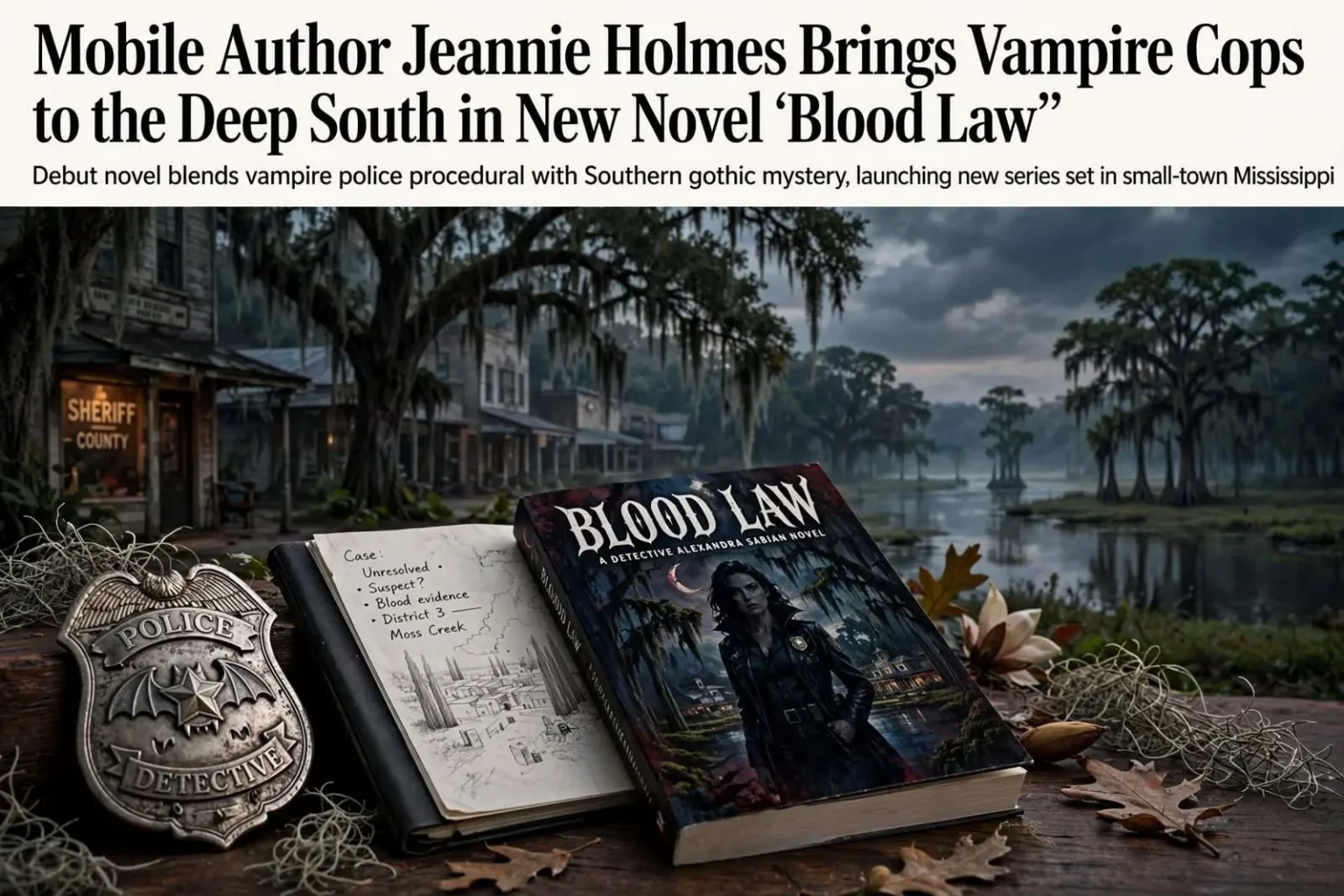
Mobile author Jeannie Holmes released her debut novel, “Blood Law,” on July 6, blending two of her longtime interests — vampires and law enforcement — into a crime story set in small-town Mississippi, and launching what she intends as a series built around a single detective.
The book follows vampire police officers investigating a killer, part of a growing genre of Southern supernatural fiction that pairs gothic atmosphere with procedural crime plotting. Rather than treating the undead as pure horror, the novel puts vampire characters inside the machinery of a police investigation, giving readers both a mystery to solve and a fully realized supernatural world to move through.
Holmes said the region’s visible history, distinctive landscapes and lingering sense of the past give Southern vampire fiction a texture that’s hard to find elsewhere. The moss-draped setting, the old family secrets and the long memories of small towns, in her view, do narrative work that a generic urban backdrop cannot, which is why she grounded the book in the Deep South rather than one of the genre’s more familiar big-city settings.
From the medical field to fiction
Holmes, a native of southwestern Mississippi, spent years working in the medical field before returning to school to complete degrees in English and creative writing at the University of South Alabama. The pivot from clinical work to fiction writing is an unusual path, but one that shaped how she approaches her material — an eye for detail, comfort with the physical realities of injury and death, and an understanding of how institutions respond when things go wrong.
She has said elements of the crimes in “Blood Law” were shaped by an unresolved murder case from the region where she grew up, giving the novel’s fictional investigation a grounding in real local history. That connection between a real community’s lingering wound and a fictional detective’s caseload is part of what gives the book its sense of place, and it reflects a broader tradition in Southern crime writing of fiction that carries the weight of actual events.
The move to Mobile for her studies put her in the middle of one of the Gulf Coast’s most literate cities, home to a long line of Southern writers and to an independent bookstore scene that would later host her first appearances as a published novelist.
Meet Detective Alexandra Sabian
“Blood Law” introduces Holmes’ recurring character, Detective Alexandra Sabian, and marks the start of a planned series. Building a series around a single investigator is a deliberate strategy in crime fiction, where readers frequently attach to a detective over multiple books and follow the character’s development case by case. Sabian’s identity as a vampire police officer places her in an unusual position within her own department — a member of the community she polices, with all the friction that implies.
Holmes had already completed a second Sabian novel by the time “Blood Law” reached shelves, a head start that signals the series was conceived as an ongoing project rather than a one-book experiment. Working ahead of publication gives a new author momentum and lets a publisher maintain a steady release rhythm, something that matters in a genre where readers expect their favorite detectives back within a year or two.
She said she was also developing a separate urban-fantasy trilogy set in Denver, a project that moves her writing from the humid small towns of Mississippi to the Rocky Mountain West. Maintaining two distinct fictional worlds at once is an ambitious workload for a debut author, but it reflects the breadth of the urban-fantasy market, where series spanning multiple settings and casts can run for a dozen volumes or more.
The genre itself has grown steadily on the strength of readers who follow series character by character, and publishers have learned that a strong debut with a recurring lead is one of the most dependable long-term investments in category fiction. A detective like Sabian — part insider, part outsider in her own department — gives the series its engine: each new case can test her loyalties from a different direction, and the fictional Mississippi community around her can grow more layered with every book, the way the settings of successful Southern series so often do.
The rise of Southern supernatural fiction
“Blood Law” arrives at a moment when Southern gothic tradition and paranormal romance have been merging into one of publishing’s most reliable subgenres. The South has always supplied American fiction with its most atmospheric settings — decaying mansions, fever-ridden port towns, communities where history is felt as a physical presence — and supernatural writers have learned to use that atmosphere as more than decoration.
The combination of vampires and police procedure adds a structural element those settings historically lacked. A procedural plot imposes discipline on a supernatural story: there is a crime, evidence, witnesses and a deadline, and the fantastic elements must operate within the rules of an investigation. For readers, that means the appeal is not only the world-building but the puzzle, the same satisfaction that drives mainstream crime fiction.
Small-town Mississippi fits that formula well. In a small community, a detective cannot be anonymous, every suspect has a history with every other suspect, and old crimes cast long shadows — conditions that both complicate an investigation and deepen a story. It is a setting choice that distinguishes Holmes’ work from the urban vampire novels that dominated the genre’s earlier waves.
Local signings around Mobile Bay
Holmes scheduled a run of signings around the Mobile area to mark the release, including stops at Bienville Books downtown, the Barnes & Noble at Eastern Shore Centre, and Page & Palette in Fairhope. The three venues form a natural circuit for a Mobile-area author: an independent bookstore in the heart of downtown, a national chain on the Eastern Shore, and one of the Eastern Shore’s best-known independents in Fairhope, a town with its own deep literary identity.
For a debut novelist, the home-region tour serves double duty. It reconnects the author with the community that produced her — including, in Holmes’ case, the university where she trained as a writer — and it builds the local base of readers whose word of mouth can carry a first novel beyond the region. Genre fiction in particular tends to grow through dedicated reader communities, and signings give an author direct contact with the people most likely to hand the book to friends.
The signing stops also mark the author’s formal introduction to the region’s readers as a novelist rather than a student. Authors who trained locally and debut locally tend to keep those early relationships — bookstore owners, writing instructors, fellow writers — and the tour schedule reflects how closely knit the Gulf Coast book community remains, with venues on both sides of Mobile Bay participating in a single release.
The events give local readers a chance to meet a hometown author whose work is rooted in the region’s storytelling traditions even as it reaches for a national genre audience. Whether the Sabian series finds that national readership will depend on how “Blood Law” performs in its first months on shelves, but the groundwork — a completed second book, a third project in development and a supportive home market — was already in place the day the novel went on sale.
What the debut means for the local literary scene
A debut novel also tends to ripple through the network of people who helped produce it. Writing programs measure themselves partly by published graduates, bookstores build events calendars around hometown authors, and readers who attend a first signing frequently return for the second book, forming the early audience on which a series stands or falls. For the Mobile area, “Blood Law” adds a genre title to a scene more often associated with literary and historical fiction, and it demonstrates that supernatural crime can be written authentically from the Gulf Coast rather than imported from larger markets.
Mobile has long claimed a place in Southern letters, and each new author who emerges from the area adds to a catalog that runs from antebellum memoirists to contemporary crime and genre writers. A debut that puts a Mobile-trained writer on national bookstore shelves, with a character who may anchor a series for years, is the kind of story the local literary community tracks closely.
It also illustrates the practical role institutions like the University of South Alabama’s writing programs play in the region’s cultural economy. A student who arrives from a Mississippi hometown with a medical career behind her and leaves with English and creative writing degrees, then publishes within a few years, is a pipeline the university and the city’s bookstores both benefit from showcasing.
For readers along the Gulf Coast, the signing circuit this summer offers a first look at a character likely to return. And for Holmes, the release of “Blood Law” closes one long stretch of work — the years of study, drafting and revision that produced the novel — and opens another, in which the reception of Detective Alexandra Sabian’s first case will determine how many more cases follow.