Mobile Baykeeper Accuses Daphne Utilities of Dumping Millions of Gallons of Sewage Into Mobile Bay
Mobile Baykeeper claims Daphne Utilities released 3 million gallons of untreated sewage daily into Mobile Bay; the utility denies any danger.
The environmental group Mobile Baykeeper has leveled new accusations against Daphne Utilities, claiming the utility released millions of gallons of untreated sewage toward the Blakeley River and Mobile Bay — allegations the utility flatly disputes.
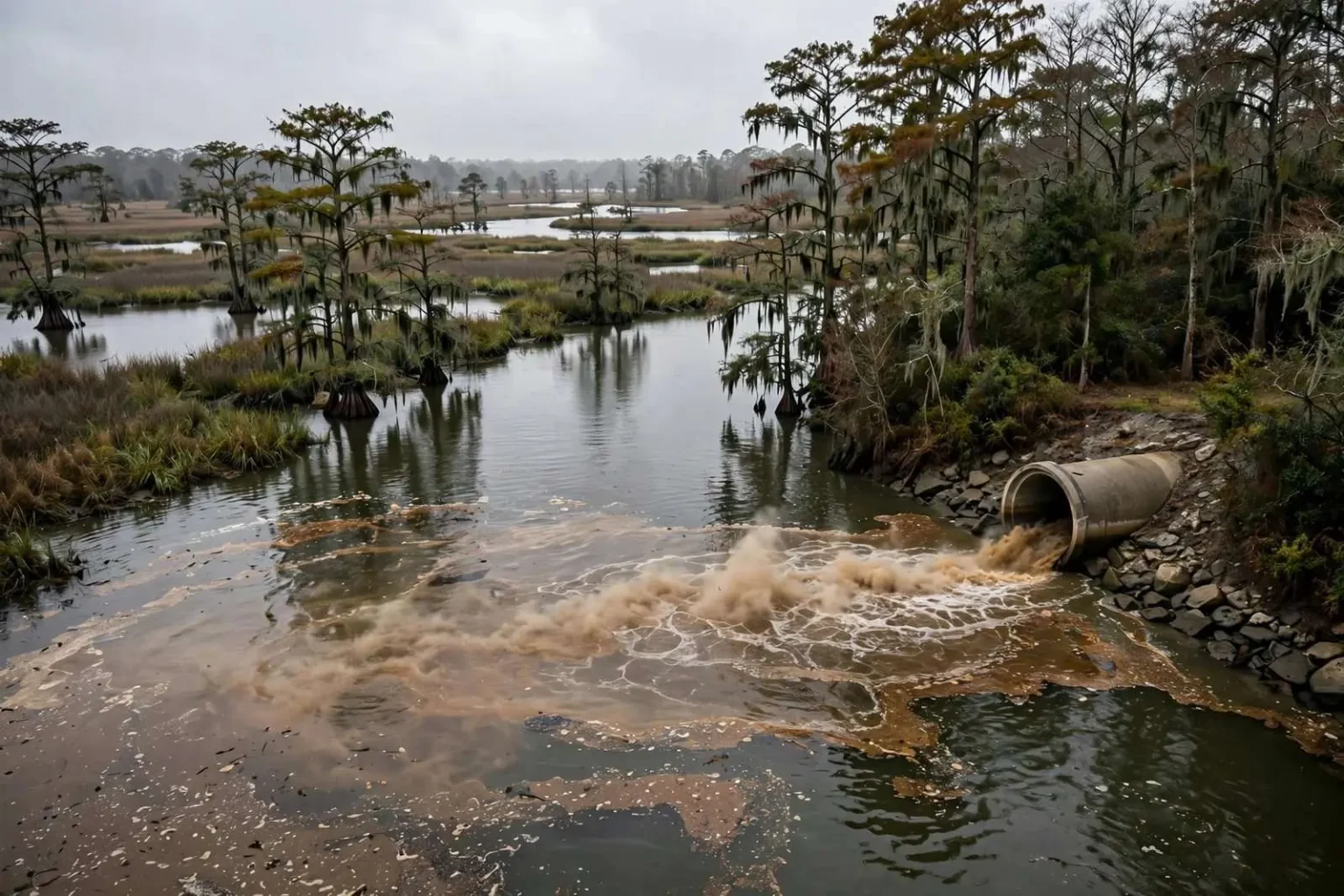
According to Mobile Baykeeper, three million gallons of untreated sewage per day flowed into the Blakeley River and Mobile Bay during January. The group says photographs show brown sludge discharging from Daphne Utilities’ waste management plant and claims bacteria levels in the water ran 4,000 percent above the legal limit.
“This problem isn’t going to be solved by glossing over,” said Cade Kistler with Mobile Baykeeper. “We’re gonna need to get to the root of the issue, and we’re gonna have to make some major changes so we can feel safe to swim and play downstream of there in Mobile Bay.”
Utility Says It Is Back in Compliance
Daphne Utilities representative Jon Gray says changes are already underway and that the utility was back in compliance with regulations by February. He denied that treated water shown in the group’s photos is dangerous, accusing Mobile Baykeeper of exaggerating what is actually in the water.
“While we’re doing some of that maintenance we may see spikes in our test results to the outfall line, but that doesn’t mean we’re putting raw sewage in Mobile Bay,” Gray said.
Ongoing Lawsuit and Possible Rate Impact
The dispute is the latest round in a conflict dating back over a year. Daphne Utilities is already a defendant in a lawsuit brought by ADEM and Mobile Baykeeper alleging failure to report — and under-reporting of — sewage spills. Depositions from former utility employees who first alerted Mobile Baykeeper were set to begin Thursday.
Customers may eventually feel the cost: asked whether upgrades could trigger a rate increase, board members said they were still looking into it.
The confrontation between the state’s largest clean-water advocacy organization and one of the Eastern Shore’s essential utilities has unfolded along a fault line familiar to every fast-growing coastal community: what happens when the infrastructure that treats a city’s sewage meets the growth that outpaces it. Daphne, one of the fastest-growing cities on the Eastern Shore of Mobile Bay, has spent two decades adding subdivisions, schools, and commercial development on the bluffs above the bay’s tributaries. Every new bathroom, dishwasher, and washing machine connects to the same system whose performance Mobile Baykeeper now disputes — a system of collection lines, lift stations, and a treatment plant whose capacity and condition determine whether what reaches the bay is clean water or something else.
The Blakeley River, the waterway at the center of the dispute, is one of the Mobile-Tensaw Delta’s distributaries — a channel through the great cypress and marsh labyrinth that the Mobile and Alabama rivers carve on their way to the bay. The delta is among the most ecologically significant landscapes on the Gulf Coast: second only to the Mississippi River delta in size in the continental United States, it supports commercial fisheries, recreational fishing and boating of enormous regional value, and the nursery habitats on which the Gulf’s marine life depends. Water quality in the Blakeley is therefore not a parochial concern of riverside property owners but a variable in the health of the entire Mobile Bay estuary — the argument that underlies Mobile Baykeeper’s insistence that the dispute is about the bay everyone shares, not merely a pipe on the city’s edge.
The numbers in dispute illustrate the scale of what is alleged. Three million gallons a day — if that is what flowed toward the river in January — is not a pipe-break overflow but a systemic failure, the output of an entire community’s sewage passing through a plant that is failing to treat it. Sewage treatment is measured in stages: solids settle out, bacteria consume the organic load, and disinfection kills the pathogens before discharge. A plant operating outside its permitted parameters can fail any of those stages, and the discharge that results carries the bacteria, nutrients, and solids that made Mobile Baykeeper’s claims of 4,000-percent bacteria exceedances — if accurate — a public-health statement as much as an environmental one.
The utility’s response — that the photos show treated water, that maintenance produces test spikes, that compliance was restored by February — presents the other half of the dispute’s dynamic. Utilities operating aging systems face a genuine dilemma: the maintenance that keeps a plant functional requires taking treatment steps offline, rerouting flows, and working on the outfall lines, each of which can produce temporary exceedances that a monitoring program records. Jon Gray’s characterization — that spikes during maintenance don’t equal raw sewage in the bay — is the standard defense of a system working through deferred work. Whether it accounts for what Mobile Baykeeper documented is the question the monitoring data, and eventually the courts, will answer.
The under-reporting allegations at the case’s core cut deeper than any single overflow. Alabama’s environmental regulatory framework — administered by ADEM, the Alabama Department of Environmental Management — requires utilities to report sewage spills and treatment failures within defined windows, on the theory that the public and downstream users have a right to know when waters are contaminated. A utility that under-reports failures doesn’t merely violate paperwork requirements: it deprives the public of the warnings that let swimmers, anglers, and oystermen avoid contaminated water, and it conceals from regulators the pattern of failures that justifies enforcement. The lawsuit’s focus on reporting failures is why former employees’ depositions matter — the people who worked inside the utility are the witnesses to what was recorded, what was omitted, and what was known.
Mobile Baykeeper’s role in the dispute follows two decades of the organization’s clean-water advocacy on the bay. Founded in the late 1990s, the group has made sewage enforcement one of its signature issues, documenting overflows across the region’s utilities and pushing — through lawsuits, public records requests, and citizen monitoring programs — for the infrastructure investment that keeps sewage out of the bay’s waters. Its Baykeeper patrol program, water-quality monitoring, and Swim Where It’s Monsoon-safe campaign have made the organization the public’s reference point for questions about where swimming and fishing are safe. In a dispute like Daphne’s, the organization plays the role that federal and state enforcement have historically underweighted: the private litigant with the standing and the will to force the issue into court.
The financial dimension the board’s rate-inquiry comment raised is where the dispute meets every utility customer’s household. Sewage system upgrades — treatment plant expansions, collection-line replacement, lift-station rebuilds — run to millions of dollars in a growing city, and the money comes from ratepayers. The question the Daphne board faced is the one utility boards across the Gulf Coast confront when enforcement and aging infrastructure intersect: whether to fund the fixes through rates, bonds, or the penalties and settlement terms that litigation imposes. Customers of utilities that have faced similar suits — Mobile’s system among them — have seen the pattern: the cost of deferred maintenance is eventually paid in rate increases that are larger and more abrupt than the steady investment that would have prevented the failure.
The deposition schedule that set former employees’ testimony for Thursday marked the phase of the litigation where the parties’ accounts meet the people who operated the system. Deposition testimony in a case like this establishes the record on which any settlement, consent decree, or trial will rest: what the plant’s operators saw, what its records showed, what was reported to ADEM, and what the utility’s management knew. Environmental cases of this kind frequently end in consent decrees — judicially supervised agreements that mandate specific upgrades on specific timelines, with monitoring and penalties for future violations — and the strength of the factual record is what determines whether the terms are meaningful. Mobile Baykeeper’s statement that the problem requires “major changes” describes the scale of remedy the organization will be negotiating for; the utility’s assertion that compliance has been restored describes the baseline from which it will argue.
For the people who swim, fish, and boat in the bay’s Eastern Shore waters, the dispute’s stakes are expressed in the direct terms Kistler used: feeling safe to swim and play downstream. Water quality advisories, beach monitoring, and the informal knowledge that local anglers carry about when the water looks wrong are the everyday instruments through which sewage disputes touch the public. The resolution that the lawsuit, the regulators, and the utility reach will determine what flows toward the Blakeley for years — and whether the Eastern Shore’s growth continues on infrastructure that can carry it, or on a system whose failures the bay keeps absorbing.
Sewage overflows have a documented history across the Mobile Bay region that gives the Daphne dispute its wider context. Older collection systems across the Gulf Coast — Mobile’s included — experience hundreds of overflows a year during heavy rains, when stormwater infiltrates aging pipes and overwhelms capacity, and public databases maintained under state permit requirements log each event’s location, volume, and duration. Environmental groups have used those records to build the enforcement cases that utilities’ own reporting made possible, a dynamic that explains why reporting failures are treated as seriously as the spills themselves. The pattern has produced consent decrees, rate-funded capital programs, and gradual system replacement across the region — the slow, expensive work of bringing a century of infrastructure up to the standard a growing coast requires.
The treatment plant’s January performance, whatever the monitoring data ultimately shows, occurred during a season that stresses sewage systems hardest. Winter rains raise groundwater and flood collection lines; cold temperatures slow the bacterial processes that treatment depends on; and holiday-period load spikes tax plants designed around average flows. Utilities that maintain their systems plan for these stresses; utilities running deferred maintenance discover their margins in exactly these weeks. The seasonality of the alleged failures — documented in the year’s first month — will be among the technical questions the litigation examines, since the timing distinguishes a system operating beyond its capacity from one operating beyond its condition.
What the Daphne case will ultimately produce depends on the path the parties take from the deposition table. A settlement that funds the plant and collection-line upgrades on an enforceable schedule would resolve the enforcement questions and set the utility’s capital program for a generation, at a rate cost the board has already begun studying. A trial, by contrast, risks penalties, court-ordered remedies, and a public record of the utility’s internal operations that neither side fully controls. Utilities facing similar suits across the Southeast have generally settled — the arithmetic of litigation favors investment over penalties — and the board’s public acknowledgment that rate increases are on the table suggests the outcome, whatever its form, will be paid for in Daphne’s water bills before it is paid for anywhere else.