Coastal Alabama’s Beach Water Testing Returns Sept. 11 After a Five-Month Funding Gap
Mobile Baykeeper's SWIM program, paused in April when funding ran out, restarts Sept. 11 as the CrowderGulf SWIM program. Volunteers will sample beaches and swimming holes across Mobile and Baldwin counties, with results posted every Friday through September.
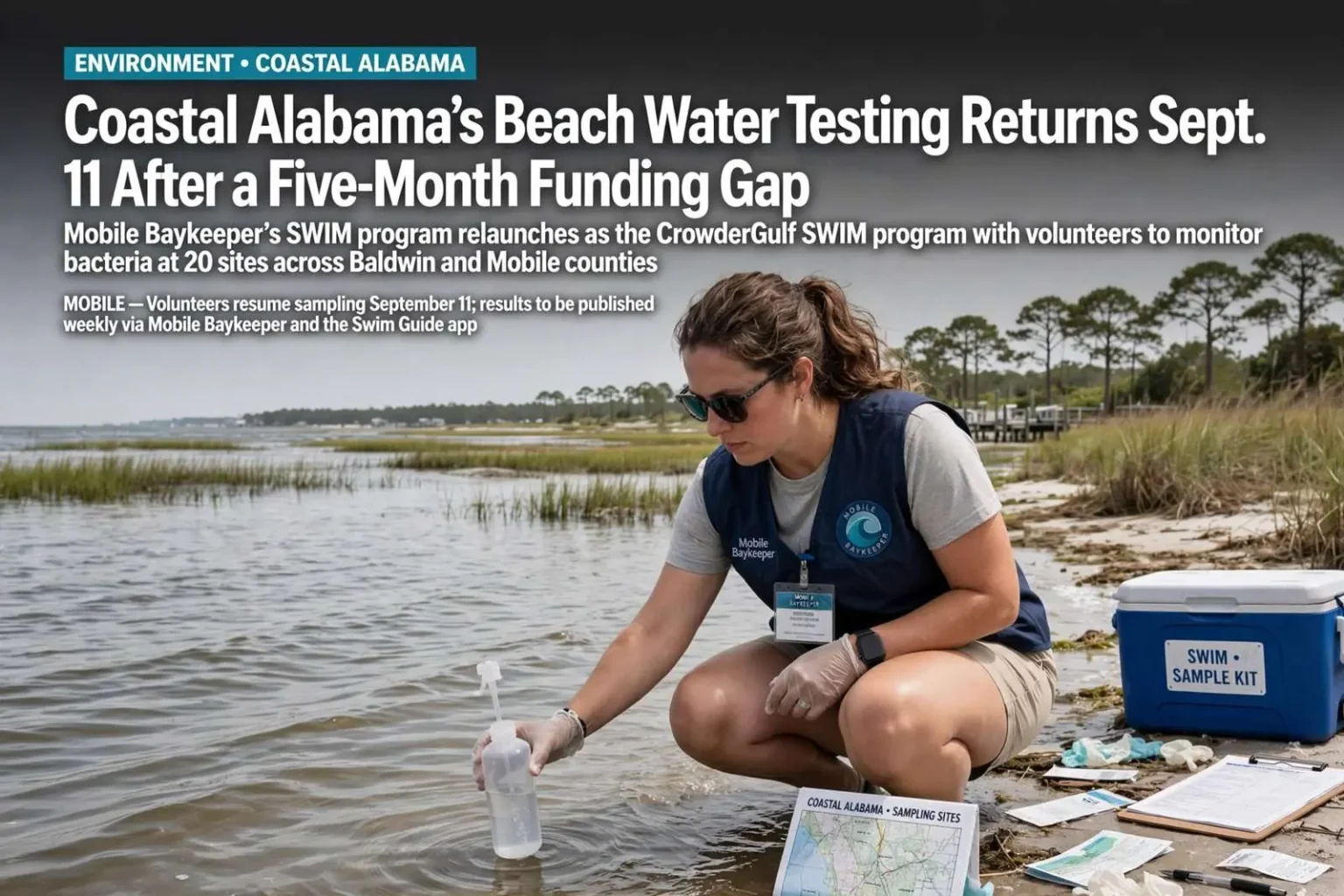
MOBILE — For five months this year, anyone on the Alabama coast who wanted to know whether the water at their favorite swimming spot was safe had to guess.
That ends Sept. 11. Mobile Baykeeper announced Friday that its Swim Where It’s Monitored program — SWIM, the bacteria-testing operation that has sampled coastal Alabama swimming areas since 2017 — is coming back, rebuilt around a new set of funders and a larger role for volunteers. It returns under a new name: the CrowderGulf SWIM program.
What Changed, and Why It Stopped
SWIM began in 2017 and grew into a network of 20 bacteria-testing sites at swimming locations on Mobile Bay and the Gulf Coast, spread across Baldwin and Mobile counties. In April, Mobile Baykeeper paused the program because of a funding shortfall.
The organization says the reaction from the public is a substantial part of why it is back.
“When SWIM paused, our community let us know just how much they relied on it,” Mobile Baykeeper Executive Director William Strickland said. “Families use SWIM to decide where to swim, and they know its absence changed the way they lived. Several businesses stepped up to fill the gap in funding, and we are now able to employ people to run the program.”
“Volunteers stepped up to make the program more affordable and community-centered,” Strickland added. “The community has chosen to help their neighbors across Coastal Alabama have access to reliable water-quality information while we can continue the work of defending and reviving our waters and our way of life.”
The relaunch was made possible by investments from CrowderGulf Disaster Recovery and Debris Management, Michael and Debbie Quinn, Bay Break Fairhope, Gulf Surgical Dermatology and Fly Creek Marina.
“For decades, CrowderGulf has been proud to call Alabama’s coast home,” CrowderGulf Senior Vice President Reid Loper said. “We’ve seen firsthand how these waters sustain local communities, support livelihoods, and shape the way of life we all share. Supporting SWIM’s return is one small way we can give back, help protect these vital waters, and empower people with the knowledge they need to make informed decisions.”
How It Will Work
Beginning Sept. 11, trained community volunteers will collect water samples from public swimming and recreational areas across coastal Alabama. Those samples go to Mobile Baykeeper’s own laboratory for analysis.
The tests look for indicator bacteria — organisms whose presence signals that sewage or other fecal contamination has reached the water — and results are compared against the U.S. Environmental Protection Agency’s standards for recreational water quality.
Through the remainder of swim season, results will be published every Friday in September. After that, the program shifts to monthly testing for the rest of the year.
Results will appear on Mobile Baykeeper’s website and in the Swim Guide app, and will be emailed to subscribers.
The program is restarting at what Mobile Baykeeper describes as its “highest priority” sites, with plans to expand if more funding arrives. The organization said the newly planned testing sites would be announced on its website Sept. 8.
What Indicator Bacteria Actually Tell You
Water-quality testing of this kind does not look for every pathogen that could make a swimmer sick. That would be impractical and expensive. Instead, it measures a proxy.
Indicator bacteria — typically Enterococcus in salt and brackish water, and E. coli in fresh water — live in the digestive tracts of warm-blooded animals, including humans. They are not usually the organisms that cause illness. What they signal is that fecal material has entered the water, and where fecal material goes, so do the viruses, bacteria and protozoa that can cause gastrointestinal illness, skin infections, and ear and eye infections.
The EPA publishes recreational water quality criteria that set thresholds for these indicators, and state and local health agencies use them to issue swimming advisories. A single elevated sample is not automatically a crisis; sustained or repeated exceedances at a site are what tend to point to a persistent source.
This matters on the Alabama coast for reasons of both geography and weather. Mobile Bay is fed by one of the largest river deltas in the country, and the watershed above it drains a very large area. Heavy rain moves stormwater — and everything it picks up along the way — into creeks, bayous and eventually the bay in a matter of hours. Aging sewer infrastructure can overflow during those same rain events. Failing or undersized septic systems in unsewered areas contribute steadily rather than in pulses. Wildlife and pet waste add to the baseline.
That combination is why bacteria levels at a coastal swimming site can look entirely different on a Tuesday than they did on the preceding Saturday, and why a testing program that reports on a predictable weekly schedule is more useful to a family than an occasional snapshot.
Why a Volunteer Model
The rebuilt program leans harder on volunteers than the original did, and Strickland framed that as a feature rather than a compromise.
Sample collection is the part of the process that scales poorly with paid staff. Bacteria samples have a short holding time between collection and analysis — they need to reach a laboratory quickly to produce a valid result — which means a testing network covering two counties needs people near each site at roughly the same time on the same morning. A small paid staff driving between 20 sites cannot do that. Trained volunteers who live near the sites they sample can.
The laboratory work stays in professional hands. Volunteers collect; Baykeeper’s lab analyzes. That division keeps the data credible while making the geography possible.
The Organization Says It Still Needs Help
Strickland was direct that the relaunch does not close the gap.
“There is still a need for our community to help,” he said. “We need more sponsors and volunteers to be able to add more sites and track down more sources of bacteria problem areas. If you want to join with your community in helping your neighbor, you can email us at [email protected].”
The phrase “track down more sources” points to the second half of what a monitoring program does. Testing tells swimmers where not to swim on a given weekend. Source tracking — sampling upstream, working a watershed section by section until the origin of a recurring problem is identified — is what eventually gets a problem fixed. That work requires more sites, more samples and more people, which is what additional funding would buy.
What Beachgoers Should Do With the Results
A few practical notes for anyone planning to use the data once it starts flowing again:
- Check after rain. Bacteria levels commonly spike in the 24 to 48 hours following a significant rainfall as stormwater reaches the water body. A site that tests clean on a dry Friday may not be clean on a wet Sunday.
- Understand what a result covers. A sample describes one location at one moment. Conditions a few hundred yards away, or a day later, can differ.
- Avoid swallowing water and keep open wounds out. Most recreational water illness comes from ingestion; skin and soft-tissue infections generally require a break in the skin.
- Watch for official advisories separately. County health departments issue their own swimming advisories, which are a distinct process from a nonprofit monitoring program. Both are worth checking.
Where to Find the Data
Results will be posted on Mobile Baykeeper’s website and to the Swim Guide app, and distributed by email to subscribers. The list of testing sites for the relaunched program was scheduled for release on the organization’s website Sept. 8, with sampling to begin Sept. 11. Anyone interested in volunteering or sponsoring additional sites can reach the organization at [email protected].
What Sewage Contamination Actually Comes From
The word “sewage” suggests a single failure at a treatment plant. In practice, bacteria reaching coastal water in a place like Mobile Bay arrive by several routes at once, and understanding which is which is the difference between a testing program and a fix.
Sanitary sewer overflows. Collection systems are sized for a design flow. When rainwater enters them — through cracked pipes, faulty manhole covers, or illegal connections of gutters and drains — volumes can exceed what the pipes and pump stations can carry, and the system relieves itself at the lowest available point. This is why overflow reports cluster after heavy rain rather than being distributed evenly through the year. Aging clay and concrete pipe, common in older systems throughout the region, is particularly prone to this kind of infiltration.
Septic systems. Large portions of Baldwin and Mobile counties are unsewered, and rely on individual on-site systems. A properly sited, properly maintained septic system in suitable soil works well. A system installed in the wrong soil, sited too close to the water table, undersized for the household, or simply old enough that the drain field has failed does not treat what passes through it. Coastal soils and high water tables make this a persistent regional issue, and unlike an overflow event, a failing septic system contributes continuously without generating a report.
Stormwater runoff. Rain moving across developed land picks up pet waste, wildlife waste, and everything else on the ground and delivers it to the nearest water body through storm drains that, unlike sanitary sewers, receive no treatment. This is the diffuse, hardest-to-fix category, and it grows with impervious surface.
Vessels. Discharge from boats in marinas and anchorages is a smaller contributor but a locally concentrated one.
A monitoring program that samples repeatedly at fixed sites is what allows these to be told apart. A site that spikes only after rain points at stormwater or an overflow. A site that reads elevated in dry weather points at something continuous — a failing septic system, a cracked line, an illicit connection. That is what Strickland meant by tracking down sources.
What a Swim Advisory Does and Does Not Mean
Readers should understand the relationship between a nonprofit monitoring program and the official advisory system, because they are separate and they answer to different authorities.
County health departments in Alabama issue swimming advisories based on their own sampling. An advisory is an official public health communication; it is not a closure, and beaches generally remain open with signage posted. Advisories are lifted when follow-up sampling returns results below the threshold.
A nonprofit program like SWIM operates alongside that system rather than within it. Its value is coverage and frequency — more sites, sampled on a predictable schedule, with results published directly to the public rather than filtered through an advisory decision. A reading that is elevated but below an advisory threshold still tells a family something useful, and that is information the official system does not routinely publish.
The two together give a fuller picture than either alone. Residents planning a weekend on the water are best served checking both.
Volunteering
Mobile Baykeeper has said explicitly that it needs more volunteers and more sponsors to expand beyond the priority sites where the program is restarting. Volunteer sampling generally requires a short training session, a commitment to a specific site on a specific morning, and reliable transportation to get samples to the lab within the required holding time. Anyone interested can reach the organization at [email protected].
Update: What the State Tests, and What the Map Shows Right Now
Mobile Baykeeper’s volunteer sampling is not the only bacteria testing happening on the Alabama coast, and the two programs are worth understanding side by side.
ADEM’s Coastal Beach Monitoring Program
The Alabama Department of Environmental Management, working with the Alabama Department of Public Health, has run its own coastal water quality monitoring since June 1999. The state program routinely samples bacteria levels at 25 high-use or potentially high-risk public recreational sites stretching from Perdido Bay to Dauphin Island.
ADEM and ADPH use a three-tier, color-coded advisory system — green, yellow and red — to tell the public when bacteria levels exceed the Environmental Protection Agency’s safe-swimming threshold of 104 colonies per 100 milliliters of water.
The two efforts are complementary rather than redundant. The state program covers a defined set of public beaches on a fixed schedule; the SWIM network samples 20 high-priority sites chosen by the organization, including bay and creek locations that fall outside the state’s public-beach list. Volunteers test for Enterococcus and E. coli, both of which serve as fecal indicator bacteria — signals that sewage contamination and the pathogens that travel with it may be present.
Current Conditions: Two Sites Reading High
As the relaunch approaches, conditions at some popular spots are not encouraging. Mobile Baykeeper’s map currently shows elevated bacteria levels at the public piers in Fairhope and at Gulf State Park.
Swimmers and families are urged to check current readings before entering the water. Both the Mobile Baykeeper Swim Guide and ADEM’s Coastal Beach Monitoring portal publish interactive maps and active advisories.
Who Is Paying for the Relaunch
The program returns as the CrowderGulf SWIM program, funded through investments from local businesses and individuals: CrowderGulf Disaster Recovery and Debris Management, Michael and Debbie Quinn, Bay Break Fairhope, Gulf Surgical Dermatology, and Fly Creek Marina.
Beginning Sept. 11, trained community volunteers resume collecting samples from public swimming and recreational spots across coastal Alabama. Samples are processed in Mobile Baykeeper’s own laboratory. Results will be published every Friday through September, then monthly for the remainder of the year.