Mobile Baykeeper’s ‘The Big Float’ Paddles Fly Creek for Clean Water
Mobile Baykeeper hosted The Big Float kayak trip down Fly Creek in Fairhope, with rentals benefiting clean water, clean air and healthy coastal communities.
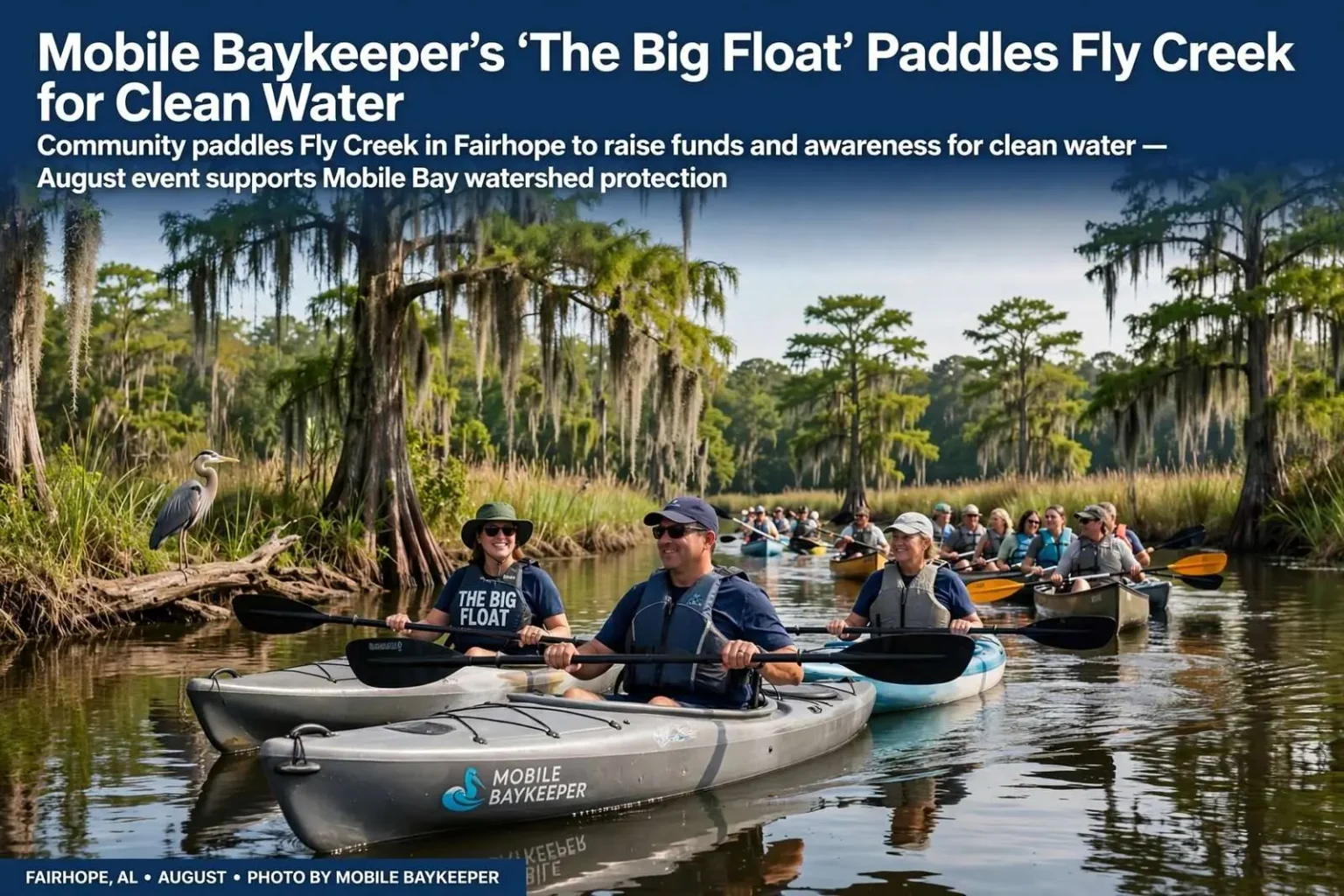
Looking to beat the August heat while supporting a good cause? Mobile Baykeeper invited the public out on the water for “THE BIG FLOAT,” a kayak trip down Fly Creek in Fairhope. The paddle ran from 10 a.m. until noon, followed by an after party at Sunset Pointe at Fly Creek Marina from noon to 3 p.m., where SweetWater Brewing Company offered drink specials — a summer morning built around the organization’s central argument that the best way to care for Mobile Bay’s waters is to spend time on them.
Fly Creek winds through some of the Eastern Shore’s most scenic wetlands before opening into Mobile Bay at the Fairhope marina district, and a float down its length delivers the Baykeeper message more vividly than any brochure. Paddlers drifting past marsh grass, cypress and the herons and turtles that live along the creek’s banks see exactly what the organization works to protect: the network of streams and wetlands that feeds the bay, filters its water and shelters its wildlife. Events like this translate that scenery into membership, volunteers and donations, which is why the group has made on-the-water gatherings a recurring part of its calendar.
How it helps
Boat rentals were available on a first-come, first-served basis, and proceeds from boats rented through Fairhope Boat Company benefit Mobile Baykeeper’s work for clean water, clean air and healthy communities. Paddlers who own their own canoes or kayaks were encouraged to bring them along, which meant the day welcomed everyone from experienced kayakers with their own gear to first-timers renting on a whim. The first-come arrangement kept the event simple — no registration tiers, no sign-up deadline — and the rental proceeds turned every borrowed boat into a contribution.
The after party at Sunset Pointe gave the morning a social finish. The restaurant at Fly Creek Marina overlooks the water where the float ends, and from noon to 3 p.m. paddlers, volunteers and curious passersby filled the deck with SweetWater Brewing Company specials in hand. Sunset Pointe has been a natural partner for waterfront events in Fairhope, and the party format lets an organization like Baykeeper thank its participants in a setting that reinforces the point of the whole day: this water is worth gathering around.
Mobile Baykeeper’s mission is to give citizens the means to protect the beauty, health and heritage of the Mobile Bay Watershed and coastal communities. With more than 4,500 members, the group advocates for environmental protection and restoration, arguing that a healthy environment is key to a thriving economy and quality of life along the Gulf Coast.
Why Fly Creek matters
Fly Creek is a working example of the watershed the organization defends. Creeks like it are the capillaries of Mobile Bay’s circulatory system — collecting rain from the land, carrying it through wetlands that trap sediment and absorb pollutants, and delivering it to the bay that gives the region its seafood, its shoreline and much of its identity. When development hardens the land around a creek with pavement and rooftops, stormwater rushes in faster and dirtier, and the creek’s health declines in ways that eventually reach the bay itself. Protecting the riparian corridors around creeks like Fly Creek is therefore not just an aesthetic cause but a practical one for anyone who fishes, swims, or earns a living from the water.
Baldwin County’s explosive growth has made that work urgent on the Eastern Shore. Fairhope sits in one of Alabama’s fastest-growing communities, and every new subdivision and shopping center in the county’s watersheds changes how water moves toward the bay. Organizations like Mobile Baykeeper monitor water quality, review permits and push for smarter stormwater management precisely because the growth is happening now, creek by creek.
Development Director Justine Herlihy discussed the event during a recent segment of the local program “Mark Your Calendar,” walking viewers through the float’s schedule, the rental arrangement and the cause behind it all — the kind of local-media appearance that turns an environmental mission into a Saturday plan.
The watershed behind the mission
The Mobile Bay Watershed is enormous by any measure, draining a broad swath of Alabama and parts of neighboring states through the Mobile, Tombigbee and Alabama river systems before emptying into the bay. Everything that happens on that land — every farm field, industrial site, subdivision and forest — eventually writes itself into the water that reaches the coast. Mobile Baykeeper was founded to give ordinary citizens a role in that story, pairing grassroots membership with the technical work of water-quality monitoring, permit review and advocacy at city, county and state levels.
The organization’s structure reflects its strategy. Members provide the numbers and the political weight; staff scientists and advocates provide the expertise; and events like the Big Float provide the visibility and funding that tie it together. The group has built its reputation over the years on a mix of collaboration and persistence — working with municipalities on stormwater fixes, challenging polluters when persuasion fails, and insisting in every forum that a healthy environment is the foundation of a healthy economy along the Gulf Coast. The seafood industry, the tourism trade, the waterfront property values and the simple pleasure of a swimable bay all depend on water quality, which makes environmental protection one of the region’s core economic positions rather than a luxury cause.
More than 4,500 members give the organization standing when it speaks on coastal issues. In a state where environmental groups are outnumbered by industrial and development interests, that membership base is the resource that makes the rest of the work possible — and events that add members are the lifeblood of the operation.
Fairhope and the Eastern Shore connection
The event’s Fairhope setting was more than picturesque. The city has built a civic identity around its waterfront — the pier, the parks, the bluff overlooking the bay — and its residents have historically been among the Eastern Shore’s most engaged on environmental questions. Growth pressures around Fairhope have put creeks and wetlands under real stress, making the area both a showcase for what protected waters look like and a proving ground for how the region manages development. Hosting a clean-water fundraiser on Fly Creek puts the issue in front of exactly the community whose choices will shape the creek’s future.
Fairhope Boat Company’s role — renting boats and passing the proceeds to Baykeeper — illustrates how local businesses become part of the region’s conservation infrastructure. Outfitters, marinas, restaurants and tackle shops all have a stake in healthy water, and partnerships like this one turn that stake into support. The SweetWater Brewing sponsorship fits the same pattern, bringing a brewer with a well-known conservation streak into an afternoon on the shore.
An August morning on the water
The logistics of the Big Float were deliberately accessible. A 10 a.m. start let families with children participate before the worst of the August heat, and the two-hour paddle covered a stretch of creek gentle enough for beginners. Rentals on a first-come, first-served basis rewarded early arrivals, and private-boat paddlers filled out the fleet. By noon, the group drifted to the marina where the after party was already taking shape on the deck at Sunset Pointe.
That arc — paddle, party, purpose — is the template of modern conservation fundraising. The experience recruits the heart, the party recruits the calendar, and the mission statement closes the sale. For the paddlers who floated Fly Creek that morning, the connection between a healthy creek and a healthy bay stopped being an abstraction: it was the scenery, the payoff and the reason to come back next August.
Mobile Baykeeper’s work continues year-round — monitoring, advocacy and restoration across the watershed — with each event like this adding members, funding and voices to the effort to keep the region’s waters clean for the communities that depend on them.
Stormwater: the quiet threat to the bay
Much of Mobile Baykeeper’s advocacy comes back to a single word — stormwater — and a morning on Fly Creek shows why. Rain that falls on forests and wetlands soaks in slowly and arrives at the creek clean; rain that falls on driveways and rooftops races through gutters and pipes, picking up oil, fertilizer, sediment and litter on the way. The result shows up in the water as muddied creeks, algal blooms, closed swimming areas and stressed oyster reefs. Because stormwater is dispersed across thousands of small sources rather than one pipe, fixing it requires the kind of broad public engagement — membership, education, events — that the organization specializes in building.
The bay’s seafood economy gives the argument its teeth. Oysters, blue crabs, shrimp and the finfish that support charter captains and recreational anglers all depend on the salinity balance and water clarity that upstream land use determines. When a creek silts in or a bacterial count closes a swimming beach, the damage registers in livelihoods as well as landscapes. That framing — environment as economic infrastructure — has been Mobile Baykeeper’s consistent message to city councils, county commissions and state regulators across two decades of coastal growth.
Volunteer water monitoring is one of the tools that makes the message concrete. Trained members sample streams across the watershed and feed the data into a public record, giving communities evidence about which creeks are thriving and which are declining. The program turns residents into stewards of the specific waters near their homes, and it is the kind of work that membership dues and event proceeds keep running.
What participants took home
For those who rented through Fairhope Boat Company, the day’s contribution was automatic — the rental proceeds flowing straight into the organization’s programs. For those who brought their own boats, the value was participation itself: paddlers who know a creek personally tend to notice when it changes, report problems and speak up at public meetings. Conservation groups across the Gulf Coast have learned that a population on the water is a population that defends the water, which is why the Big Float’s simple formula endures.
The after party extended that engagement. Deck-side conversations over SweetWater specials are where new members sign up, volunteer dates get volunteered for, and the organization’s staff put faces to the name of the group residents may have only seen in a permit hearing. Justine Herlihy’s “Mark Your Calendar” appearance had done the advance work of explaining the event on television; the afternoon at Sunset Pointe did the follow-through of turning viewers into participants.
The bigger Gulf Coast picture
The Big Float fits into a wider stretch of the Gulf Coast calendar where conservation groups lean on the region’s love of the water. From bayou cleanups to bay swim events, the organizations that protect coastal Alabama survive on participation — and Mobile Baykeeper’s 4,500-member base is both the product of that participation and the engine behind its advocacy on issues from stormwater rules to industrial permits to the health of the delta.
August, with its heat, is an odd month for outdoor fundraising until one remembers the product being sold: a cool morning on the water, in one of the prettiest corners of Baldwin County, with a cold drink waiting at the end. The heat that drives people to the creek in August also drives home the stakes — this is a region where the water is never far away, and where its condition is never someone else’s problem.
Fly Creek floated, the party wound down by 3 p.m., and the watershed work continued the next morning — which is, in the end, exactly how Mobile Baykeeper planned it.