Mobile Big Band Society Brings Swing Era Sound to MoonPie Over Mobile
The Mobile Big Band Society brings swing-era standards and decades of local big band history to the MoonPie Over Mobile New Year's Eve stage.
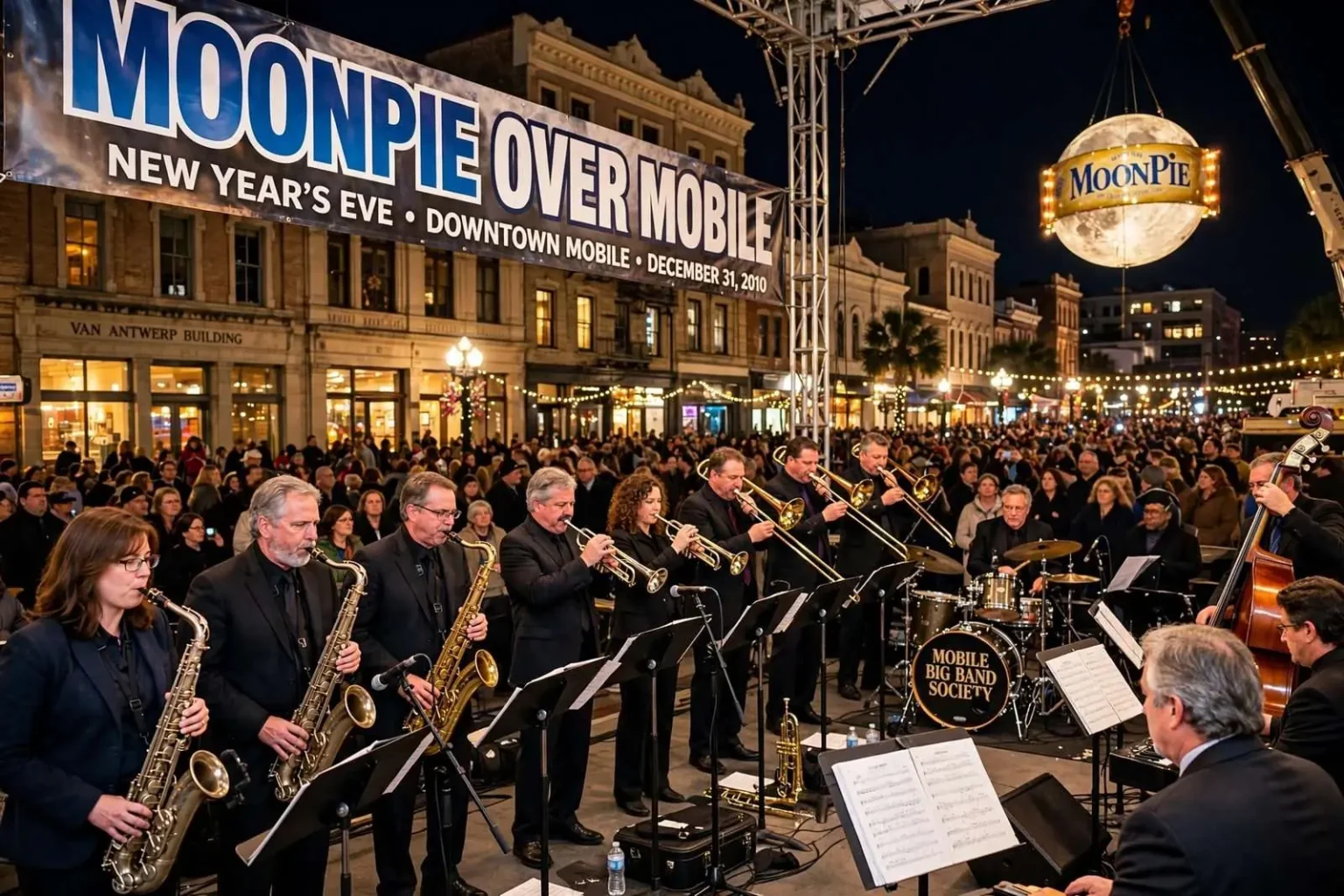
When downtown Mobile rings in the new year with the MoonPie Over Mobile celebration, one of the acts on stage will be keeping a much older American tradition alive: the Mobile Big Band Society, formed to preserve and perform the music of the big band era.
The society takes the stage as the city closes out 2010 downtown, sharing the bill at a New Year’s Eve celebration that has become one of the Gulf Coast’s signature year-end events. While headline acts draw the crowds, the big band society brings something different to the program: a living connection to the swing era, played by musicians who treat the repertoire as a craft to be maintained rather than a novelty to be revived.
Big band music dominated American popular culture from the 1930s through the late 1940s, when large orchestras built around brass, reeds, and rhythm sections played the arrangements that filled dance halls across the country. The sound defined a generation — Duke Ellington, Count Basie, Glenn Miller, Benny Goodman — and it produced a songbook of standards whose harmonies and lyric craft still anchor American popular music. As the decades passed, the economics of maintaining a full big band grew harder, and the music survived largely through dedicated regional groups willing to keep the charts in print and the players in the seats.
Keeping the Songbook Alive
The regional musicians who make up the society play for the sheer pleasure of the craft — for themselves, for longtime fans who grew up on those melodies, and for younger listeners discovering the harmonies and romantic lyrics of the Great American Songbook for the first time. That mix of audiences is central to the group’s identity. Veterans of the era hear the arrangements exactly as they remember them, while first-time listeners encounter the music without any sense that they are walking into a museum piece.
The repertoire the society performs demands range from its players. Big band charts call for tight ensemble section work, featured solos, and the rhythmic drive that made the music a dance-floor phenomenon. Unlike smaller jazz combos, a big band fills a stage — saxophone, trumpet, and trombone sections stacked behind a rhythm section — and every player carries a defined role in the arrangement. Keeping a full ensemble of regional musicians rehearsed and available is itself a preservation effort, since many of the players hold day jobs and perform with the society out of dedication to the material.
Beyond performing, the group plans to run music clinics aimed at introducing student musicians to the genre, building a next generation of big band players along the Gulf Coast. Those clinics address a practical problem: the music survives only if young players learn to read the charts, blend into a section, and appreciate the stylistic conventions of swing. School jazz programs introduce elements of the repertoire, but a dedicated clinic led by working big band musicians gives students a direct line to the tradition and to the players who have kept it alive in Mobile for decades.
A Deep Bench of Mobile Swing
The society’s sound carries particular resonance in Mobile, which has long savored homegrown big band music. Local audiences will remember the orchestras of Bill Lagman, Roy Choice, Bob Schultz and E.B. Coleman — and several of those players are still performing. Those bandleaders built the city’s appetite for large-ensemble dance music over decades of ballroom dates, society dances, and Carnival season appearances, and their alumni form much of the talent pool from which groups like the society draw.
Hosea London’s Excelsior Band and Paul Filben’s Carnival band remain touchstones of the scene, still swinging to the delight of devoted followings. The Excelsior Band in particular is woven into Mobile’s cultural fabric, with a history stretching back generations and a calendar that has long included Mardi Gras season appearances that make it as much a part of Carnival as the floats themselves. Filben’s Carnival band fills a similar role, supplying live music for events across the season. That a city of Mobile’s size has sustained multiple working big bands into the modern era says something about the depth of its musical tradition.
That continuity matters during Mardi Gras season and beyond. The same musicians who play the Songbook standards on a concert stage may be found a few weeks later steering a Carnival crowd through a second-line groove, and Mobile audiences treat those as complementary chapters of one story rather than separate genres. The Mobile Big Band Society sits squarely in that lineage: a group of players with deep local roots, devoted to the music that first made Mobile dancers swing.
The MoonPie Over Mobile Stage
The society’s appearance at the New Year’s Eve celebration puts that living history front and center as Mobile closes out 2010 downtown. MoonPie Over Mobile has grown into the city’s answer to the Times Square ball drop, centering its celebration on a giant electronic MoonPie descending as midnight arrives — a nod to the snack cake that Mobile’s own bakery has produced for generations and that Carnival crowds along the parade routes have tossed and traded for decades.
The choice of a big band for the bill fits the occasion’s blend of nostalgia and local pride. New Year’s Eve audiences skew multigenerational, with families, longtime residents, and visitors all sharing the downtown blocks, and the swing repertoire plays equally well as background for conversation and as a call to the dance floor. Countdown celebrations also reward acts that can keep a broad crowd engaged through a long evening of waiting for midnight, something a full big band is built to do.
Downtown’s celebration district gives the performance a fitting backdrop. The blocks around the major stage draw tens of thousands as midnight approaches, filling restaurants, hotels, and viewing areas in the heart of the city. For the society’s musicians, the setting transforms a typically intimate big band audience into one of the largest crowds they will play for all year.
An Evening Where Eras Meet
As 2010 gives way to the new year, the Mobile Big Band Society’s set offers a through-line between the city’s past and its present: a music born nearly a century ago, carried by local bandleaders through the decades, now handed to a new audience under a descending MoonPie. For the players, the gig is another entry in a long tradition of Mobile musicians keeping the big band sound in public ear. For the crowd, it is a chance to hear the Great American Songbook performed the way it was meant to be heard — live, full-size, and swinging into the new year.
Why Regional Preservation Groups Matter
The Mobile Big Band Society belongs to a broader family of regional ensembles across the country that have taken on the work of keeping historical American music in live performance. Recording makes the classics permanently available, but recordings cannot reproduce the experience of a full big band in the room: the punch of a trumpet section, the swell of the reeds, the rhythm section locking into a shuffle underneath it all. Preservation happens in rehearsal rooms and on stages, one performance at a time, by groups willing to shoulder the cost of music stands, charts, and rehearsal space.
In Mobile, that effort carries extra weight because the city’s own musical history is so tightly bound to the repertoire. The local orchestras remembered by longtime audiences — the bands of Lagman, Choice, Schultz and Coleman — were community institutions as much as entertainment, playing the weddings, reunions, dances, and Carnival balls that structured civic life. When those ensembles’ former players and students gather in a group like the society, they are not simply covering the national Songbook; they are extending a local tradition of big band performance that has run continuously through the city’s modern history.
The planned music clinics extend that work to the classroom level, and they come at a time when school music programs across Alabama are working to keep jazz education funded and staffed. Student musicians who learn big band charts gain skills that transfer across genres — sight-reading, section discipline, dynamic control — while also gaining an appreciation for the American music that laid the groundwork for everything that followed. A clinic taught by working regional players also shows students that a life in music is possible close to home, without relocating to a major market.
New Year’s Eve, Downtown Style
Downtown Mobile has invested heavily in making New Year’s Eve a destination evening, and the celebration’s growth reflects the broader revitalization of the city center, from the restaurants along Dauphin Street to the hotels that fill with visitors for holiday weekends. A lineup that mixes contemporary entertainment with a big band ensemble gives the event range, letting it speak simultaneously to different generations crowded onto the same blocks.
For attendees, the practical details matter: arrive early, expect street closures around the celebration area, and be prepared for a crowd that builds steadily through the evening toward the midnight descent of the giant MoonPie. Families often stake out viewing spots well before the headline performances begin, which means early sets like the society’s reach some of the largest and most attentive audiences of the night.
When the final chorus lands and the countdown begins, the Mobile Big Band Society will have done exactly what it set out to do: put the big band era back at the center of a Mobile celebration, performed by musicians who learned it from the local players who never stopped swinging. The city closes out 2010 with a party that honors its own past — and with a new generation of listeners humming melodies older than any of the buildings surrounding the stage.