
Mobile Builder White-Spunner Rings Up $85 Million in Retail Work Across the South
Mobile's White-Spunner Construction won $85 million in retail work across the South, plus news from Airbus-Delta, Baldwin County EDA and Better Skin Co.
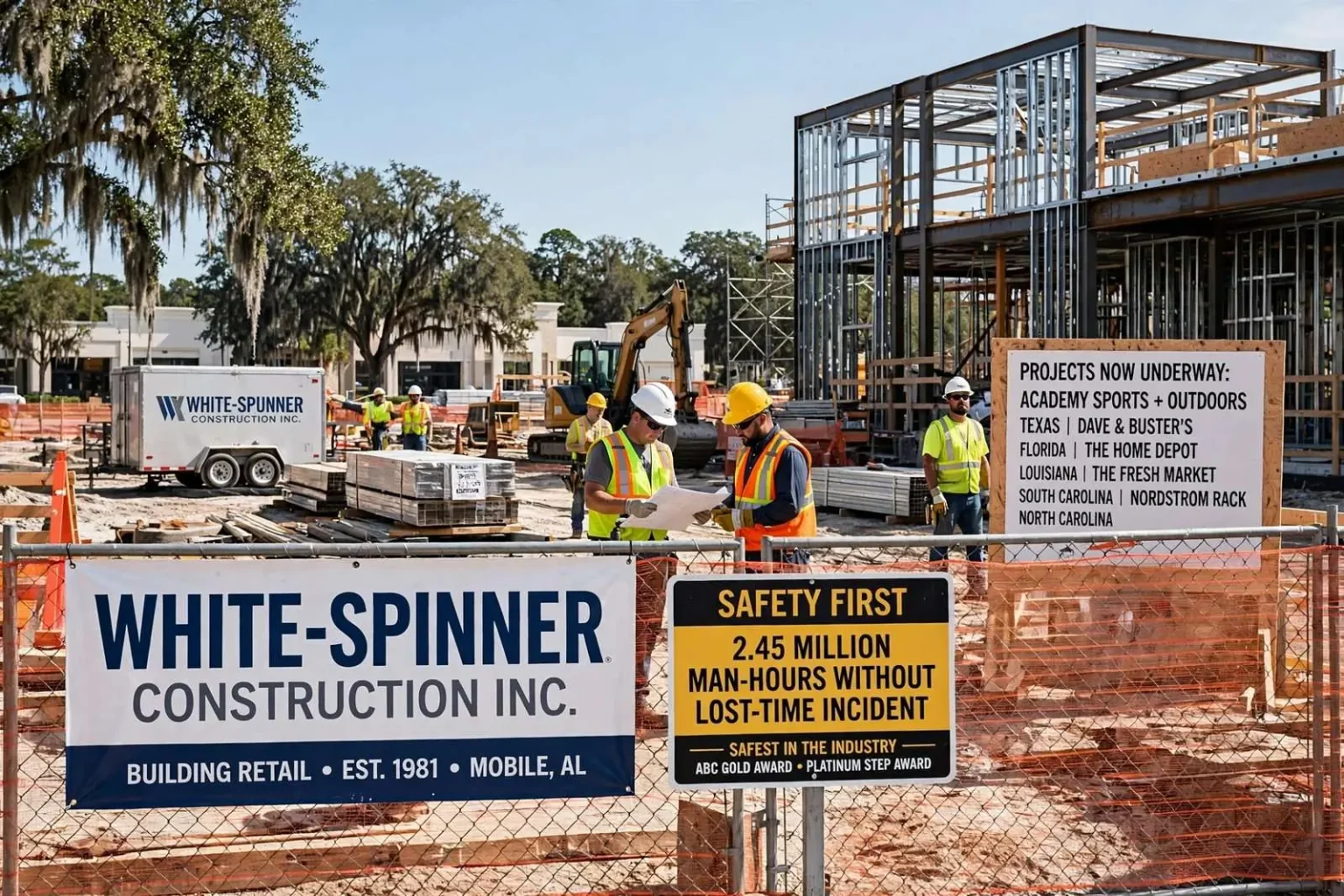
Mobile-based White-Spunner Construction Inc. has spent the past twelve months quietly assembling one of the busiest retail construction portfolios on the Gulf Coast. Over that span, the company started projects or won bids on at least 13 national retail accounts across the southern United States, a body of work totaling $85 million, according to figures the company reported. Much of that new retail work sits outside coastal Alabama, but the client roster is heavyweight by any measure: Academy Sports + Outdoors, Dave & Buster’s, The Home Depot, The Fresh Market and Nordstrom Rack, with individual projects stretching across Texas, Louisiana, South Carolina, Florida, Mississippi and North Carolina.
For a contractor founded in Mobile in 1981, the scope of the recent run reflects four decades of deliberate specialization. The company has built thousands of retail projects in at least 27 states since its founding, serving clients that include Fortune 500 names such as Lowe’s, Publix and Target. Over 35 years in business, White-Spunner has completed more than $2.4 billion in construction value, and its annual volume has averaged $73.5 million during the last five years. Those figures place the firm among the most experienced retail builders in the Southeast, in a niche where reputation travels quickly from one national tenant to the next.
Retail construction is an unforgiving corner of the industry, and the people who run White-Spunner describe it in blunt terms. Vice president Chris Carruth said finishing on schedule and on budget is everything in his line of work. Every day a store opens late costs it revenue, he noted, adding that construction is complex and often challenging despite the old saying that it never rains on retail sites. National chains coordinate grand openings, staffing and advertising around fixed dates, which means a contractor’s schedule slip becomes the tenant’s lost sales, and a cost overrun can poison a relationship that might otherwise produce a decade of repeat work.
That discipline has shown up most clearly in the company’s safety record, which has become a signature strength and a selling point in its own right. The firm logged 2.45 million man-hours without a lost-time incident, a figure that matters to national clients because jobsite injuries translate directly into delays, liability and higher insurance costs. In 2016, the Associated Builders and Contractors honored the company with the Safest in the Industry Gold Award along with a Platinum Level STEP Award, one of the highest recognitions the national trade group gives for safety performance and training programs.
Repeat Clients and the Rooms To Go Benchmark
The clearest evidence of how the company performs under pressure comes from clients who keep coming back. Rooms To Go, a repeat client, praised the contractor for delivering an 875,000-square-foot distribution center in Pearl River, Louisiana, on time and on budget. The scale of that job illustrates the range of work a retail account can demand of its builder: the project moved more than half a million cubic yards of dirt across a 62-acre site before the building itself could even rise. Distribution centers of that size serve entire regions, and the furniture retailer’s willingness to return to White-Spunner for such a demanding job speaks to how the Mobile firm is viewed inside corporate construction departments.
Airbus Hands Delta Its First U.S.-Built A321
In other Mobile business news, Airbus delivered the first A321 assembled at its Mobile facility to Delta Air Lines at a handover ceremony held Friday. The aircraft is the first A321 built on American soil for Delta, the world’s second-largest airline by revenue and capacity, and it marks the 14th such jet added to the Atlanta-based carrier’s fleet from the growing Alabama production line.
Daryl Taylor, vice president and general manager of Airbus in Mobile, said the Brookley plant is targeting a production rate of four aircraft per month by the start of 2017 — evidence, he said, of the operation’s progress toward full capacity. Hitting that pace would put the Mobile final assembly line among the most productive single-aircraft facilities in the Airbus system, and it underscores how quickly the Brookley Aeroplex has grown from an announcement into a working industrial campus on Mobile Bay.
For Delta, the ceremony carried strategic weight beyond a single delivery. Delta senior vice president Greg May Sr. suggested that Mobile’s proximity to Atlanta should deepen the carrier’s relationship with Airbus in North America, and the numbers behind that suggestion are substantial: Delta has more than 80 A321s on backorder. Every aircraft delivered from Mobile shortens the ferry distance to the airline’s Atlanta hub and ties one of the nation’s largest carriers more closely to a Gulf Coast manufacturing footprint that now includes the final assembly line, its network of suppliers and the thousands of jobs that orbit both.
The handover also landed at a moment when Mobile’s industrial identity has been shifting. A city that long depended on the Port of Mobile, shipbuilding and chemical manufacturing has added aerospace to its roster, and the Airbus line has become the anchor tenant of that transformation. Local officials have pointed to the plant when courting suppliers, and the delivery cadence itself — one jet at a time, month after month — has turned Brookley into a recurring symbol of the region’s diversification.
Baldwin County EDA Adds a Project Manager
Across the bay, economic development efforts got their own reinforcement. The Baldwin County Economic Development Alliance has hired Alex Doleac as project manager, charged with directing business recruitment aimed at sustaining the county’s rapid growth. Doleac spent the previous year in a similar role with the economic development partnership in Hattiesburg, Mississippi, and interned with the West Florida Economic Development Alliance in Pensacola during graduate school, giving him hands-on experience in two neighboring Gulf Coast markets that compete with Baldwin County for many of the same projects.
Doleac called Baldwin County’s momentum real, pointing to a decade of population growth as proof. The county has consistently ranked among Alabama’s fastest-growing, driven by its beaches, its schools and its position along the Interstate 10 and Highway 98 corridors, and that growth has made recruitment work a year-round task rather than an occasional campaign. The alliance he joins is unusually broad for an organization its size: based in Robertsdale, it is backed by county government, 14 municipalities, five chambers of commerce, eight industrial development boards and more than 100 private businesses. That coalition structure allows the group to speak for nearly every corner of a county that stretches from Mobile Bay to the Florida line.
The hire signals continuity in a county where economic development has become inseparable from daily politics. New rooftops demand new roads, schools and utilities, and the alliance’s recruitment targets — advanced manufacturing, aerospace suppliers, corporate services — are chosen partly for the quality jobs they add to a tax base already straining to keep pace. A project manager whose job is to direct that recruitment effectively becomes one of the more consequential hires in county government’s orbit, even though the alliance itself is a private-public partnership rather than a department of county government.
Skin-Care Brand With Mobile-Area Roots Goes Global
The region’s business reach extends well beyond heavy industry, and one of the more unlikely exports from south Alabama comes in a jar. The Better Skin Co., maker of a product called Better Skin Mirakle Cream, traces its origins to the Mobile area: co-founder Murphy D. Bishop grew up in Grand Bay, attended Faulkner State Community College and finished his degree at Birmingham-Southern College before spending more than two decades in the beauty industry with Estée Lauder, Bobbi Brown, Victoria’s Secret Beauty, Bare Escentuals and Molton Brown. That résumé gave him both the product knowledge and the industry contacts that most startup founders in the category spend years trying to build.
Bishop launched the California-based brand in 2015 with co-founder Natalya Rachkova, using his industry contacts to bring her product to the U.S. market. The company now ships to more than 10 countries, projects seven-figure sales in 2017 and is lined up with a national retailer carrying more than 40 doors early next year — the kind of distribution deal that can turn a niche skin-care line into a shelf fixture. Bishop was due back in Mobile the following week to promote the line, closing a circle that began in Grand Bay and now runs through beauty counters well beyond the Gulf Coast.
His return visit doubles as a reminder of how south Alabama products travel. A brand conceived on the West Coast but rooted in Mobile County now competes in one of the most crowded consumer categories in the world, where shelf space is won through retailer relationships and demonstrated sell-through rather than advertising budgets alone. For a company projecting seven figures in sales in only its second full year, the national retail placement represents the traditional proving ground: if the product moves at 40 doors, larger orders and wider distribution typically follow.
What the Stories Share
Taken together, the four items sketch a regional economy broader than the industrial headlines usually suggest. White-Spunner’s $85 million retail portfolio shows a homegrown contractor competing nationally on schedule discipline and safety rather than geography. The Delta delivery shows a global manufacturer that chose Mobile now shipping product to one of the world’s largest airlines at a rising monthly rate. The Baldwin County alliance’s hire shows a fast-growing county investing in recruitment talent to keep pace with its own population curve. And The Better Skin Co. shows a Mobile-area native building a consumer brand with worldwide reach.
Each also illustrates the same underlying truth about the Gulf Coast economy: the region’s fortunes increasingly depend on connections — to national corporate construction departments, to a European aircraft manufacturer’s production plan, to site-selection consultants scouting Baldwin County, and to retailers deciding which new products deserve shelf space. The businesses that thrive are the ones that can deliver on those connections reliably, whether the product is a store that opens on time, an airliner that rolls out of the Brookley hangar, a recruited employer breaking ground in Robertsdale, or a jar of Mirakle Cream bound for a shelf two thousand miles from where its co-founder grew up.
For local readers, the practical takeaway is straightforward. The commercial construction boom that White-Spunner is feeding means more retail options across the South and continued work for the subcontractors and tradespeople who staff those jobsites. Airbus’s production ramp means a steadier stream of aerospace employment at Brookley and among its suppliers. Baldwin County’s recruitment machinery means continued pressure on roads, schools and utilities — growth that arrives with costs attached as well as paychecks. And the global reach of even a small brand like The Better Skin Co. shows that south Alabama’s business footprint is no longer defined solely by what is shipped through the Port of Mobile, but by everything the region’s companies now build, deliver and sell far beyond it.


