The Mobile Area Chamber of Commerce is among the business groups that joined a legal brief backing a federal court decision to lift the Obama administration’s six-month moratorium on deepwater oil and gas exploration in the Gulf of Mexico, part of the response to the Deepwater Horizon disaster earlier that year. The filing placed Mobile’s business leadership squarely inside one of the most consequential economic and legal fights of 2010, a dispute over whether the safest response to an environmental catastrophe was to shut down an entire industry while regulators rethought their rules. For the organizations that signed on, the answer was a resounding no, and they took that argument to federal court.
The National Chamber Litigation Center, the litigation arm of the U.S. Chamber of Commerce, filed the amicus brief in Hornbeck Offshore Services, Inc. v. Salazar, the case brought by Gulf drilling and marine services companies challenging the moratorium the Interior Department imposed after the April 2010 rig explosion and oil spill. Amicus briefs allow parties who are not directly involved in a lawsuit to tell the court how a ruling will affect their members and communities, and the business coalition behind this one used that platform to describe the human and economic toll of idling the Gulf’s deepwater fleet.
A federal judge had already blocked the moratorium, and the government was appealing that ruling when the brief was filed. The stakes of the appeal were enormous for the companies that owned and crewed the rigs, many of which were already weighing moves to relocate their vessels to foreign waters where the work could continue. Every week of uncertainty, the companies argued, cost jobs and contracts that might never return if the fleet scattered during a prolonged shutdown.
A broad coalition signs on
Along with the U.S. Chamber and the Mobile chamber, the brief was supported by 29 other Gulf Coast business and industry groups, the Business Council of Alabama, and U.S. Sen. Mary Landrieu of Louisiana. The breadth of the coalition reflected how widely the moratorium’s effects were expected to spread, reaching far beyond the drilling contractors themselves. Trade associations from across the Gulf states joined the filing alongside statewide business organizations, and a sitting United States senator lending her name to an amicus brief underscored how high the issue ran in Washington and in the coastal states alike.
The coalition argued that federal regulators had not adequately weighed the economic damage a prolonged shutdown would inflict on drilling crews, support businesses and coastal economies still absorbing the effects of the spill itself. In their view, the government had imposed a blanket pause without studying the consequences, treating an entire industry as uniformly unsafe rather than evaluating each rig, operator and set of safety measures on its own merits. That approach, the brief contended, punished thousands of workers whose operations had nothing to do with the failures that caused the disaster.
The moratorium, imposed in the weeks after the Deepwater Horizon explosion, halted deepwater drilling across the Gulf for what the Interior Department described as a six-month safety review. Critics countered that the review’s findings did not justify the breadth of the shutdown, and the legal challenge quickly became the focal point for every community that depended on energy work. When a federal judge blocked the order, the government’s appeal kept the fleet in limbo, and the amicus coalition stepped in to press the court to let the lower court’s decision stand.
Stakes for the local economy
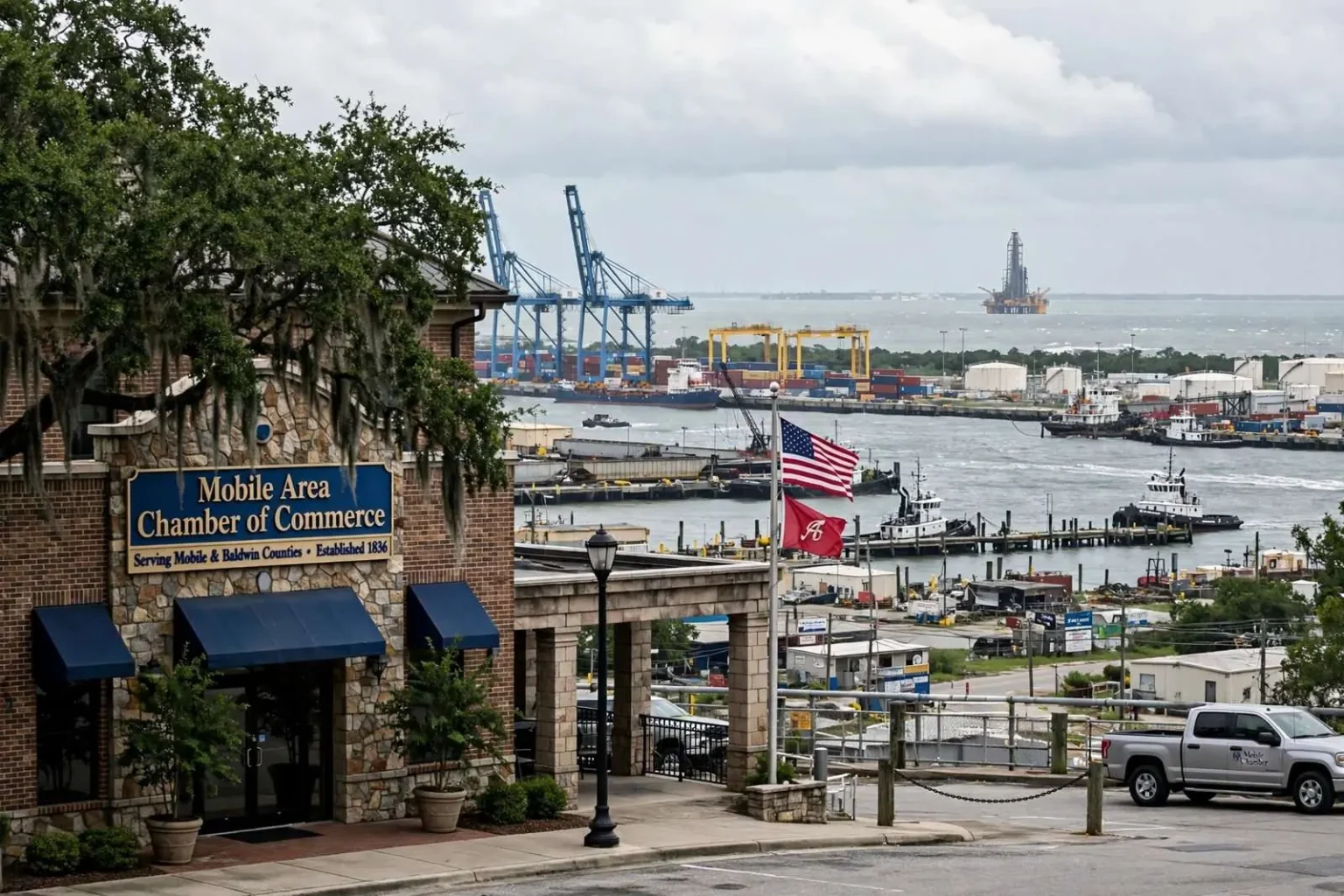
Mobile’s port and manufacturing base include suppliers and service companies tied to offshore energy work, giving the Mobile Area Chamber a direct financial interest in how long deepwater exploration stayed paused. The Port of Mobile has long served as a working hub for the industries that support Gulf energy production, and local fabricators, marine service firms and logistics companies count energy customers among their steadiest accounts. A shutdown that idled rigs offshore would eventually work its way down that supply chain, order by order and shift by shift.
Business groups on the Gulf Coast had warned that an extended moratorium threatened thousands of jobs on rigs and in the onshore companies that support them, at a time when the same region’s tourism and fishing industries were already reeling from the spill. That double hit was the central fear of 2010: the same disaster that closed fishing grounds and scared off beach visitors was now threatening to idle the energy industry that anchored port cities like Mobile. Chamber leaders argued the region could not absorb both blows at once, and that recovery from the spill required the rest of the economy to keep running.
The concern extended to the long term as well. Deepwater rigs are mobile assets, and operators had already begun considering moves to other countries where regulators were still issuing permits. Business leaders warned that once a rig relocated and crews disbanded, rebuilding the industry’s Gulf presence could take years, permanently shifting jobs and investment away from communities that had hosted offshore energy for decades. The amicus brief framed the appeal not as a fight over whether drilling would eventually resume, but over whether the Gulf’s existing industry would survive the wait intact.
The legal fight also became a test of how amicus participation works in practice. The National Chamber Litigation Center built its brief around declarations and economic analysis supplied by the coalition’s members, giving the appellate judges a documented picture of shipyards, service fleets and small contractors whose revenues stopped the day the moratorium took effect. Chambers like Mobile’s provided the local detail, the named industries and the regional numbers that turned an abstract policy dispute into an argument about payrolls in specific Gulf communities. That combination of national legal resources and local economic knowledge became a template for how regional business groups would engage federal issues in the years that followed.
The dispute also sharpened a debate that continues in coastal states today over how to balance offshore energy production against the risks that come with it. Supporters of the drilling industry pointed to the safety record of the vast majority of operations and the economic weight of the sector; environmental advocates countered that the disaster proved the consequences of failure were simply too large to accept. The courts, in the end, declined to settle that larger argument, resolving instead the narrow question of whether a blanket, open-ended shutdown was a lawful response. The Gulf’s deepwater industry resumed work under stricter rules, and the region returned to the harder, longer task of recovering from the spill itself.
For the workers most directly affected, the months of the moratorium were measured in practical worries rather than legal arguments. Rig crews faced uncertain schedules and shrinking rotations, while the small companies that supply everything from drill pipe to dockside services watched contracts pause with the rigs. Industry and political leaders discussed ways to keep crews working during the shutdown, but many employees simply waited, and some left the industry entirely for jobs in other states. Those departures were part of what business groups meant when they warned that the damage of a long shutdown could outlast the shutdown itself.
How the case ended
The Fifth Circuit Court of Appeals ultimately declined to reinstate the moratorium, siding with the drilling companies and the business groups that had intervened in the case. The appellate ruling kept the blocked order in place, a decisive victory for the coalition that had argued the shutdown was arbitrary and economically devastating. For Mobile’s business community and its allies across the Gulf, the decision validated the strategy of pressing the economic argument in court alongside the safety questions.
The Interior Department later replaced the blanket moratorium with a new permitting process for deepwater drilling, requiring operators to demonstrate stronger well control and containment capabilities before receiving approval to resume work. That shift moved the dispute from a categorical shutdown to a case-by-case review, which was effectively the outcome the business coalition had sought. Work resumed in stages over the following months as operators met the new standards, though the episode left a lasting imprint on how the industry and its regulators approached deepwater safety in the Gulf.
For Mobile, the episode remains an instructive chapter in the region’s economic history. It showed how a disaster hundreds of miles offshore can reach into port-side machine shops and marine yards, and it demonstrated that local chambers were willing to carry their members’ concerns all the way to a federal appeals court. The case also foreshadowed the years of litigation, compensation claims and regulatory change that followed the spill, an era in which the Gulf Coast’s economy proved both more fragile and more resilient than anyone expected in the spring of 2010.