Mobile Child Died in 2008 Apartment Fire, Authorities Said
Archived WKRG coverage reported that a three-year-old child died after an apartment fire in Mobile in 2008 and that the child's mother was arrested.
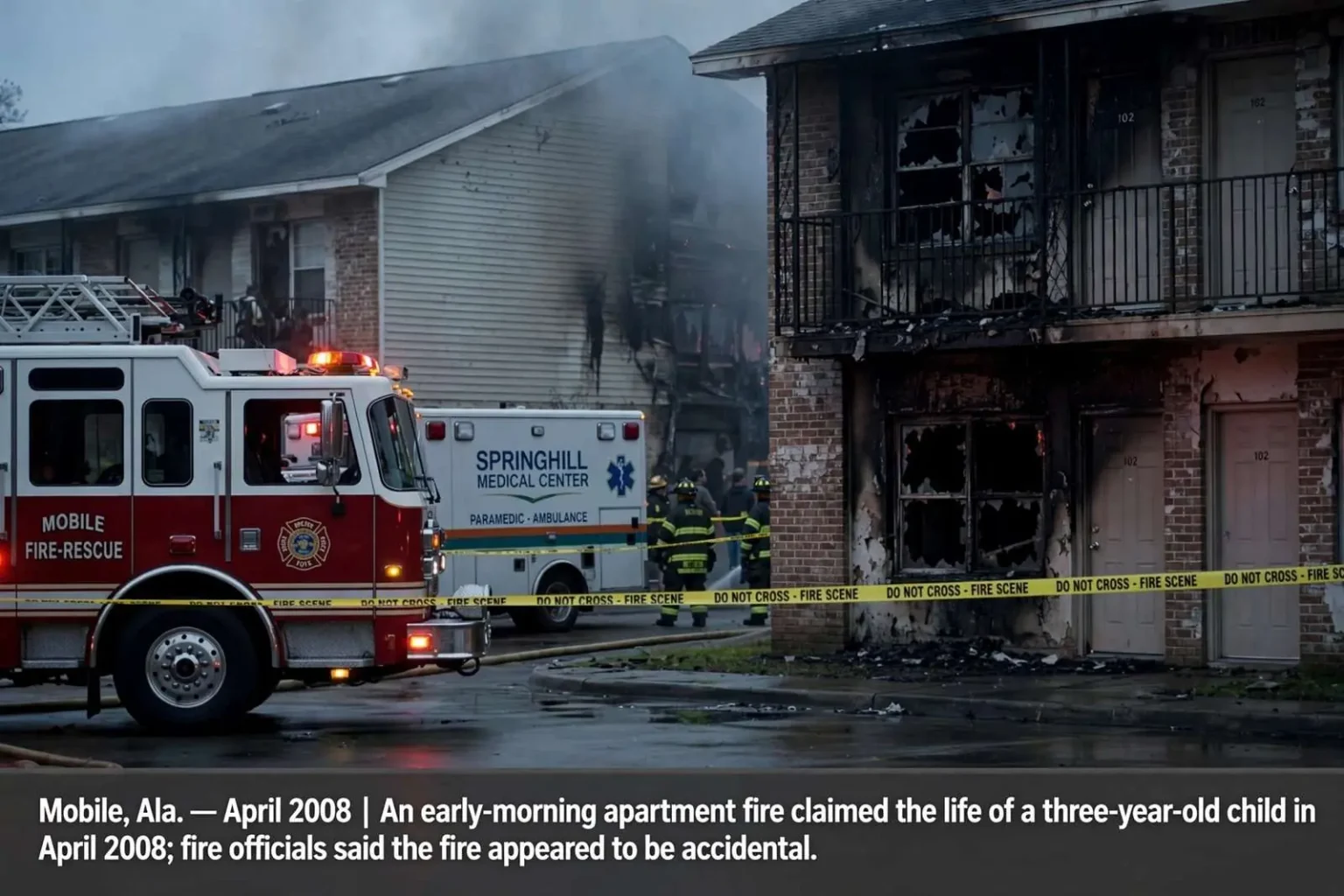
MOBILE, Ala. — A three-year-old child died after an early-morning apartment fire in Mobile in April 2008, according to an archived local news report. Fire officials said the child was taken to Springhill Medical Center and later pronounced dead.
Authorities said the fire appeared to have been accidental. The report said the child’s mother was arrested after returning to the apartment with another child, and the arrest reflected officials’ assessment of the circumstances in which the children were left at the time the fire broke out. This historical article reflects official information and an arrest reported at the time. It does not establish guilt or report any later court outcome, and it omits graphic details.
The fire struck in the early-morning hours, a window in which residential fires are disproportionately deadly. Occupants are asleep, smoke alarms may be silent or absent, and the time between ignition and untenable conditions inside a small apartment can be shorter than anyone inside realizes. For a young child, that margin is narrower still — children hide from fire rather than flee it, and they cannot open doors or windows on their own.
Neighbors described trying to help after seeing smoke, but said conditions made it too dangerous to enter. That account — residents drawn out of their own homes by smoke, willing to risk themselves, forced back by heat and toxic air — is a recurring feature of apartment fires, and it underscores a message fire departments repeat after nearly every such incident: untrained rescues without protection are frequently fatal to the rescuer, and in a fully involved apartment the window for entry is measured in seconds.
The medical response
Springhill Medical Center, the hospital to which the child was transported, is a full-service acute-care hospital in west Mobile, and it was among the facilities positioned to receive pediatric emergencies from across the city. In fire cases, the medical work begins at the scene — firefighters and medics assess for smoke inhalation, carbon monoxide poisoning, and burns — and continues in the emergency department, where smoke-inhalation patients can deteriorate hours after exposure as airway damage progresses.
The time between rescue and hospital arrival is the most decisive period in such cases, and early-morning apartment fires strain it. Fire crews arriving to a well-involved apartment must first control the fire enough to enter and search, and every minute of that fight is a minute a victim inside is not receiving oxygen. Fire officials’ account of the child’s death — transported, then pronounced dead at the hospital — reflects that sequence.
For the crews involved, calls involving children are the ones that stay with them. Fire departments across the country operate peer-support and counseling programs for precisely these calls, and Mobile Fire-Rescue personnel who responded to the April 2008 fire carried out the same scene work, search, and medical handoff they train on throughout their careers, in circumstances no training fully prepares anyone for.
An arrest, and the questions it raised
The report that the mother was arrested after returning to the apartment with another child indicates that investigators focused on the circumstances under which the children were in the apartment when the fire began. Police and prosecutors in Mobile County make such charging decisions based on what the initial investigation shows, and misdemeanor or felony charges filed at the scene can change as investigators, and later prosecutors, develop the facts.
An arrest is an accusation, not a finding of guilt, and the archived report is explicit on that limit: it reflects an arrest reported at the time and does not establish guilt or report any later court outcome. The historical record here preserves that boundary — the facts of the fire, the child’s death, the determination that the fire appeared accidental, and the arrest as reported in April 2008.
The presence of another child, returned to the scene with the mother according to the report, also became part of the immediate response. When a parent is arrested at a scene and other children are present, child welfare authorities are notified and take temporary custody of the children pending an assessment — a routine but wrenching part of incidents like this one, and one more reason the emergency response to a fatal fire extends well beyond the fire itself.
Young children and fire risk
National fire data has long identified young children as among the groups at highest risk of dying in residential fires. Children under five cannot escape on their own, are often asleep in rooms far from exits, and are more vulnerable to smoke inhalation than adults. Fire safety campaigns aimed at families with small children emphasize three measures above others: working smoke alarms on every level and outside sleeping areas, a practiced escape plan with adults responsible for each child, and keeping lighters and matches out of children’s reach.
The determination that the April 2008 fire appeared accidental aligns with the broader pattern: most fatal residential fires are not deliberately set, but arise from cooking, electrical faults, heating equipment, or smoking materials, and their lethality turns on whether occupants are alerted early and can get out. In an apartment, the failure of any one of those links can be decisive — and in the middle of the night, it usually is.
The neighbors who gathered as smoke poured from the building were acting on the instinct most people have in a fire: go toward it and help. Fire officials’ standard guidance — call 911 first, never enter a burning building without training and equipment — exists because unaided entry attempts too often add victims. On this April morning in 2008, conditions made rescue attempts impossible, as the neighbors themselves told officials.
A death the record keeps carefully
Historical accounts of incidents involving children carry a responsibility to be accurate without being invasive, and the archived report this article preserves reflects that approach: it names no child, includes no graphic detail, and reports the arrest without presuming its outcome. What it records is a three-year-old’s death, an early-morning apartment fire in Mobile in April 2008, a determination by fire officials that the fire appeared accidental, a mother’s arrest as reported at the time, and a neighborhood’s neighbors trying and failing to get inside.
The incident remains part of Mobile’s public-safety record — a fire that killed a child, sent another family’s life into the courts and the child-welfare system, and gave the firefighters and medics who responded the kind of call they remember for the rest of their careers. The record here preserves those facts as they were reported, with the limits the original coverage observed.
How Mobile’s emergency system responds to a fatal fire
A fatal apartment fire in Mobile draws several agencies at once. Mobile Fire-Rescue handles suppression, search, and initial medical care; Mobile Police secure the scene and begin the parallel investigation that any death triggers; the Alabama Department of Forensic Sciences conducts the examination that establishes cause and manner of death; and, where children are involved, the Department of Human Resources is brought in for the welfare of surviving siblings. The April 2008 incident, with its arrest and the second child returned to the scene according to the report, would have set all of those steps in motion.
Fire investigators work an accidental-determination in tandem with the medical examination. Their scene work — burn patterns, the location of the ignition source, the condition of smoke alarms, the position of doors — builds the account that determines whether a fire is classified as accidental, and whether the circumstances surrounding it support any criminal referral. That is the process that produced the picture the archived report preserves: an accidental fire, and an arrest based on the circumstances rather than on the fire’s origin.
Springhill Medical Center’s role in the incident also reflects the geography of Mobile’s hospital network. As a hospital in west Mobile with an emergency department, it receives emergencies from across the city depending on ambulance routing and capacity, and in an early-morning fire its teams would have received a child whose smoke inhalation and injuries exceeded what field care could reverse — the sequence that ended in the pronouncement fire officials later reported.
What the neighborhood carried afterward
For the people who lived in the apartment complex, the aftermath of such a fire is its own ordeal. Displaced households need shelter, the damaged unit must be repaired or cleared, and the community absorbs the knowledge that a child died a few doors away. Neighbors who had gathered in the dark to try to get inside carried the particular weight of having acted and having been stopped — a common aftermath in fatal fires that local pastors, counselors, and Red Cross volunteers quietly help neighborhoods manage.
The archived report does not follow the case past the arrest, and neither does this account. What the record supports is the sequence reported at the time: an early-morning apartment fire in Mobile in April 2008; a three-year-old transported to Springhill Medical Center and later pronounced dead; fire officials’ determination that the fire appeared accidental; the mother’s arrest after returning to the apartment with another child; neighbors who tried to help and could not get in; and no reported injuries to anyone else.
It is a spare record for a death that size, but the spareness is deliberate. The report omits graphic details, withholds the child’s identity, and stops where the original coverage stopped — leaving the courts, not the archive, to hold whatever came next.