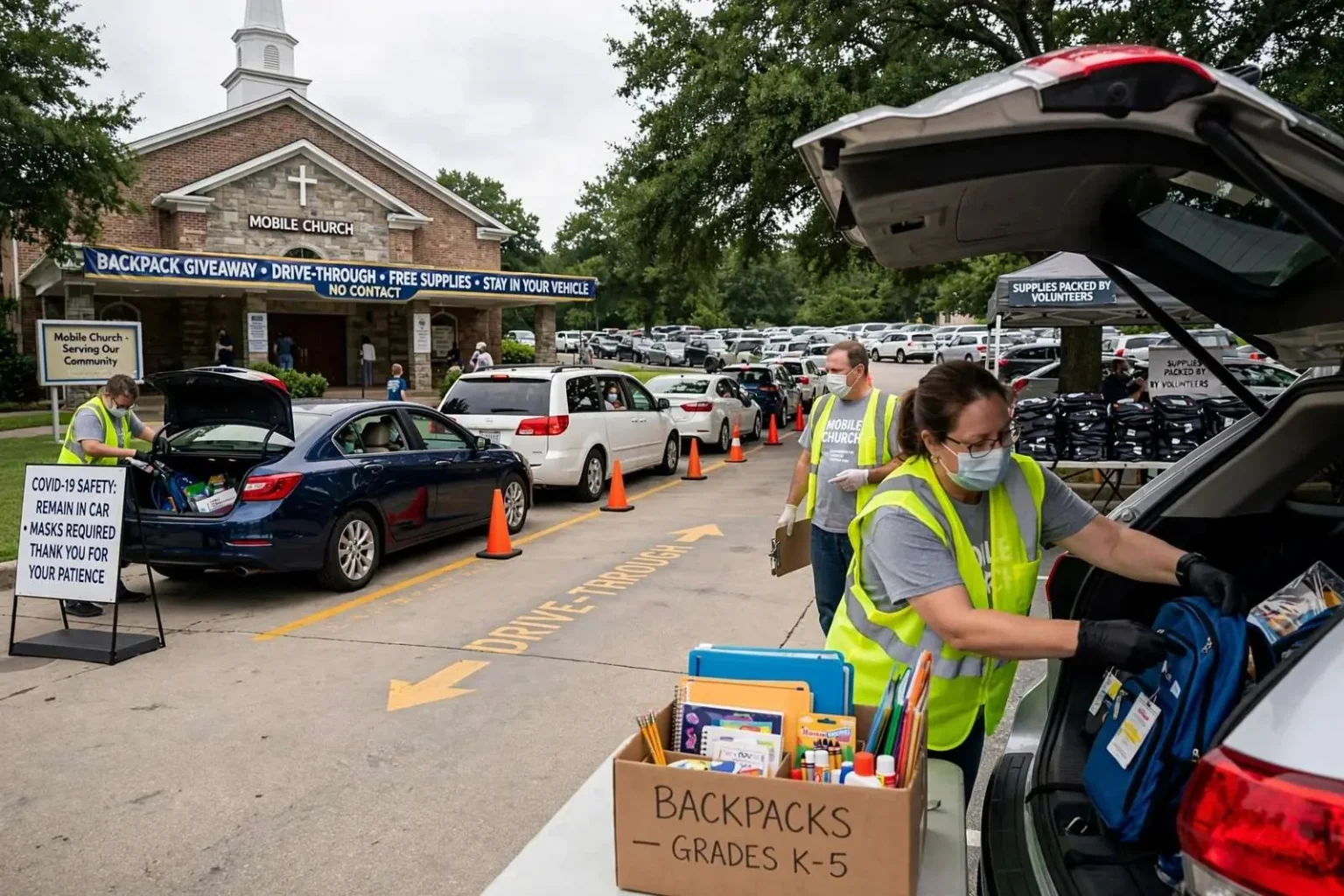
A back-to-school tradition in Mobile got a pandemic makeover when a local church converted its annual backpack giveaway into a drive-through event, allowing families to pick up school supplies while maintaining physical distance during COVID-19.
A long line of cars wound through the church parking lot as volunteers loaded backpacks into trunks and back seats, replacing the crowded indoor gatherings of years past with a touchless experience behind the wheel.
The format change was more than cosmetic. Indoor backpack giveaways typically mean hallways full of families, children picking through bins of supplies and volunteers handing items face to face — exactly the kind of close contact public health guidance warned against during the pandemic. Moving the event to the parking lot preserved the giveaway while stripping out nearly every touchpoint.
The event came as Mobile County Public Schools had pushed back the start of the school year due to the pandemic, leaving many families uncertain about when classes would resume. The delayed calendar left parents juggling work schedules and childcare plans with no firm first day of school to anchor them.
For parents picking up supplies, the giveaway offered both practical help and peace of mind — a way to check one task off the back-to-school list no matter when classrooms reopened.
Families Grateful for the Support
One recipient, identified only as Cheryl, said from her car that the giveaway was a big help and a blessing, noting it was something she did not have to search for or pay for on her own.
Her comment captured the particular strain the pandemic placed on household budgets. School supply lists arrive whether or not a family’s income has survived the disruptions of the past year, and for parents facing reduced hours or lost jobs, a free backpack stocked with supplies removed an expense that could not be postponed.
Hattie Jones, another parent picking up backpacks, said the event helped her family prepare even though the school calendar remained in flux. She said she was not sure when children would return to classrooms but wanted to be ready when they did.
Jones’ readiness instinct was one many parents shared. With the school year’s start up in the air, families could not control the calendar — but they could control whether the supplies were on the shelf waiting when the date finally came.
Drive-through distribution also worked in families’ favor logistically. Parents did not have to find parking, unload children or wait in indoor lines with restless kids; the entire pickup happened from the driver’s seat in a matter of minutes.
Church Members Continue Serving Through the Pandemic
Volunteer Sonya Black said the drive-through format still carried the same message at the heart of the church’s community work. She described the event as an expression of God’s love, which she said is what the congregation is about.
Volunteers worked the line in shifts, directing traffic through the lot, confirming family sizes and loading supplies without close contact. The congregation’s familiarity with the annual event made the adaptation quick — the supplies were the same, only the choreography changed.
Pastor Travis Johnson said the church has been involved in several community service projects since the pandemic began and has no plans to stop. He described Mobile as a loving, tight-knit community and said the giveaway was a way of telling neighbors they are not alone and that the community will get through the crisis together.
Johnson’s congregation was far from alone in adapting. Churches across Mobile have long functioned as first-response institutions for family needs — food pantries, clothing closets, school supply drives — and the pandemic raised the demand on all of them at the moment it complicated how they could operate.
The backpack giveaway has a long history in American church life, and in Mobile the back-to-school season typically brings a wave of such events across denominations. Families often piece together their supply lists from several giveaways, and each one that shifts to a drive-through format multiplies the capacity of the season’s giving without adding contact risk.
A New Model for Community Events
The drive-through format has become a common adaptation for churches, schools and nonprofit organizations across the country during the pandemic, allowing community events to continue while reducing the risk of virus transmission.
What began as a workaround has revealed lasting advantages. Drive-through distribution requires fewer volunteers per family served, eliminates crowd-capacity limits, accommodates families without transportation challenges differently — no parking, no strollers, no long waits — and can run efficiently in rain or heat that would end an outdoor walk-up event.
Food banks adopted the model at scale, with some Gulf Coast distribution sites serving thousands of vehicles per event. School systems used it for laptop and textbook handouts, health departments for testing, and festivals and trunk-or-treat events followed. In Mobile, the backpack giveaway showed that even a major shift in format could not diminish the spirit of giving that drives the annual tradition.
The Schools Behind the Calendar
Mobile County Public Schools, the system whose delayed start framed the event, is Alabama’s largest school district, serving tens of thousands of students across the county from Citronelle to Dauphin Island. Its pandemic-era decisions — reopening dates, remote and hybrid schedules, meal distribution — set the rhythm for family life across the region.
When the district pushed back the school year, supply drives already on the calendar had to decide whether to wait or proceed. Churches that went ahead, like the one behind this giveaway, ensured that supplies were in hand whenever the first bell rang, however late it came.
The district’s delayed start also intersected with its meal programs, which continued serving families during the extended summer, underscoring how deeply school operations are woven into household budgets across Mobile County.
What Comes After
For the families in the pickup line, the backpacks represent more than pencils and paper — they are a signal that the community’s institutions still show up, even in a year when almost nothing else has gone according to plan.
Johnson’s message to neighbors — that they are not alone and will get through the crisis together — was the kind of reassurance that pandemic-era Mobile heard from its churches repeatedly. Whether delivered from a pulpit or through a car window in a parking lot, it carried the same weight.
The drive-through backpack giveaway stands as a small artifact of an extraordinary year: a tradition preserved by reinvention, families served without a single handshake, and a congregation that found a way to keep an old promise through a new format.
The Supplies Families Received
Backpack giveaways typically assemble the core of a school supply list — notebooks, pencils, crayons, folders, glue and the backpack itself — into a single package matched to general age groups. The bundle covers the predictable costs of August, leaving families to fill in the teacher-specific items once classrooms open.
That remaining gap matters, and parents like Jones and Cheryl described the giveaway in those terms: it did not finish the back-to-school shopping, but it carried the heaviest part of it. In a year when many households were rebuilding finances after job disruptions, cutting the largest single supply expense changed what August felt like.
Supplies also carry a psychological weight for children. Starting a school year — particularly a year as disrupted as this one — with a new backpack and fresh materials signals normalcy, and teachers across the region have long noted that students arrive more confident when they are equipped like their classmates.
Volunteers Behind the Line
The drive-through version of the giveaway demanded more of volunteers, not less. Directing a slow-moving line of cars through a church parking lot takes traffic marshals, runners fetching backpacks by family size, and loaders working each vehicle’s trunk or back seat — all in August heat, in masks and at a distance from one another.
Congregations that had run indoor giveaways for years had to re-plan their layouts, pre-bag supplies by household rather than letting children choose their own, and work out the signage that kept the line moving without confusion. The logistics were borrowed from food distributions that had already made the same pivot earlier in the pandemic.
Black’s description of the event as an expression of the congregation’s purpose reflected that volunteer experience. The work was hotter and more regimented than in years past, but the reason for it had not changed, and the volunteers’ visible delight in waving each car forward was, for many families, the first face-to-face — window-to-window — kindness of the season.
The pandemic had already tested church volunteerism across Mobile with suspended services and remote worship. Events like the giveaway gave members a way to serve together again, even apart, restoring some of the fellowship that lockdowns had interrupted.
Looking Toward the School Year
With supplies secured, families in the line turned to the question still hanging over every household in the district: when would students return, and under what conditions? The district’s deliberations over reopening plans — remote learning, hybrid schedules, safety protocols — continued to evolve as health data shifted through the summer.
Whatever configuration the district settled on, the fundamentals the giveaway addressed remained constant. Children learning from kitchen tables need the same notebooks and pencils as children in classrooms, and the uncertainty of the schedule made having supplies in the house more valuable, not less.
The event also gave families a moment of community at a time when most back-to-school rituals — open houses, shopping trips, classroom meetups — had been canceled or diminished. For a few minutes in a church parking lot, the school year felt like it was beginning on schedule.
As the last cars cleared the lot, volunteers counted the empty boxes and began planning, already discussing whether the drive-through model might be worth keeping even after the pandemic passes. The tradition had survived the year’s disruption — and may have found its future format in the process.