Mobile Church Replaces Black Lives Matter Banner After It Is Stolen for a Second Time
All Saints Episcopal Church in Mobile replaced its Black Lives Matter banner for a second time after the sign was stolen again from the church property.
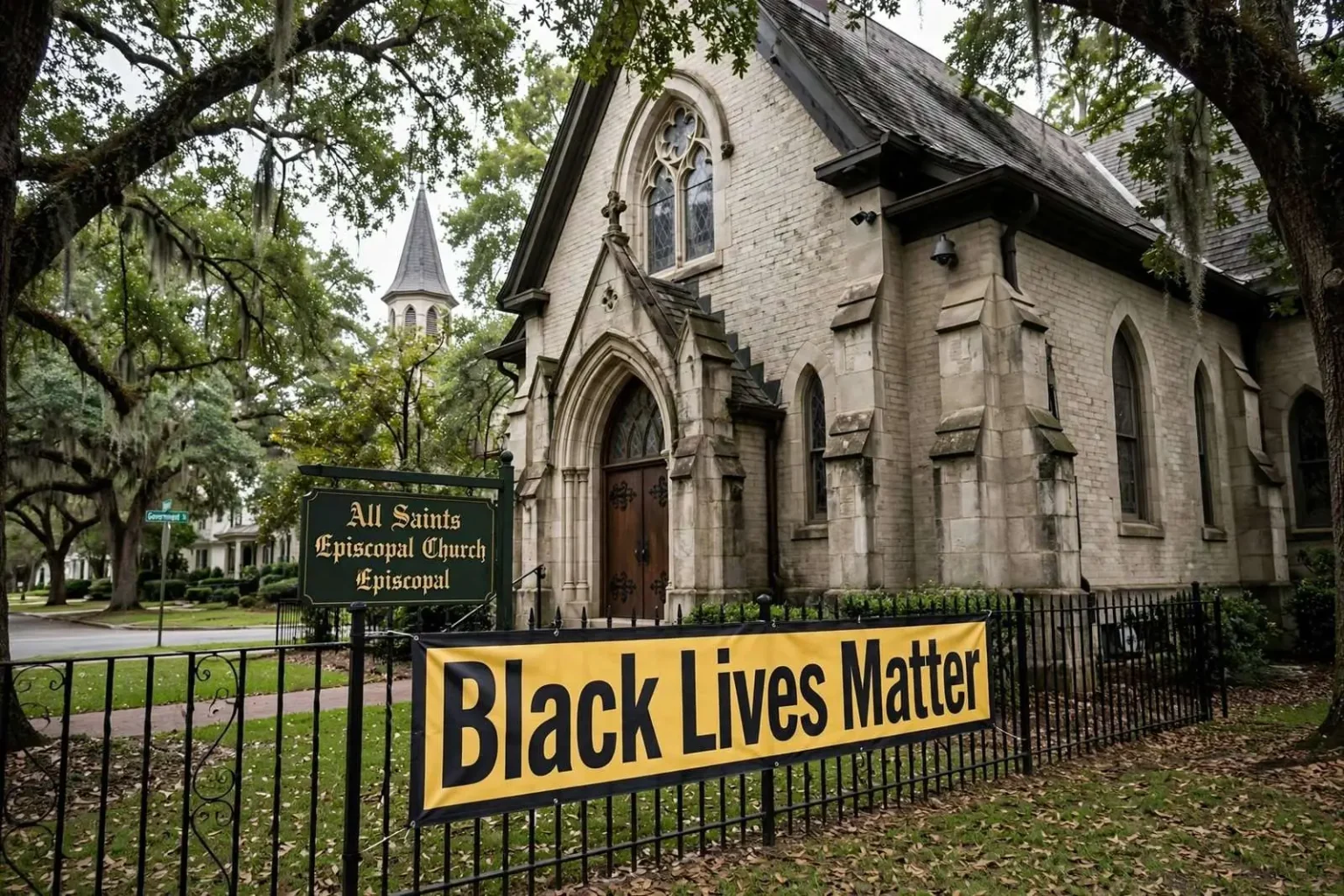
A prominent Mobile church has replaced its Black Lives Matter banner for a second time after the sign was stolen again from the property of All Saints Episcopal Church. The church posted to Facebook on Wednesday confirming that the banner, originally hung as a statement of solidarity against racism, had been taken once more. Church leaders said they immediately ordered a replacement and re-hung it, making clear that repeated thefts would not change the congregation’s decision to display it.
The second theft drew renewed attention to a dispute that has simmered since the banner first appeared on the church grounds. In Mobile, where church signs frequently become points of neighborhood conversation, the repeated disappearance of the same banner has transformed a static display into an ongoing public statement — one that the congregation has now maintained through three separate printings.
How the Banner Went Up
The decision to display the banner came after a discussion about racism during a Sunday school class prompted the church’s governing board to take action. The board voted unanimously to hang the sign, which reads “Black Lives Matter,” on the church grounds. That process — a class discussion leading to a formal board vote — reflected the congregation’s desire that the display represent the whole parish rather than the preference of any single member or clergy leader.
All Saints Episcopal Church, located in an affluent, predominantly white neighborhood of Mobile, has drawn both opposition and support since the banner first went up. Church members said they have received criticism from people outside the congregation, but they have also received significant affirmation from the broader community. Messages of encouragement have come from other Episcopal parishes in the region, from interfaith partners and from Mobile residents who passed the sign and wanted church leaders to know it mattered to them.
The Episcopal Church in the United States has in recent years engaged in formal racial reconciliation work, with General Convention resolutions urging dioceses and congregations to examine the legacy of racism and to take public stands against it. All Saints’ banner fits within that denominational context, and church members have pointed to it as an expression of faith rather than partisan politics.
Responding to the Thefts
Despite the repeated thefts, church leaders said they remain committed to their message and will continue to replace the banner as many times as necessary. The congregation’s response — quick replacement, public acknowledgment and no change in position — has been consistent across both incidents. Members say each theft has, if anything, strengthened the congregation’s resolve and generated more conversation about the banner’s meaning than the sign alone ever would have.
Church leaders had not contacted police about the theft as of the initial reports, but the congregation was discussing installing a camera at the front of the Government Street church to deter future incidents. Security cameras at houses of worship have become increasingly common in Mobile and nationwide, both to protect property and to address vandalism and theft, and the cost of a single exterior camera is modest compared with the recurring expense of replacing stolen signage.
Under Alabama law, the theft of a banner from church property would generally be treated as theft of property, with the classification depending on the item’s value. Congregations that experience repeated property crimes sometimes coordinate with nearby churches and neighborhood associations to share surveillance footage and report patterns to police, an approach All Saints could adopt if the thefts continue.
The Rector’s Reasoning
The Rev. Jim Flowers said keeping the banner up matters because the congregation sees the movement as aligned with Christian values. “Jesus’s ministry was to serve the people who mattered least in his world, and so our Black brothers and sisters have mattered least over the last 400 years,” Flowers said. “So we think it’s a powerful Christian message to stand in solidarity with people who have been left out, and not only left out but oppressed.”
Flowers’ framing places the banner within a theological argument rather than a political one: the congregation’s position is that solidarity with marginalized communities is a continuation of the ministry described in the Gospels. That view has resonated with parishioners who supported the board’s unanimous vote, and it shapes how the church talks about the banner in worship, in classes and in its public communications.
Public displays by congregations on questions of race have a long history in the American South, from sanctuary signs during the civil rights era to modern banner campaigns. In Mobile — a city whose religious landscape includes Catholic, Episcopal, Baptist, Methodist and Pentecostal congregations, among others — church signage has often been one of the most visible ways a parish communicates its values to the surrounding neighborhood.
The Neighborhood Context
All Saints sits in one of Mobile’s established residential districts, an area of historic homes and mature oak canopy where church properties are woven into the street grid. The demographic makeup of the surrounding neighborhood — affluent and predominantly white — is part of why the banner has generated the response it has, both supportive and critical. Congregations in more diverse parts of the city sometimes display similar messages with less controversy; at All Saints, the banner functions as an intentional statement to its own community.
The church’s leaders have acknowledged the criticism directly, saying members of the congregation have been questioned by neighbors and passersby about the sign. Their consistent answer has been that the banner speaks to the congregation’s understanding of its faith, and that disagreements about it, while unwelcome, do not alter the parish’s commitment. Support has come in the form of notes, donations toward replacement signage and messages from Mobile residents unaffiliated with the parish.
Whether a third theft will occur is unknowable, but the congregation has positioned itself for that possibility: a replacement was ordered immediately after the second theft was discovered, and discussions about a front-facing camera continue. What began as a Sunday school conversation has become, through repetition and response, a defining public stance for a parish that has chosen to keep its message hanging where Government Street traffic can read it.
What Comes Next
For now, the banner is back up. Church leaders say they will evaluate security options in the coming weeks and continue to monitor the property. If additional incidents occur, the parish’s stated position is unchanged — replace the sign, acknowledge the loss publicly and carry on with the ministry work the banner is meant to represent.
The episode has also given the congregation an unexpected platform. Local coverage of the thefts, and the church’s own Facebook posts, have spread the banner’s message well beyond the neighbors who pass it daily. In that sense, the congregation notes, those who took the sign accomplished the opposite of their goal: the statement now reaches more people in Mobile than it did before the first theft, and the church has no plans to take it down.
Episcopal Tradition and Public Witness
The Episcopal Church’s approach to questions like this one is rooted in its structure. Congregations are governed by elected lay leadership — at All Saints, the board that voted unanimously — working alongside clergy, which means public statements of this kind carry the weight of a formal congregational decision rather than a single pastor’s preference. That governance model also means reversing course would require another vote, making the parish’s commitment to the banner institutionally durable, not dependent on one leader’s tenure.
Denominationally, the Episcopal Church has passed resolutions addressing racial reconciliation for decades, and in recent years dioceses across the South have sponsored truth-telling projects examining local histories of slavery and segregation. Congregations have expressed that work publicly through banners, stained glass, liturgies and partnerships with historically Black churches. All Saints’ sign places the parish inside that larger denominational movement, a point members have made when explaining the display to critics.
Religious scholars note that public signage is one of the oldest forms of congregational witness. A banner on a church lawn speaks to everyone who passes, member and non-member alike, and it invites response — including unwanted response. The history of civil-rights-era church signage in the South includes vandalism and threats, which is part of why the congregation’s calm, repeated response to the thefts has drawn respect even from observers who do not share the banner’s message.
The Cost of Standing by a Sign
Replacing a banner twice carries real costs, though modest ones: printing, hardware and staff time. The greater cost is organizational attention — meetings, discussions and decisions about security that a parish would rather spend elsewhere. Church members say the conversation about a front-facing camera is pragmatic rather than retaliatory; the goal is deterrence, and if footage ever identified a suspect, leaders have indicated they would follow the congregation’s original instinct to address the matter through community means first.
Insurance typically does not cover repeated small thefts of this kind, since losses fall below deductibles, which makes deterrence the sensible strategy. Neighborhood watch groups in Mobile advise institutions experiencing repeated property incidents to document each occurrence, share timelines with adjacent property owners and report patterns even when individual losses are small — a record helps police connect dots across incidents that might otherwise look isolated.
Whatever the next weeks bring, the parish’s position is settled. The banner hangs on Government Street for the third time, the board’s vote stands, and the rector’s explanation — that solidarity with the marginalized is central to the Gospel the congregation professes — remains the church’s public answer. In Mobile’s church culture, where buildings and signs have long carried meaning, All Saints has demonstrated that a piece of printed fabric can hold a congregation’s conviction against more than one attempt to remove it.