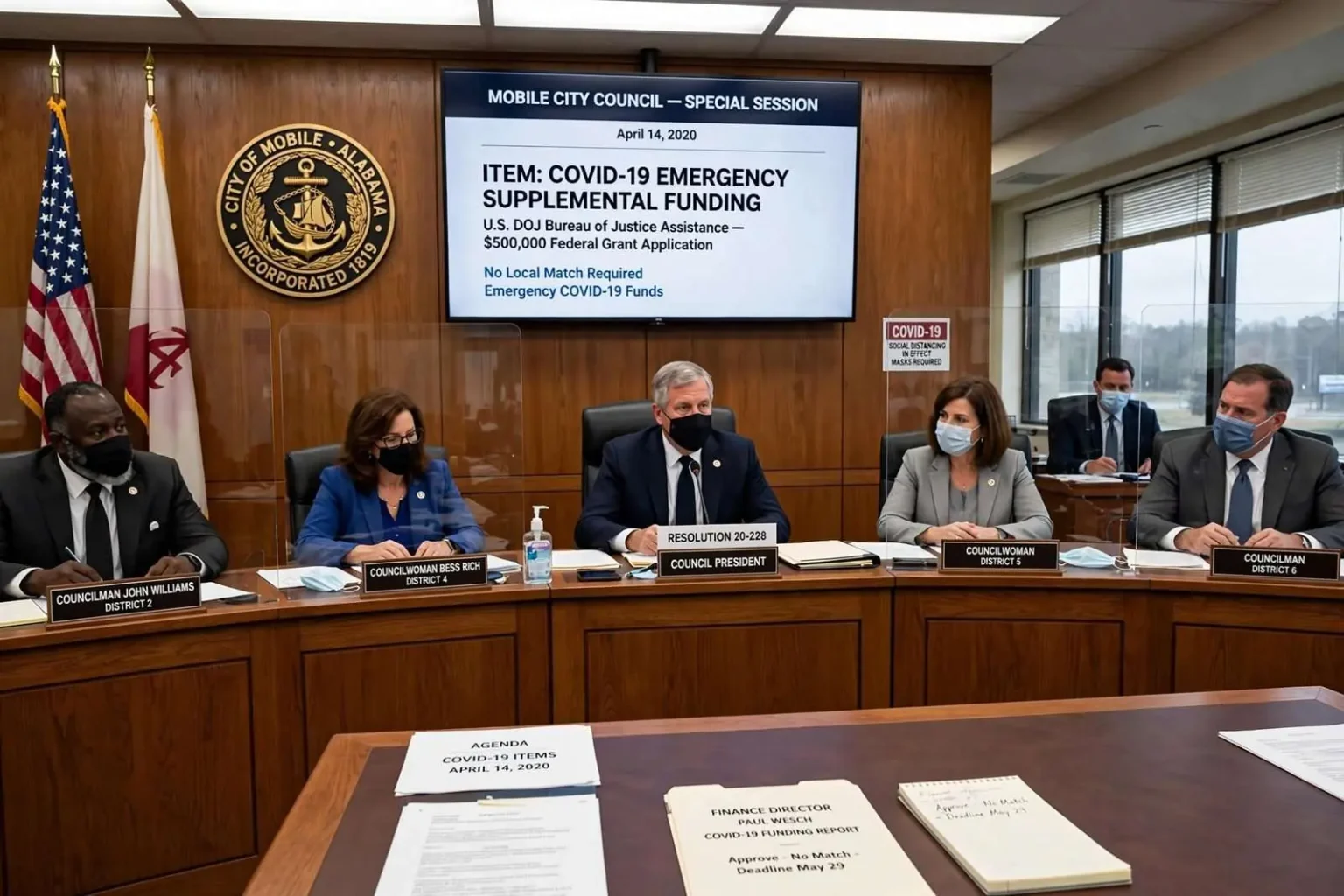
The Mobile City Council voted unanimously on Tuesday, April 14, 2020, to authorize Mayor Sandy Stimpson to apply for a $500,000 grant through the U.S. Department of Justice’s Bureau of Justice Assistance Fiscal Year 2020 Coronavirus Emergency Supplemental Funding Program. The vote came in the early weeks of the pandemic, when cities across the country were scrambling to identify every available stream of federal money, and it put Mobile in line for a half-million dollars with no strings attached to the city’s own budget.
The city is not required to provide any matching funds to receive the money. That detail — unusual in a grant landscape where local matches of 10 to 25 percent are standard — made the application an easy call for a city facing both a public health emergency and the revenue uncertainty that came with it. Every dollar of the grant, if awarded, would be federal money doing work the city’s general fund would otherwise have to do.
According to the Department of Justice, state, local and tribal agencies had until May 29, 2020, to apply for the grant funding, which was designated for a range of pandemic-related expenses, including hiring personnel, covering overtime costs, purchasing protective equipment and supplies, and addressing the medical needs of inmates, among other eligible uses. The eligible uses read like a checklist of the pressures police departments, sheriff’s offices and corrections systems were feeling that spring: overtime budgets blown by staffing shortages and quarantine protocols, mask and glove supplies that had evaporated from the market, and jail medical costs climbing as agencies tried to keep the coronavirus out of confined populations.
The item was not originally on the council’s agenda because it had not gone through the city’s regular routing process, but Councilman John Williams pushed to have it added and voted on immediately. Under the council’s normal practice, items move through committees and administrative review before reaching the full council, a process designed to catch problems but one that takes time the deadline did not allow. Williams argued that the grant application should not wait for paperwork’s sake.
“All we’re doing is we’re authorizing the mayor to pursue (the grant),” Williams said. “Let’s not delay it. What if we’re one day short on that?” The councilman’s point was procedural humility: a vote to apply committed the city to nothing except trying, and the cost of missing the deadline would be a half-million dollars Mobile could not afford to leave in Washington.
Councilwoman Bess Rich agreed the resolution carried little downside for the city. “There’s no match and there might be a timeline to submit the grant,” Rich said. “If there is no harm and no money that we have to let go at any point, according to this resolution, it’s pretty clean.” Rich, known on the council for her scrutiny of spending, effectively gave the item a fiscal blessing — the rare resolution with no local cost, no obligation and a hard expiration date.
Finance Director Paul Wesch also urged the council to move quickly. “We would appreciate any indulgence you can in sending it forward,” Wesch said. “It would sound like something we would like to do sooner rather than later. We are faced with a number of expenditures related to COVID-19.” The finance director’s appeal reflected the view from the budget office: Mobile was already paying for pandemic response in April 2020, and would be paying for months, so every external dollar directly offset spending the city had not planned for in its budget.
A Pandemic Agenda
The grant application was one of seven COVID-19-related items on the council’s agenda that day. The clustering showed how completely the pandemic had overtaken municipal business six weeks into Alabama’s emergency: what would ordinarily have been a routine agenda of zoning cases and infrastructure items had become a rolling response to a crisis that changed week to week, with council members, administrators and department heads improvising procedures as fast as state and federal guidance evolved.
Four construction-related items were held over until the next meeting, and a public hearing on the proposed Mobile Tourism District was postponed four weeks, to May 12. The holds reflected the realities of April 2020 — public meetings curtailed, project schedules in flux and stakeholders unable to gather — but they also illustrated how the crisis reordered the city’s priorities, with emergency response items jumping the queue while the ordinary business of development waited.
The Tourism District proposal, whose hearing was pushed to May 12, had been one of the city’s significant economic development discussions before the pandemic froze it in place. The concept involved designating a downtown district to capture and reinvest tourism-related revenues, part of a longer-running effort to build on the city’s convention business, its waterfront and its historic attractions. Delaying the hearing was the practical choice, but it also meant that the city’s pre-pandemic agenda — the agenda about growth and downtown — sat on pause while the government dealt with survival items.
Council members also approved a separate COVID-19-related item that day: a $2,000 appropriation to Feeding the Gulf Coast to support the organization’s pandemic relief efforts. The amount was small by the standards of the day’s business, but the recipient was central to the region’s emergency response. Feeding the Gulf Coast, the food bank serving south Alabama and the central Gulf Coast, saw demand explode in the spring of 2020 as restaurant closures, layoffs and school shutdowns — which cut off free meal programs for students — pushed tens of thousands of households toward emergency food assistance for the first time.
The contrast between the two votes — $500,000 in federal money applied for and $2,000 in local money spent — captured the fiscal moment municipalities were navigating. Cities were being told to respond to a national emergency with budgets built before it existed, waiting on federal programs whose rules arrived late and shifted, while absorbing immediate costs with whatever flexibility their reserves allowed. Small local appropriations, quick grant applications and improvised procedures were the tools at hand.
What the Money Would Do
If the Bureau of Justice Assistance awarded the grant, the $500,000 would flow to the city with federal reporting requirements but broad discretion among the eligible uses. For the Mobile Police Department, the likeliest claim on the funds was overtime: maintaining patrol coverage while officers rotated through quarantines, staffing pandemic-related call volume and adjusting to new procedures had strained overtime budgets in departments everywhere, and the CESF program was designed precisely to backfill those costs.
The equipment categories mattered as well. In the spring of 2020, personal protective equipment was scarce and expensive nationwide, and police departments — whose officers could not stop answering calls — were competing with hospitals and nursing homes for masks, gloves, sanitizer and disinfectant. Grant money that could cover PPE purchases freed the city’s operating budget for other pandemic costs, from cleaning contracts to technology that let staff work remotely.
The eligible category covering the medical needs of inmates pointed to another pressure point: the city jail. Corrections facilities across the country became outbreak sites in 2020, and jails responded with medical screening at intake, isolation space, additional cleaning and telehealth arrangements. Those measures cost money that jail budgets had never contemplated, and the CESF program’s explicit inclusion of inmate medical needs acknowledged that public safety and public health had temporarily merged.
For the Stimpson administration, the unanimous vote was a small but useful demonstration of city government working at pandemic speed. The council suspended its usual routing, the finance director endorsed it, and seven members voted yes within minutes of the item reaching the floor — the kind of agility that grant program administrators, processing applications from thousands of agencies on a compressed timeline, tended to reward. Whether Mobile received the full $500,000 would depend on federal demand for the funds, but the city had at least made itself eligible before the deadline, which was, as Williams put it, all the resolution asked.
The CESF program itself was part of a federal architecture that had been assembled and rebuilt over two decades of emergencies. The Bureau of Justice Assistance, an arm of the Office of Justice Programs, had run supplemental funding rounds after hurricanes, mass shootings and previous disasters, and the 2020 coronavirus round was its largest to that point, with CARES Act money flowing to every state and thousands of eligible localities. The program’s design — fast awards, broad eligible uses, no local match — reflected lessons from earlier rounds, where slow applications and narrow categories had left small agencies behind.
April 14, 2020, fell in the week Alabama’s coronavirus case counts were beginning their first sustained climb, weeks after the state’s first reported cases and the closure of schools statewide. Mobile had already canceled or postponed its signature spring gatherings, downtown offices had emptied, and the city’s restaurants — the backbone of its tourist economy — had shifted to takeout under state health orders. The council meeting itself was among the first conducted under the city’s pandemic adjustments, with members and staff spaced and the public participation limited, a format that would become routine before it ended.
The unanimity of the vote was itself notable in a council known for vigorous debate over spending. Seven members who had argued over budgets, districts and development incentives found nothing to argue about in a resolution that cost nothing, risked nothing and expired quickly. In a spring when every municipal government was improvising, that kind of consensus was the exception worth noting — and a sign that the pandemic’s fiscal demands, at least in its early weeks, were being met with the simplest tools the city had: apply fast, spend carefully, and keep every option open.