Mobile City Council Approves Richardson’s COVID-19 Distancing Rule for City Property
Mobile City Council passed a Fred Richardson-sponsored resolution 5-2 requiring six feet of distance between people on city property, empowering the mayor to close public property if the rule can't be enforced amid the COVID-19 outbreak.
The Mobile City Council voted 5-2 on Tuesday to approve a resolution from Councilman Fred Richardson limiting how people may gather on property owned by the City of Mobile, part of a wave of local measures aimed at slowing the spread of COVID-19.
The measure requires anyone on city-owned property to keep a consistent six-foot distance from others for as long as the state health officer’s emergency order remains in effect. It also directs Mobile’s mayor to take whatever steps are needed to carry out the distancing requirement and gives the mayor authority to close city property to the public altogether if that spacing cannot be maintained.
The closure power carves out exceptions for COVID-19 testing, other efforts to fight the outbreak, and official city business.
The resolution’s reach is broad by design. City-owned property in Mobile includes an extensive inventory — parks and playgrounds across all seven council districts, squares downtown, recreational facilities, ball fields, the civic center complex and municipal buildings — and the measure threads the distance requirement through all of it. By tying the rule’s duration to the state health officer’s emergency order rather than a date certain, the council built in an automatic sunset: when the state’s order lifts, Mobile’s local rule lapses with it.
The vote and how it was cast
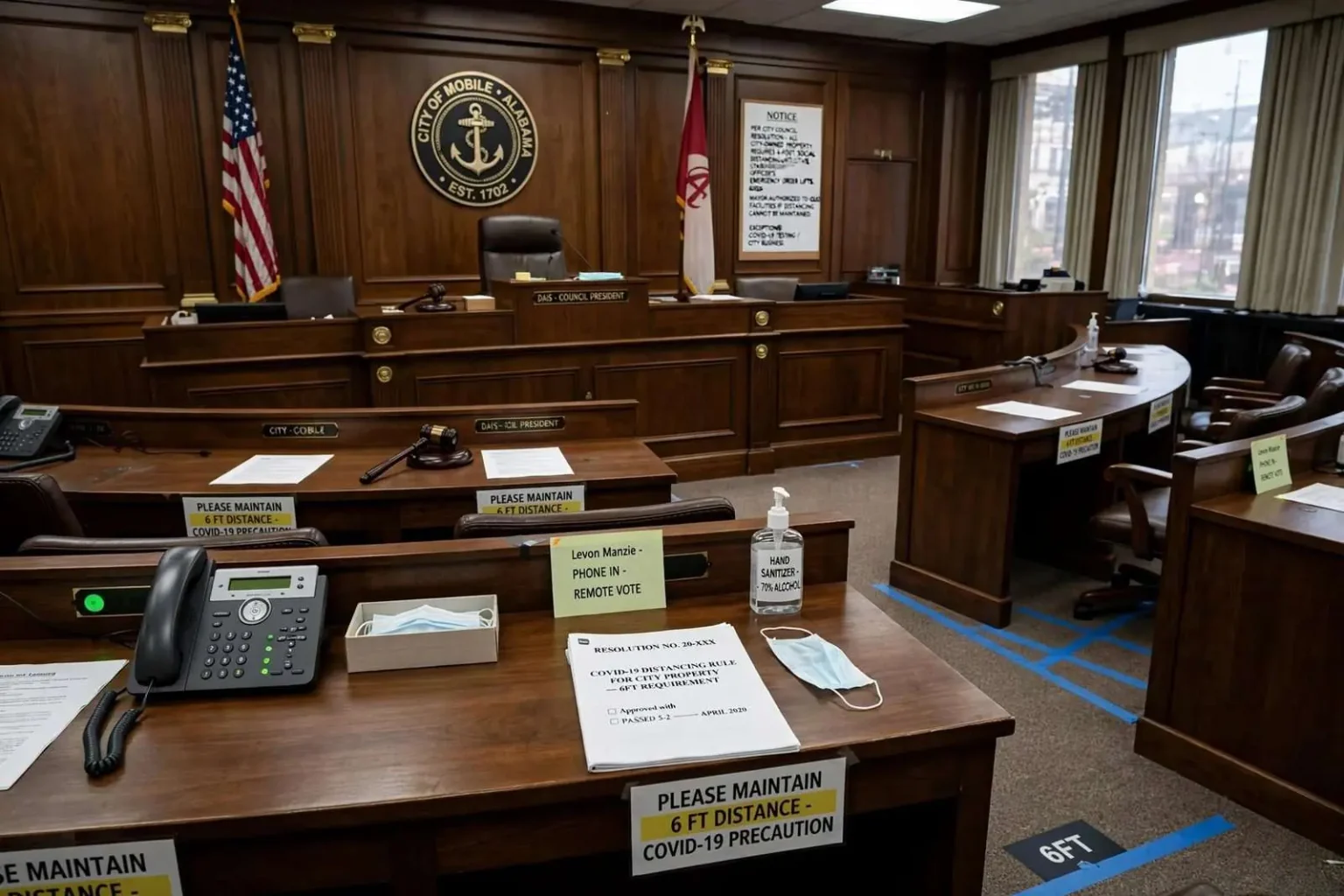
Council President Levon Manzie and Councilwoman Bess Rich both phoned in to cast votes in favor of the resolution, joining Richardson, Gina Gregory and C.J. Small in the 5-2 majority. Councilmen Joel Daves and John Williams voted no.
The phoned-in votes were themselves a marker of the moment. With public health guidance urging separation and members of the council among those most exposed to the public in their daily work, the council adapted its own procedures — allowing members to participate and vote remotely — while continuing to conduct the city’s business. The image of a council chamber conducting a pandemic vote by speakerphone was one repeated in city halls across the country that spring, as local governments worked out, in real time, how to govern while keeping their own governing bodies safe.
The item consumed much of the council’s work session before Tuesday’s regular meeting, with debate stretching close to an hour.
Richardson said the resolution was not meant to stop residents from visiting parks or taking walks, but to prevent people from gathering in groups.
“Nothing in my resolution says anything about closing parks,” he said. “The reason we have so few cases here in Mobile is because people haven’t been tested. We don’t know what it is until we start testing. The only way to jump on COVID-19 is to separate the well from the sick. Until we know who is sick, we have to use some restraint ourselves.”
Richardson’s argument about testing reflected a frustration widespread among local officials in the outbreak’s early weeks: confirmed case counts were rising slowly in many Southern communities not because the virus was absent but because diagnostic capacity was scarce, leaving officials to make decisions on partial information. His framing — that a community that does not know who is sick must act as if anyone could be — was the case for precaution in its simplest form, and he pressed it against colleagues who worried about the resolution’s reach.
Public Safety Director James Barber and Public Works Director John DeLapp told the council the resolution would reinforce, rather than duplicate, an order Gov. Kay Ivey had already issued statewide restricting large gatherings.
Williams pointed to Ivey’s order as evidence a local rule wasn’t needed, while Daves said he agreed with Richardson’s underlying aim even as he voted against the resolution itself.
The disagreement was a familiar one in the layering of American emergency authority. The governor’s order bound everyone in Alabama already; the question was whether a city resolution added anything beyond it. Supporters argued that local action sends a local signal — that residents see their own city government acting, and that city police and parks staff get a clear rule to enforce on the specific property the city controls. Critics answered that duplicative rules confuse the public, invite selective enforcement and add legal obligations without changing behavior the state order doesn’t already cover.
For city departments, the distinction matters in the field. Barber’s public safety personnel and DeLapp’s public works crews are the ones who would encounter a crowd at a playground, a pickup game at a ball field or a gathering in a downtown square — and they are also the city’s own employees tasked with keeping facilities open or closing them. A local rule gives them authority to act on city property without waiting on the state; it also makes them the visible face of enforcement in neighborhoods where, in a pandemic, the goal is compliance rather than citations.
What the resolution actually changes for residents
For most residents, the practical effect is guidance wrapped in law: use city parks, but keep six feet apart; don’t congregate in groups; expect that if a site cannot accommodate spacing, the mayor may close it. The mayor’s closure authority — the sharpest tool in the resolution — is contingent and targeted, meant for the specific park or facility where distancing fails, with the testing and city-business exceptions preserved so that emergency operations continue.
The exceptions also mark the resolution’s logic: the point is not to seal the city but to keep city property from becoming the place where the virus spreads. Outdoor transmission risks were still being studied in the pandemic’s early months, but the precautionary consensus among health officials held that close, sustained contact — the kind that happens at crowded courts, playgrounds and group gatherings — is how the disease moves, indoors or out.
Mobile’s measure joined a wave of similar actions across Alabama’s municipalities that spring, as mayors and councils from Huntsville to Birmingham to the coast layered local rules onto the state’s emergency framework. Cities with large public-event calendars — and Mobile’s calendar, from Mardi Gras through spring festivals, had already been stripped bare by the outbreak — had particular incentive to formalize the rules governing their public spaces until large gatherings could safely resume.
The two dissenting votes did not block the measure, but they recorded the concern that would echo through the pandemic’s local governance debates for months to come: how much restraint is enough, how much is too much, and who decides. In Mobile’s case, the answer for now was the council’s 5-2 majority — a six-foot rule, an automatic tie to the state’s emergency order, and a closure power held in reserve in the mayor’s office.
The context behind the vote
The resolution arrived in the pandemic’s first spring, when Alabama was under a statewide state of emergency and the state health officer’s orders were closing schools, restricting gatherings and reshaping daily life. Mobile County had reported cases in the hundreds by the time of the vote, with testing still limited by national shortages of swabs, reagents and lab capacity — the shortage Richardson referenced directly in his remarks. Across the Gulf Coast, public officials were making consequential decisions with case counts they knew understated the outbreak, which is precisely why precautionary measures like the distancing rule drew support despite their breadth.
The city’s own operations were simultaneously under strain. Municipal buildings had restricted public access, city court proceedings had been curtailed, and the recreation calendar — leagues, senior programs, after-school activities — had gone dark. The resolution gave legal cover to the enforcement of spacing on the city’s remaining open spaces, the parks and squares where residents naturally congregated once every other option was closed.
Richardson, the council’s longest-serving member at the time and its most forceful advocate on the measure, framed his resolution as a community obligation rather than a restriction. His position put him, for once, in league with a cross-section of the council that included colleagues he frequently opposed — a reminder that in the outbreak’s early weeks, pandemic measures were generating coalitions that cut across the city’s usual political and geographic lines.
Enforcement, and what came next
Like most of Alabama’s local pandemic measures, the resolution was designed for persuasion first. Police departments across the state, Mobile included, treated the early distancing rules as education opportunities — dispersing groups, explaining the rules, saving citations for the rare refusal. The mayor’s closure authority under the resolution followed the same logic: it existed to be used sparingly, at the specific property where a crowd would not disperse, rather than as a blanket shutdown.
The debate Williams and Daves offered — that a statewide order made a city rule redundant — would resurface in city halls across Alabama throughout the pandemic, every time a local government considered whether to exceed, mirror or merely await state action. Mobile’s answer that Tuesday was the middle path: a local rule that did nothing the state had not done, but made the state’s requirement the city’s own on the ground the city owns, expiring automatically when the emergency does.
In the longer arc of the pandemic, the resolution stands as a record of the moment when the scale of the threat was still being measured — when a councilman could observe that his city’s low case count said more about testing than about the virus, and when six feet of distance on a park bench was the most consequential rule in city government.