RV owners hoping to park in the heart of Mobile’s Mardi Gras action will have their chances drawn by lottery next week.
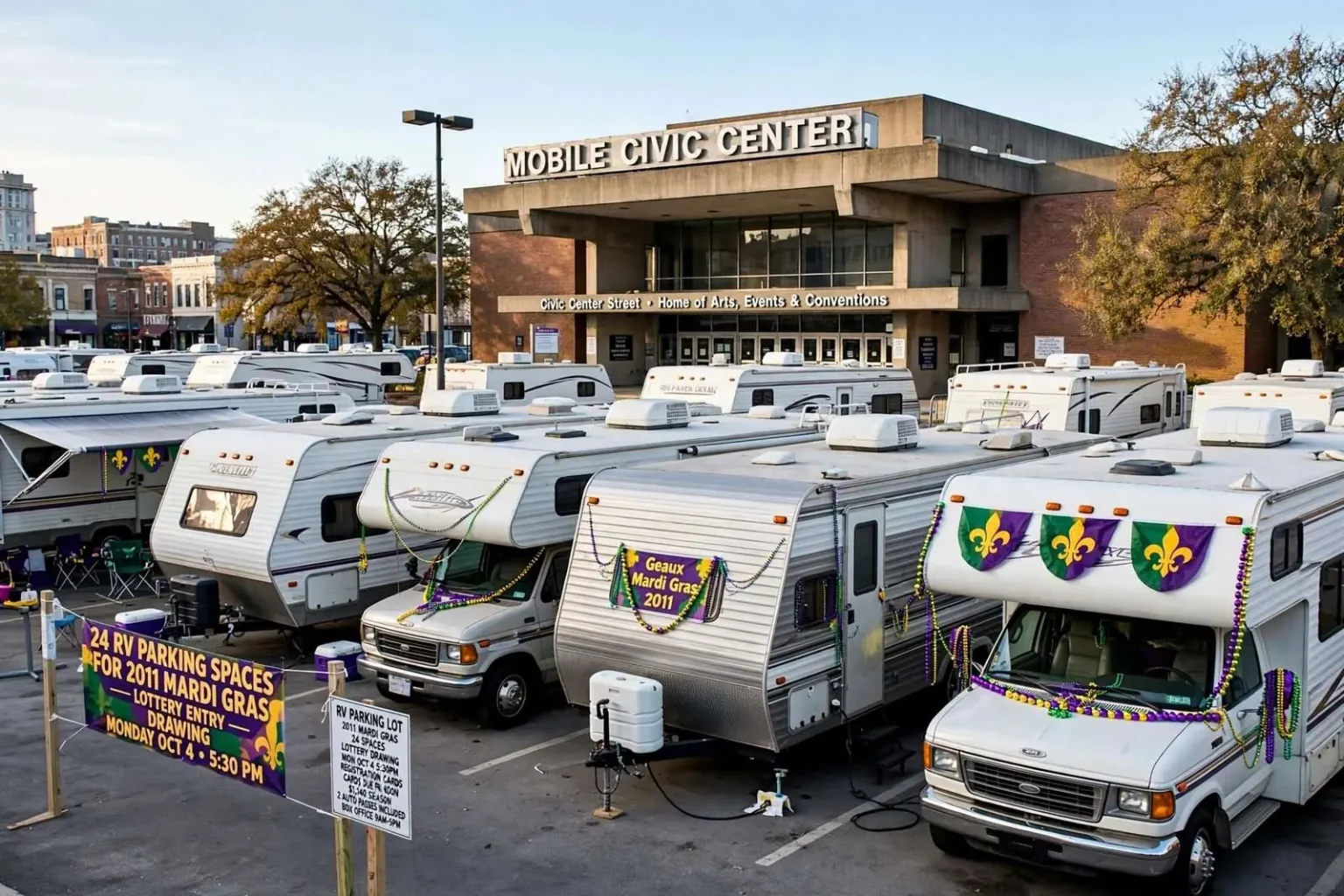
The Mobile Civic Center will hold its drawing for 24 RV parking spaces for the 2011 parade season on Monday, October 4, at 5:30 p.m. Registration cards must be turned in by noon Friday ahead of the drawing. Cards are available at the Civic Center Box Office between 9 a.m. and 5 p.m.
What the Spaces Include
All 24 spaces come with hook-ups — no free-standing RVs will be allowed during carnival season. Each space costs $1,000 plus the city’s 14 percent lodgings tax, for a total of $1,140 covering the entire parade season. The price includes two automobile passes per RV, making it possible to leave the rig parked and drive out between parades.
Those hook-ups are the entire point. A self-contained RV parked downtown without water, sewer, and electrical service becomes a logistics problem within a day, and the city’s rule barring free-standing rigs keeps the lot usable for the full season. With hook-ups, an RV owner can essentially live downtown from the first parade to Fat Tuesday — something no hotel room at Mardi Gras rates can replicate at anything close to the price.
The arithmetic explains the demand. Mobile’s downtown hotels fill months in advance for the final two weeks of the season, and rooms near the parade routes routinely run several hundred dollars a night. A season-long space at $1,140 — less than two nights at some downtown properties during the peak weekends — makes the Civic Center lot the most valuable real estate deal in Mobile carnival culture, which is why 24 spaces require a lottery rather than a sign-up sheet.
A Front-Row Seat to Mobile Mardi Gras
The Civic Center lots sit within easy reach of downtown’s parade routes, and spaces there have long been among the most coveted accommodations of Mobile’s Mardi Gras season. Mobile’s carnival celebration is the oldest in the country — dating to 1703, before New Orleans existed — and its downtown parade season stretches across more than two weeks of evening processions by mystic societies, whose floats roll through the streets around the Civic Center, Government Street, and the historic districts nearby.
From an RV in the Civic Center lot, the parade experience is a short walk: no downtown parking hunt, no traffic deadlock after the last float passes, no designated driver. Owners step outside, walk to the route, catch the parade, and walk home. The two automobile passes sweeten the arrangement for people who must work during the day — leave the rig fully set up, drive out to the office, and return each evening without ever breaking camp.
The lottery format is deliberately simple. Fill out a card at the box office by Friday noon, and the drawing on Monday evening decides who gets the season. Winners typically must complete payment promptly to hold their spaces, and any unclaimed spots are usually offered down the list — details the Civic Center box office staff confirm at registration.
The Civic Center and Its Carnival Role
The Mobile Civic Center, opened in the 1960s on Civic Center Street between Claiborne and Canal Streets, has been the workhorse venue of Mobile’s public life for decades: concerts, monster truck shows, graduations, and, every February, the site of some of carnival’s most anticipated society balls. During parade season its parking lots take on a second life, transformed into a small village of recreational vehicles whose occupants form one of the season’s most loyal constituencies.
For many families, the RV lot is a tradition as much as an accommodation. Spaces are drawn by lottery precisely because demand far exceeds supply, and losing the drawing one year means trying again the next — a cycle that has produced decades of stories about families who gathered in the same row of rigs every season. The lot becomes its own neighborhood during carnival, with neighbors watching each other’s setups, sharing gumbo between parades, and forming the kind of street-level community that Mobile’s mystic societies build in their own halls.
Planning for the 2011 Season
The October drawing gives winners months to prepare. The 2011 parade season was set to open in late February and run through Mardi Gras day on March 8, 2011 — one of the later Fat Tuesdays on the calendar, which stretches the season into two full weeks of parades. That longer window makes a season-long space even more valuable, since the usual pattern of weekend trips to Mobile cannot cover a carnival calendar that rolls every night during the final stretch.
Prospective renters should keep a few practical realities in mind. The lodgings tax adds $140 to the base price and applies because the city treats the spaces as transient accommodations — the same logic that taxes hotel rooms. Generator use, pets, guests, and space boundaries are governed by the Civic Center’s rules, and box office staff review them with winners at registration. The no-free-standing-RV rule is the one most often asked about; it exists because the hook-ups are what the city is selling, and a rig without service ties up a spot someone else would put to full use.
For those who lose the lottery, Mobile’s carnival offers alternatives, though none as central: RV parks well outside downtown with shuttle or long drives, hotels across the bay in Daphne and Spanish Fort, and the time-honored local solution of parking in a friend’s yard. None puts a visitor inside the bubble of downtown carnival the way the Civic Center lot does, and that is why the box office keeps dispensing registration cards year after year — and why Monday’s drawing will leave two dozen winners and a room full of hopefuls already planning for next season.
Registration cards are available now at the Civic Center Box Office, 9 a.m. to 5 p.m., and must be submitted by noon Friday. The drawing follows Monday at 5:30 p.m.
How Mobile’s Carnival Calendar Works
To understand why 24 parking spaces command a lottery, it helps to understand the scale of Mobile’s carnival season. The city’s mystic societies — from the oldest, like the Order of Myths, which first paraded in 1868, through the dozens of societies that roll today — stage parades almost nightly during the final weeks. Each parade brings floats, marching bands, and masked riders throwing moon pies, beads, and cups to crowds that line the route hours in advance. The season culminates on Mardi Gras day itself, when the societies parade in sequence from morning until night and downtown becomes a city within a city.
The crowd that gathers for those final days is a serious logistical population. Some arrive from New Orleans, which borrowed much of its own carnival tradition from Mobile, and others come from across Alabama, Mississippi, and the Florida panhandle. They need places to sleep, eat, and park, and downtown Mobile’s supply of all three is finite. That is the gap the Civic Center lot fills — twenty-four fully serviced sites within walking distance of every downtown parade route.
The Economics of a $1,140 Season
Looked at from the city’s side, the pricing tells its own story. The $1,000 base rate for the entire season reflects the city’s judgment that the spaces should go to committed carnival-goers rather than speculators, and the season-long structure means winners cannot subdivide the period or resell nights. The 14 percent lodgings tax is Mobile’s standard levy on short-term accommodations, the same rate applied to hotels and motels, which places the RV spaces in the same legal category as any other visitor lodging in the city.
For the occupants, the cost per night works out to a fraction of any downtown alternative once the full parade calendar is counted. Two automobile passes — included in the price — solve the classic problem of RV camping: the rig does not move, so the occupants need a way to move themselves. With passes, an owner can drive to work in the morning, be back for an evening parade, and never surrender the fully established campsite.
A Tradition That Outlives the Venue
The Civic Center itself has seen proposals over the years for renovation, replacement, and redevelopment, and Mobile’s long-range plans for its downtown have repeatedly circled the aging complex. Whatever the building’s future, the RV lot tradition illustrates why the venue’s footprint matters beyond its event calendar: during carnival season, those lots are effectively a campground, a neighborhood, and one of the best seats in American Mardi Gras culture, all at once.
Entries for the drawing are free beyond the commitment to pay if selected, and the Civic Center Box Office staff urge anyone interested to come early in the week rather than risk missing the Friday noon deadline. Last-minute hopefuls have historically numbered in the hundreds, and every year some discover too late that a stack of registration cards sat waiting at the window since the announcement.
The drawing itself, Monday at 5:30 p.m., is open to those who registered, and the Civic Center typically announces results immediately. Winners receive payment instructions and the rules packet for the season; the rest receive a lesson in Mobile carnival culture that ends the same way every year — with a promise to try again for the 2012 season.