Mobile Committee Takes Up How Medical Marijuana Dispensaries Would Be Regulated in the City
Mobile's Public Services Committee weighed how medical cannabis dispensaries would be regulated as Baldwin County cities took sides on the issue.
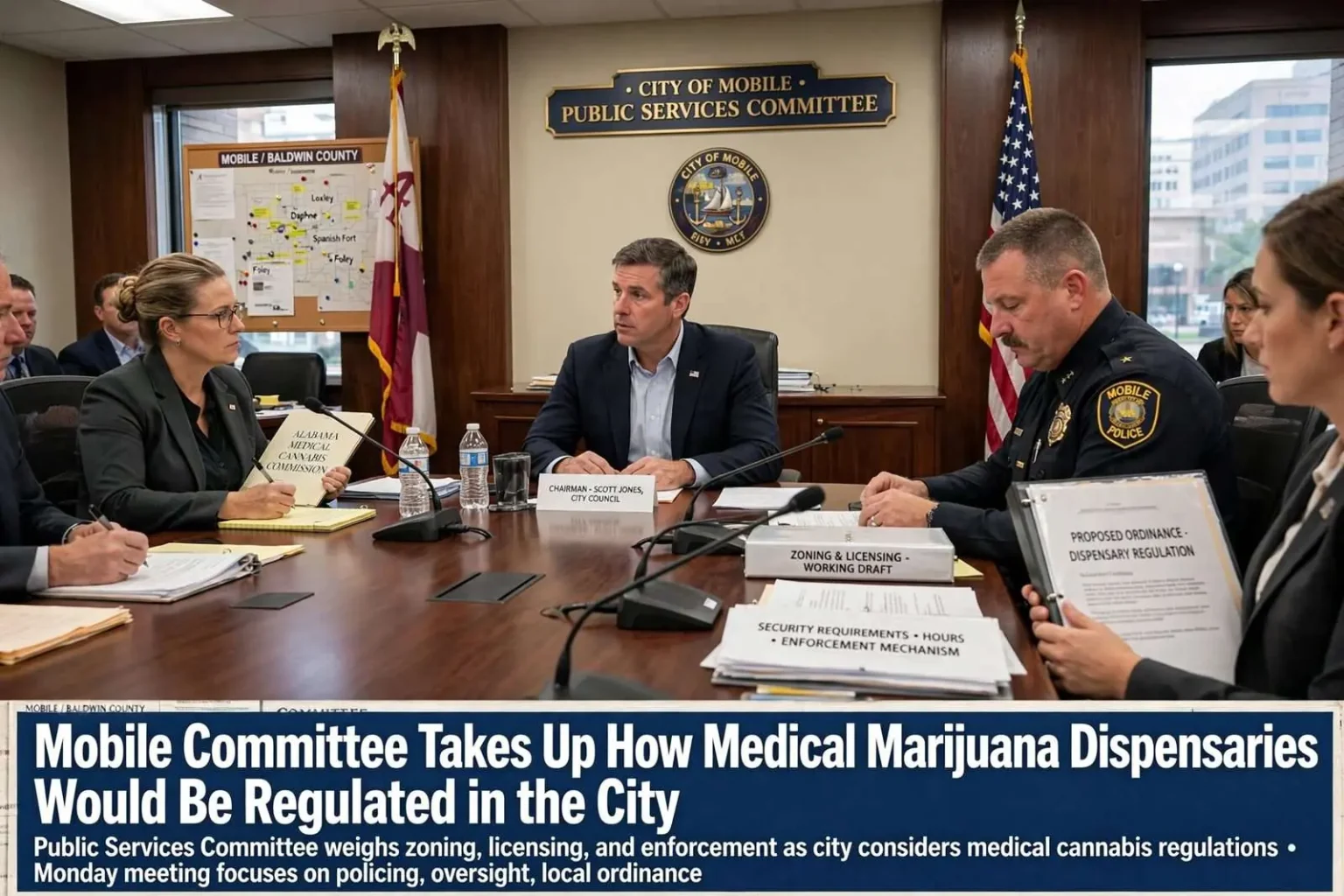
Medical marijuana dispensaries could be headed to Mobile — and city officials want to know exactly how they would be policed before letting them in. Mobile’s Public Services Committee met Monday afternoon to discuss how dispensaries would be regulated within the city, with the session focused on the legislation governing their establishment and operation proposed for Mobile. The meeting marked one of the most detailed local examinations yet of how Alabama’s medical cannabis framework would translate into rules for the state’s largest city, where questions of zoning, licensing, and law-enforcement oversight remain unresolved.
Chairman and City Councilman Scott Jones said the committee wanted to understand how the handling and enforcement of a controlled substance would work before any decision was made. His framing reflected the council’s central concern: cannabis remains a controlled substance under both state and federal law, and any local framework has to spell out who enforces the rules, what violations look like, and how a dispensary’s day-to-day operations would be monitored. Jones and other committee members wanted that enforcement picture laid out before the city opened the door to any applications.
The discussion came as neighboring Baldwin County cities had already taken positions on the issue: Loxley, Daphne, Spanish Fort and Foley passed resolutions favoring dispensaries, while Fairhope turned them down. The split on the Eastern Shore and along the I-10 corridor showed how differently communities across the region are reading the same state law, and it put pressure on Mobile — the largest market in the area — to define its own approach. Mobile’s decision carries extra weight because whatever rules the city writes would shape how cannabis businesses operate across a metro area far larger than any Baldwin County municipality.
Who Came to the Table
Representatives of the state cannabis commission, state legislators, city council members and Mobile public safety officials were expected at the meeting as Mobile — the largest metro area in this part of Alabama — weighed its own approach. The mix of participants reflected how many layers of government touch the question. The state commission handles statewide licensing and regulation, legislators write and revise the underlying statutes, the council writes whatever local ordinance applies, and police and public safety agencies answer the practical questions about enforcement on the ground.
The State Framework Behind the Local Debate
Alabama lawmakers legalized medical cannabis with the Alabama Medical Cannabis Act, which created a statewide commission to license cultivators, processors, transporters and dispensaries and to write the regulations that govern the industry. Under the state framework, patients who qualify can obtain medical cannabis products through licensed dispensaries, but the law leaves significant room for local governments to decide how, and whether, those businesses fit into their communities. That gap between state legalization and local implementation is what brought the question before Mobile’s committee.
The commission’s licensing process has been watched closely across the state, and municipalities have been forced to decide in real time how to respond. Some cities have welcomed dispensaries as a regulated business category that could bring jobs and tax activity; others have passed resolutions opposing them or used zoning powers to keep them out. The result has been a patchwork map across Alabama, with neighboring cities in the same county sometimes taking opposite positions — exactly the pattern now visible in Baldwin County, where Loxley, Daphne, Spanish Fort and Foley sit on one side and Fairhope on the other.
Mobile’s size makes its position the most consequential in southwest Alabama. As the largest metro area in this part of the state, Mobile represents the biggest potential market for licensed operators, and any ordinance the city adopts would set the template that other Mobile County municipalities watch. A permissive framework would likely draw applications from operators holding state licenses; a restrictive one would push those businesses toward smaller jurisdictions that have already signaled they are open.
For the Public Services Committee, the Monday session was a working meeting rather than a final vote. The committee’s role is to sort through proposed legislation and operational details before items reach the full council, and the dispensary question involves enough moving parts — who may operate, where facilities may locate, how products are tracked, and what happens when rules are broken — that members wanted the full enforcement picture in front of them before moving anything forward.
Public safety officials at the session were expected to address how a dispensary would be policed in practice. That includes security requirements at the facilities themselves, how officers would respond to incidents involving cannabis products, and what authority local police retain once the state licenses an operator. Those practical questions are where city regulation differs most from the state framework, and they are the questions Jones said the committee wanted answered first.
What Regulation Would Have to Cover
The legislation proposed for Mobile would govern how dispensaries are established and operated inside city limits, and the committee session focused on the details that such an ordinance has to settle. Location rules are typically the first hurdle: cities must decide which zoning districts can host a dispensary, how far facilities must sit from schools, churches and daycares, and whether the distances are measured property line to property line or door to door. Those measurements determine which commercial corridors could realistically host a facility and which are off the table entirely.
Operation rules come next. A local ordinance can set hours of operation, signage and advertising limits, security camera and alarm requirements, and rules about who may enter a facility. Cities can also require background checks for owners and employees, impose local business licensing on top of state licensing, and attach conditions that make a license easier to revoke than the state’s. Each of those levers gives the city a way to police the industry locally rather than depending entirely on the state commission’s oversight.
Enforcement is the piece Jones emphasized. If a dispensary violates its local conditions — selling outside permitted hours, exceeding limits, or failing security requirements — the city needs a defined response, whether that is a citation process, a license suspension, or closure. The committee wanted to understand how that enforcement would be handled and by whom before any decision was made, since an ordinance without a workable enforcement mechanism leaves the city with rules it cannot apply.
Lessons From Neighboring Jurisdictions
The Baldwin County split gives Mobile a nearby set of comparisons. Loxley, Daphne, Spanish Fort and Foley passed resolutions favoring dispensaries, signaling to operators that those communities are open to the business category. Those cities cover a stretch of the Eastern Shore and the Highway 59 corridor toward the beach, meaning medical cannabis patients in Baldwin County would have multiple potential access points even with Fairhope’s refusal. Fairhope, one of the Eastern Shore’s most prominent municipalities, took the opposite path and turned dispensaries down, using the tools available to it under state law to keep the industry out.
That kind of split has real consequences for patients. Medical cannabis access depends on where dispensaries actually locate, and when a county’s municipalities diverge, patients in opt-out communities may have to travel across town — or across the bay — to reach a licensed facility. For a metro area the size of Mobile, the question is not only whether the city permits dispensaries but how many locations would be practical and where they would concentrate if allowed.
The regional pattern also gives Mobile’s council members a preview of the arguments they will hear from both sides. Communities that have welcomed dispensaries have generally emphasized regulation, controlled access and economic benefit, while communities that have refused them have cited concerns about youth access, crime, and community character. Mobile’s committee session, with state regulators, legislators and police officials at the table, was structured to test those arguments against the actual mechanics of enforcement rather than settling the question by slogan.
What Comes Next for the Council
The Monday meeting was a step in a longer process. The Public Services Committee’s recommendations would eventually move to the full City Council, which would have to vote on whatever ordinance emerges from the discussion. Between the committee session and any final vote, members signaled they wanted answers from the state commission and from the city’s own public safety leadership about how a dispensary regime would actually function on Mobile streets.
The timeline matters for operators as well. Businesses holding or seeking state licenses watch municipal decisions closely, because a city’s framework determines whether an operator can open a location there and on what terms. If Mobile adopts a regulatory framework, applications would follow quickly; if the council chooses prohibition or delays, operators would concentrate on jurisdictions like those Baldwin County cities that have already passed favorable resolutions.
For now, the council’s position is that the question is open — and that the city will not decide it until it understands the enforcement mechanics. Monday’s session with the state cannabis commission, state legislators, council members and public safety officials was designed to supply that understanding, as Mobile weighs how — and whether — medical marijuana dispensaries will operate in Alabama’s largest metro area in this part of the state.