
Mobile County Animal Shelter Cuts Adoption Fees to $40 Amid Summer Pet Surge
The Mobile County Animal Shelter dropped adoption fees to $40 for all adoptable animals, with 30-plus pets awaiting homes at Howells Ferry Road.
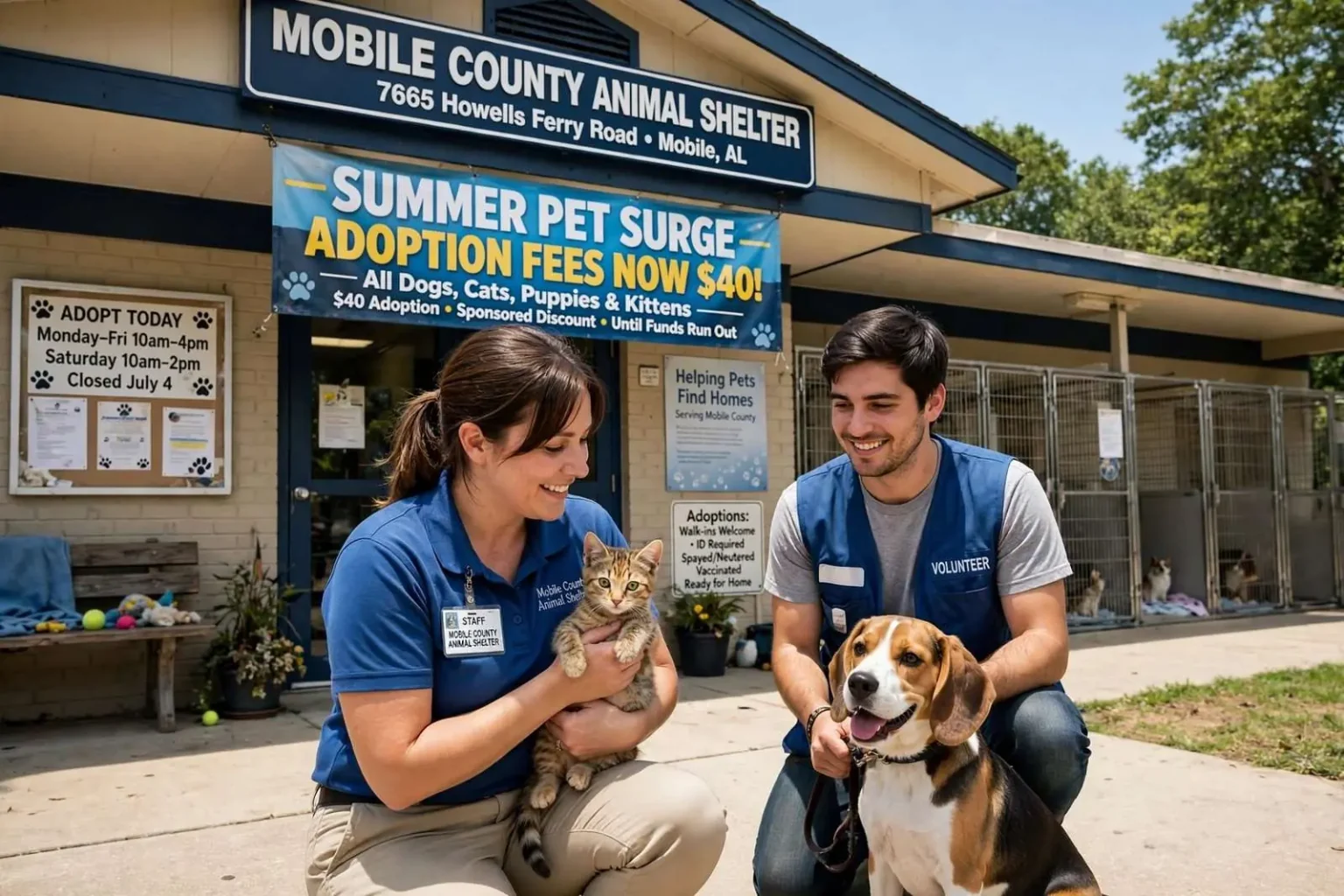
MOBILE, Ala. — Adopting a pet from the Mobile County Animal Shelter just got more affordable. The shelter is dropping its adoption fee to $40 for every adoptable animal under a sponsorship-backed discount that runs until the sponsored funds run out, a deal designed to move more dogs and cats out of kennels and into homes during the busy summer season.
Shelter officials say the timing matters. Warmer weather typically brings an expanding pet population across Mobile County, as breeding season peaks and litters of puppies and kittens arrive faster than they can be placed. More than 30 dogs and cats were waiting for forever homes when the discount was announced, and every adoption frees up kennel space, staff time and resources for the next animal through the door.
The $40 fee applies to every adoptable animal at the shelter — dogs, cats, puppies and kittens alike — rather than a tiered structure that charges more for some animals than others. Sponsorship-backed discounts like this one are a common tool for animal shelters: businesses, donors or community groups put up the money to cover part or all of the adoption fee, lowering the barrier for adopters while the shelter keeps operating.
Adoptions are handled at the shelter’s facility at 7665 Howells Ferry Road in Mobile. Hours are Monday through Friday from 10 a.m. to 4 p.m., and Saturday from 10 a.m. to 2 p.m. The shelter closes on major holidays, including July 4, so prospective adopters should plan their visits around the regular schedule.
Why summer strains animal shelters
The seasonal surge that shelter officials describe is a nationwide pattern, and Mobile County is no exception. Cats and dogs breed most actively in the warmer months, and the resulting wave of kittens and puppies lands on shelters in late spring and summer. At the same time, stray intakes climb as animals spend more time outdoors, and families moving or traveling during the summer months surrender pets they can no longer keep.
For a county shelter, that arithmetic adds up quickly. Kennels fill, isolation spaces overflow, and staff must stretch food, medicine and attention across more animals than the facility was designed to hold. Overcrowding also raises health risks, since contagious illnesses like kennel cough spread faster when animals are housed close together.
Discounted adoption events exist precisely because of that pressure. By lowering the up-front cost, the shelter widens its pool of potential adopters to include families who might hesitate at a full-price adoption — and every animal that leaves makes room for the next intake. The sponsorship model protects the shelter’s finances while the promotion runs, ensuring the reduced fee doesn’t cut into the care budget.
What adopters get for the fee
The adoption fee at a county shelter typically covers far more than the animal itself. Animals made available for adoption are generally spayed or neutered, vaccinated and evaluated for health and temperament before they go home — services that would cost a pet owner hundreds of dollars at a private veterinary clinic. The $40 fee under the sponsorship discount makes that package one of the best values in the local pet market.
Prospective adopters can preview photos of available animals on the shelter’s Facebook page before visiting, a tool that has become essential for shelters. Browsing online lets families narrow their search, discuss which animals might fit their household, and arrive at the shelter with specific candidates in mind.
But staff encourage families to come meet the animals in person to find a good match. Photos can’t capture a dog’s energy level around children, how a cat responds to a calm lap, or the chemistry between an animal and its potential owner. In-person visits — and the conversations with shelter staff that come with them — are how good adoptions happen, and the staff at Howells Ferry Road know their animals well enough to steer families toward pets that fit their living situation and lifestyle.
Preparing to adopt
Shelter staff and animal welfare professionals generally recommend that families think through a few basics before coming to meet animals. Renters should confirm pet policies with landlords, since breed and size restrictions are common. Everyone in the household should agree on the commitment before an animal comes home, and existing pets’ temperaments should be considered when choosing a companion. Budget matters too — beyond the adoption fee, a new pet needs food, veterinary care, licensing and supplies.
The shelter’s Saturday hours make visits practical for working families, while the weekday schedule offers quieter sessions for adopters who want more time with individual animals. Visitors during the promotion should be prepared for full kennels; the more than 30 animals waiting at the announcement represent only the animals present that week, and intakes continue daily.
The discount’s open-ended structure — running until the sponsored funds run out — gives it a sense of urgency. Unlike a fixed-end-date event, a sponsorship-backed promotion can conclude at any time once the pool of sponsor money is spent. Families who have been considering adoption have an added reason to visit sooner rather than later.
What happens after the discount
Promotions like this one serve the shelter’s immediate goal, but officials are quick to note that the need continues after the sponsored funds are exhausted. The county shelter operates year-round, taking in strays, owner surrenders and animals removed from neglect situations regardless of season or promotion schedule. Adoption fees help offset the cost of care, which is why the sponsorship model is so valuable — it supports the shelter’s budget while expanding access for adopters.
Community members who want to help beyond adopting have several options. Volunteers, donations of supplies and foster homes all extend the shelter’s capacity, and fostering in particular frees kennel space for the constant stream of new arrivals during summer. Spaying and neutering pets remains the single most effective way individuals can reduce the intake pressure that makes promotions like this necessary.
For now, though, the message from Howells Ferry Road is simple: more than 30 dogs and cats are ready to go home, the fee is $40, and the doors are open six days a week. For families who have been waiting for the right moment to add a pet, the shelter’s summer discount has made that moment now — until the sponsor’s generosity runs out.
Finding the shelter
The Mobile County Animal Shelter is located at 7665 Howells Ferry Road in Mobile, west of the city center. Hours are 10 a.m. to 4 p.m. Monday through Friday and 10 a.m. to 2 p.m. Saturday, with closures on major holidays including July 4. The shelter’s Facebook page carries current photos and information about animals available for adoption, along with updates on the promotion while sponsored funds last.
Prospective adopters should bring identification and be prepared to complete the shelter’s adoption paperwork, which documents the transfer and the services provided. Staff are available during visiting hours to answer questions about individual animals’ histories, health records and temperaments — details that help each match succeed long after the adoption day excitement fades.
Every adoption during the promotion does double duty: it gives one animal a home and gives the next arrival a kennel. With summer’s peak intake season still ahead, that’s math the shelter will take any day of the week.
The cost equation for shelter care
Understanding why the sponsorship matters requires a look at what animal sheltering actually costs. Every animal that enters the shelter needs food, cleaning, vaccination, medical evaluation and, in many cases, treatment for the conditions that brought it there — malnutrition, parasites, injuries or illness. Spay and neuter surgery, which shelters perform or contract before adoption, is among the most expensive per-animal services. All of that is funded through county budgets, fees and donations, stretched across every animal in the building.
That is why adoption promotions are usually backed by sponsors rather than simply given away. The sponsor’s contribution covers the fee gap, so the shelter recovers its costs while adopters pay less. The arrangement benefits everyone in the chain: animals leave faster, adopters pay less, the shelter’s budget holds steady, and the sponsoring business or donor gets credit for directly saving lives. Shelters that have used sponsorship-backed adoptions consistently report strong results during peak-intake seasons.
The $40 price point is also strategic. It is low enough to reduce the barrier for families on tight budgets, but not so low that it invites impulse adoptions by people unprepared for pet ownership. Shelter staff still screen adopters and complete paperwork, and the short conversation at the adoption counter remains a real filter — one more reason staff stress the value of visiting in person.
A community’s role in the outcome
Shelter officials often point out that the number of animals a shelter must house is a community outcome, not just a shelter statistic. Every pet that is spayed or neutered, every stray that is reclaimed by an owner, and every adoption that keeps an animal out of the system reduces the flow into kennels. The summer surge that pushed more than 30 animals onto the adoption floor this week will repeat every year unless those upstream numbers change.
That makes promotions like the $40 discount both a remedy and a message. The remedy is immediate — animals placed in homes, kennels emptied, space created for the next arrivals. The message is about prevention: affordable adoption paired with accessible spay-and-neuter services is how a community shrinks its stray population over time, and Mobile County residents have direct ways to participate, from the shelter itself to the nonprofit veterinary programs operating in the area.
For the families who visit 7665 Howells Ferry Road this summer, the statistics fade quickly. What remains is the individual dog that comes to the front of a kennel, or the cat that presses against a reaching hand — and the $40 decision that, until the sponsor’s funds run out, has never been easier to make.


