Mobile County Approves Trial Chick-fil-A Food Counter Inside Government Plaza
Mobile County Commissioners have approved a temporary Chick-fil-A food counter at Government Plaza, giving jurors and county employees a new lunch and breakfast option starting as early as April.
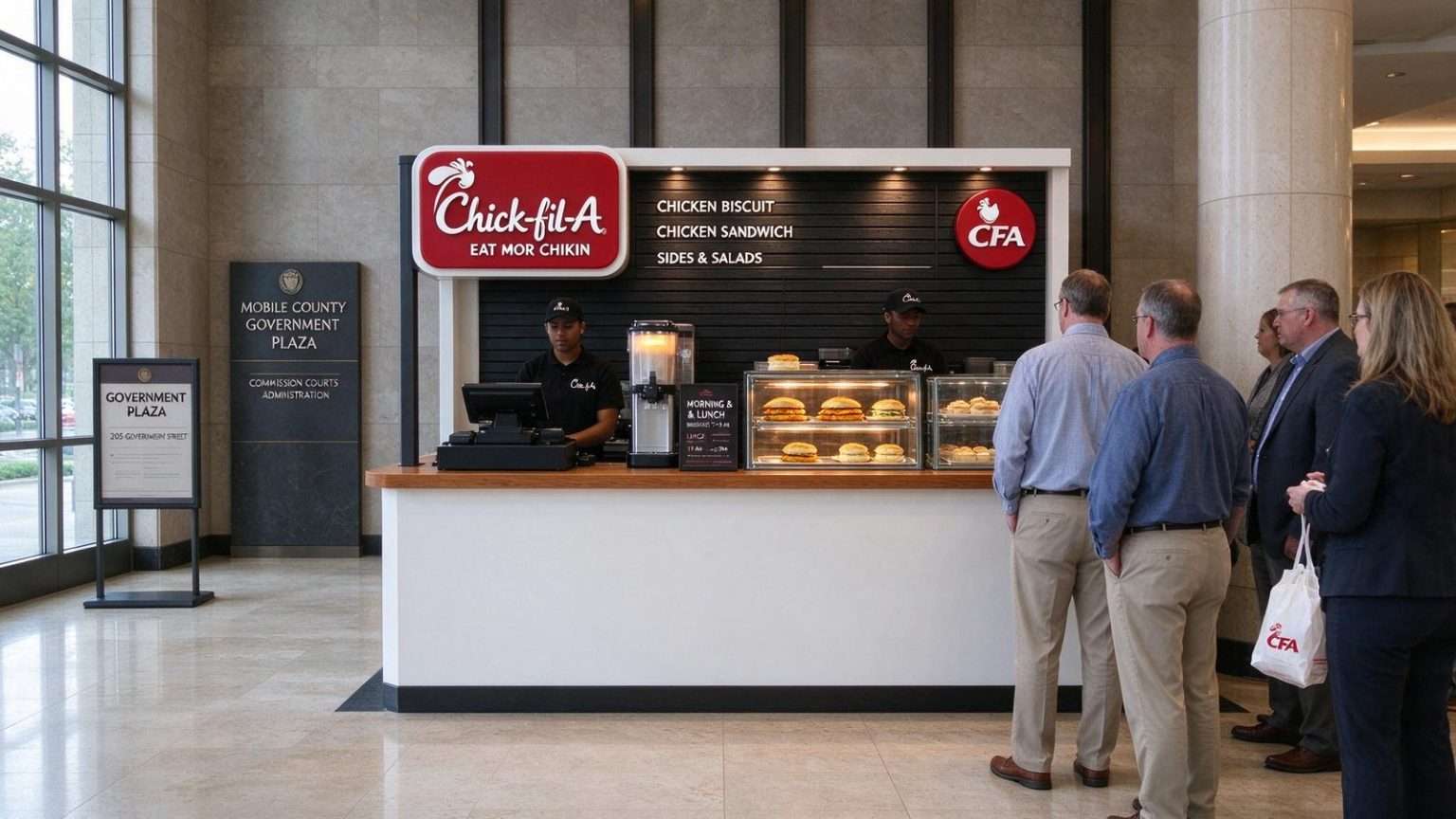
Mobile County Commissioners have signed off on a monthlong trial that will bring a Chick-fil-A food service counter into Government Plaza, giving jurors, county employees and downtown visitors a new option for breakfast and lunch without leaving the building.
The commission voted 2-1 on Monday to approve a memorandum of understanding with the downtown Chick-fil-A location on Royal Street, which will prepare food off-site and bring it into the Government Plaza lobby for a limited test run. No exact start date has been set, but county officials expect the pilot to begin sometime in early April, timed to coincide with a stretch when multiple jury trials are scheduled at the courthouse.
Under the agreement, breakfast service would run from 7 to 9 a.m. and lunch from 11 a.m. to 2 p.m. The initial trial is set to last one week, though Chick-fil-A has the option to extend it up to three weeks so the company can better gauge foot traffic at different times of day.
Commission Dynamics and the Dissenting Vote
Commission President Connie Hudson said the arrangement mirrors a model Chick-fil-A already uses at other “additional distribution point” locations around the region. At Government Plaza, the temporary counter would be set up near the building’s Government Street entrance, in the same area currently used for absentee voting.
The menu will include chicken biscuits, yogurt, orange juice and canned drinks in the morning, followed by chicken sandwiches and side or market salads at midday. Notably absent from the agreement is any mention of the chain’s signature waffle fries.
Commissioner Randall Dueitt voted against the measure, citing concerns about the precedent of allowing a private business to operate in a public building and questioning whether the county had adequately explored other food service options. Dueitt also raised the issue of Chick-fil-A’s corporate policies, which have drawn controversy nationally over the company’s charitable giving history.
Hudson and Commissioner Merceria Ludgood voted in favor. Ludgood emphasized the practical benefit for jurors, who often face long waits with limited food options, and for county employees who work in a building with no on-site cafeteria since the previous vendor departed several years ago.
Operational Details and Financial Terms
Chick-fil-A will supply its own sales counter, register and seating for roughly 100 people. The county, in turn, will allow the company to use existing sinks and a walk-in refrigerator in the building’s kitchen so it can meet public health requirements for off-site food preparation.
Financially, the county will collect 10 percent of Chick-fil-A’s pre-tax sales generated at the Government Plaza location, which Hudson described as a fair return for the use of public space. The county will not bear any startup or operational costs; Chick-fil-A assumes all risk for food preparation, staffing, and inventory.
The memorandum of understanding includes a termination clause allowing either party to end the arrangement with 24 hours’ notice. Health department inspections will be conducted before opening and at regular intervals during the trial.
The commission’s legal counsel reviewed the agreement for compliance with Alabama’s competitive bid laws and determined that the trial’s temporary nature and the use of a memorandum of understanding — rather than a formal contract — placed it within the commission’s administrative discretion for building management.
Government Plaza Context and Food Access History
Government Plaza, the 12-story tower at 205 Government Street, houses the Mobile County Commission chambers, the Mobile County Circuit Court, the District Attorney’s office, the Probate Court, the Revenue Commission, and numerous administrative departments. The building sees an estimated 1,500 to 2,000 visitors on a typical weekday, with spikes during jury trials and property tax deadlines.
The building previously housed a full-service cafeteria on the ground floor, operated by a private vendor under a county contract. That vendor departed in 2021, citing insufficient revenue. Since then, employees and visitors have relied on vending machines and a handful of food trucks that park on Government Street during lunch hours — an inconsistent option dependent on weather and vendor schedules.
The absence of reliable food service has been a recurring complaint in employee surveys and juror feedback forms. Jurors, who are prohibited from leaving the courthouse during trial days, have been particularly affected, often relying on vending machine snacks for meals during multi-day trials.
Chick-fil-A’s Local Presence and Distribution Model
The Royal Street Chick-fil-A, located three blocks from Government Plaza, has been a downtown fixture since 2018. Its operator, a local franchisee, has previously partnered with the county for catering at commission events and employee appreciation days.
The “additional distribution point” model — essentially a satellite counter supplied from a full restaurant — is one Chick-fil-A has deployed at hospitals, universities, and corporate campuses across the Southeast. The model allows the company to test demand in a new location without the capital investment of a full build-out.
For the Government Plaza trial, food will be prepared at the Royal Street kitchen, transported in heated holding units, and assembled at the counter. The franchisee has invested in portable equipment — warming drawers, beverage dispensers, a point-of-sale system — that can be removed if the trial does not lead to a longer-term arrangement.
Downtown Mobile’s Evolving Food Landscape
The trial comes as downtown Mobile’s food scene continues to expand. Since 2015, more than 30 new restaurants have opened in the central business district and adjacent neighborhoods, ranging from fine dining to fast casual. However, few are located within walking distance of Government Plaza during the limited lunch hour, and even fewer offer the speed and price point suited to jurors and employees on a 30-to-60-minute break.
The Mobile County Commission has explored other options, including a food hall concept in the building’s vacant retail space, a rotating food truck schedule with dedicated electrical hookups, and a partnership with the nearby Mobile Public Library’s planned café. None advanced beyond preliminary discussion.
Chick-fil-A’s brand recognition, speed of service, and price point — most menu items under $10 — made it a practical choice for a trial. The company’s policy of closing on Sundays aligns with the courthouse schedule, as trials rarely run on Sundays.
Public reaction to the announcement was mixed. Supporters cited convenience, food quality, and the revenue share as positives. Critics raised the corporate policy concerns noted by Commissioner Dueitt, as well as questions about whether a national chain should receive preferential access to public space over local independent operators.
Juror Experience and the Civic Dimension
Jury service in Mobile County typically runs in two-week terms, with jurors on call for the duration. During active trials, jurors report at 8 a.m. and may not be released until 5 p.m. or later. The courthouse provides a juror lounge with coffee, water, and vending machines, but no meal service.
Jurors receive a daily stipend of $10 — unchanged since the 1990s — which barely covers a fast-food meal. The ability to purchase a hot meal without leaving the building is seen by court administrators as a modest but meaningful improvement in the juror experience.
Circuit Court Judge Christopher Galanos, who presides over civil trials at Government Plaza, submitted a letter of support for the trial. “Jurors who are comfortable and fed are more attentive jurors,” he wrote. “Anything that reduces the friction of jury service — parking, food, clear communication — serves the administration of justice.”
The Alabama Constitution guarantees the right to trial by jury, and the state’s jury system relies on citizens willing to serve. Court administrators across the state have identified juror amenities — parking, food, childcare, clear scheduling — as factors that influence whether summoned citizens appear and whether they view the experience positively enough to serve again.
Next Steps and Evaluation Criteria
If the trial proceeds as planned in early April, the commission will evaluate its success based on several metrics: total sales volume, customer satisfaction surveys (distributed to jurors and employees), health inspection results, operational issues (noise, waste, queuing), and the revenue share collected.
A successful trial could lead to a longer-term concession agreement, potentially with expanded hours and menu. The county would then issue a formal request for proposals, opening the opportunity to other vendors — a step Commissioner Dueitt has insisted upon.
The trial also coincides with the commission’s broader review of Government Plaza’s ground-floor activation. The building’s Government Street frontage includes several vacant storefronts that the commission has sought to lease to retail or food tenants. A successful Chick-fil-A pilot could demonstrate the viability of food service in the building and attract other operators.
For now, the focus is on the one-week test. County Facilities Director Glen Barton said his team is coordinating with the fire marshal, the health department, and building security to ensure the temporary setup meets all codes. “We want this to be smooth,” Barton said. “If it works, great. If it doesn’t, we learn something and move on.”
The commission is expected to review the trial results at its first regular meeting in May. If the data supports continuation, a formal RFP process would begin in June, with a target of having a longer-term vendor in place by the fall jury term.