Mobile County Plans Yearlong Bicentennial to Mark 200 Years Since 1812
A volunteer commission prepared a yearlong celebration of Mobile County’s bicentennial, marking two centuries since the county’s creation in 1812 with events across its municipalities and a kickoff in Bienville Square.
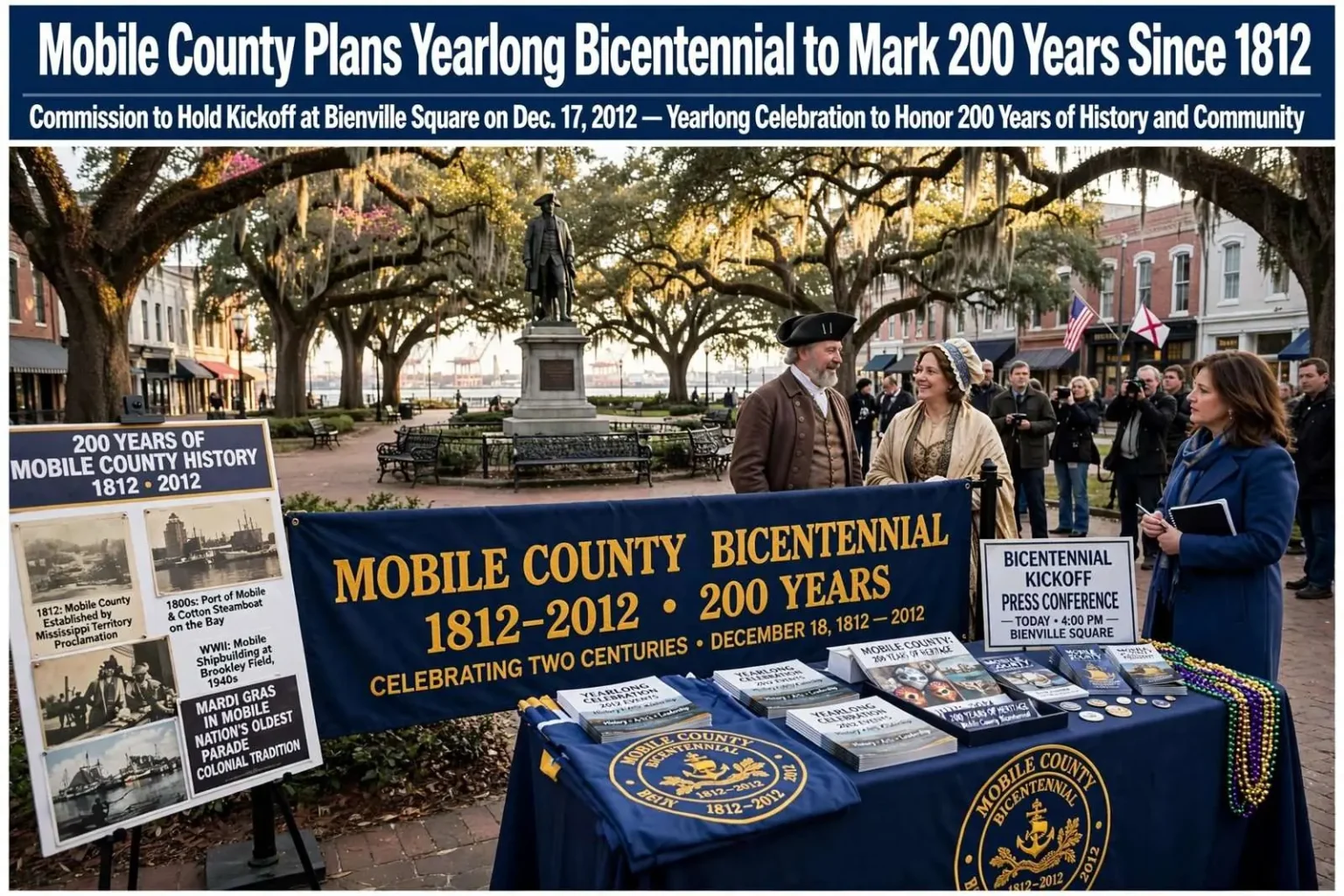
Mobile County was preparing to throw itself a 200th birthday party, with a volunteer commission planning a yearlong celebration to mark two centuries since the county’s creation. The milestone reached back to a moment when south Alabama was still the frontier edge of a young American republic — and forward to a county of more than 400,000 people whose cities and towns would spend 2012 telling their own pieces of the story.
Two Hundred Years of History
Mobile County was established on December 18, 1812, by proclamation of the governor of what was then the Mississippi Territory. The date places the county’s founding in the twilight of the territorial era, three years before Mississippi statehood and seven years before Alabama entered the Union as the nation’s 22nd state in 1819. When the proclamation created the county, Mobile itself was still a town of French and Spanish inheritance — founded by the French in 1702 at Twenty-Seven Mile Bluff and moved to its present site — whose flags had changed hands among France, Britain and Spain before the young United States secured the Gulf Coast.
Over the two centuries that followed, the county grew into a community shaped by many cultures — a heritage the celebration was intended to honor and showcase. French colonial beginnings, a British interlude, decades of Spanish rule and the American territorial period left Mobile County with a layered identity unlike any other place in Alabama: Creole and Catholic traditions, Mardi Gras celebrations older than any in the nation, a port culture drawing from every ocean, and rural communities across the county whose settlements dated to Spanish land grants and early American migration. That mixture — African, European, Caribbean and Native American threads together — was the story the bicentennial set out to tell.
To plan the observance, a group of civic-minded citizens formed the Mobile County Bicentennial Commission. The commission intended to host educational and entertaining events throughout the county across 2012, with an emphasis on history, the arts, sports and leadership, while also spotlighting annual events already held in the county’s municipalities. The strategy leaned on what the county already did well: rather than inventing a calendar from nothing, organizers folded bicentennial themes into the festivals, races, church homecomings and civic observances that filled the county’s year, giving each one a place in the anniversary. A large birthday extravaganza was planned to cap the year.
A Kickoff in Bienville Square
The commission scheduled a news conference for 4 p.m. Saturday, Dec. 17, in Bienville Square in downtown Mobile to announce details of the celebration and its kickoff events. The square itself was a piece of the county’s story — a downtown park named for Jean-Baptiste Le Moyne, Sieur de Bienville, the French colonial founder of Mobile and of Louisiana, whose name runs through the city’s geography from the square to the avenue to the causeway across the Mobile Delta. The timing was deliberate: the press conference was set to follow the Mobile Christmas and Holiday Parade, ensuring a ready-made downtown crowd still gathered along the parade route when the announcement began.
The kickoff was designed to be festive and inclusive. Volunteers in historic attire would take part, Gov. Robert Bentley was to issue a proclamation, and a display of photographs from various parts of the county would trace its many communities. Each municipality was to be represented and presented with a commemorative bicentennial flag to fly during the anniversary year. The roster of municipalities itself sketches the county’s breadth — Mobile, the county seat and Alabama’s third-largest city; Prichard, Chickasaw and Saraland to the north; Satsuma and Creola farther up the delta; Citronelle in the county’s northwestern reaches; Mount Vernon on the Tombigbee; and Bayou La Batre on the coast, the seafood village immortalized in film and sustained for generations by the Gulf’s harvest.
Organizers also promised giveaways and unique items available for purchase, the keepsakes and commemorative merchandise that anniversary years traditionally generate — and that, in a county with Mobile’s gift for celebration, were sure to find buyers.
An Invitation to Take Part
The commission encouraged residents who wanted to join the celebration — or to sponsor activities — to reach out directly. The invitation was aimed at the civic infrastructure that makes a year of events possible: historical and genealogical societies, museums, schools, churches, arts organizations and businesses with a stake in the county’s story. By tying the observance to existing community events and giving each town a role, the planners aimed to make the bicentennial a countywide affair rather than a downtown-only spectacle.
The design reflected a practical wisdom about how history gets celebrated. A county as large and varied as Mobile cannot be summoned to a single event; it can, however, be given a year’s worth of reasons to remember. School programs could take the anniversary into classrooms. Municipal festivals could each carry the bicentennial flag through their crowds. Sports events, arts programming and leadership observances could each attach the milestone to occasions residents already attended. The commission’s role was less that of a producer than of a convener — issuing the theme, the flags and the calendar, and letting the county’s existing institutions carry the year.
For a county with deep and layered roots, the milestone offered a chance to look back across 200 years while bringing its cities and towns together around a shared history. The yearlong slate of programming promised residents of every corner of Mobile County a reason to take part in marking the anniversary — from the parade crowds in Bienville Square where the kickoff was announced to the bayou, the delta crossroads and the small towns where the county’s oldest families still kept their stories. Two hundred years after a territorial governor’s proclamation put the county on the map, its residents were preparing to celebrate the place those two centuries had made.
The Story the Year Would Tell
The 200 years the commission set out to celebrate could be read in the landscape of the county itself. The 19th century made Mobile County a cotton empire’s outlet: riverboats and later railroads funneled the bounty of Alabama’s Black Belt down to the wharves on Mobile Bay, and the city’s antebellum fortunes — its fine houses, its banks, its early cultural institutions — were built on that trade. The Civil War brought the naval battle that is still taught in every Alabama classroom: in August 1864, Adm. David Farragut’s fleet fought its way past the forts guarding Mobile Bay, giving the Union a decisive victory and the Navy a famous motto in the process.
The decades after the war remade the county again. Lumber replaced cotton as the great export, the port’s channel was deepened and its infrastructure rebuilt, and waves of immigration — from the American interior, from Europe, from across the Caribbean — added to the cultural mixture the bicentennial would celebrate. By the time of the two world wars, Mobile County had become one of the great shipbuilding centers of the United States, its yards turning out vessels by the thousand during World War II and transforming the city’s population and economy in the span of a few years. The Brookley complex, the Alabama State Docks — later the Port of Mobile — and the industrial corridor along the Mobile River all trace their modern form to that era.
And woven through all of it, the traditions that make the county unlike anywhere else in Alabama. Mardi Gras in Mobile predates the American republic itself, with masked balls and parades dating to the colonial period and continuing every winter since. The Azalea Trail of the mid-20th century made springtime Mobile famous across the country. The seafood houses of Bayou La Batre, the churches and schools of the county’s African American communities, the oral histories of the Creek and Choctaw presence in the region — each is a strand in the heritage the commission meant its year of programming to honor.
Why Anniversaries Matter to a Community
Anniversaries on the scale of a county’s bicentennial serve purposes beyond festivity. They give historical societies a deadline that draws forgotten materials out of attics and archives. They give schools a ready-made unit of local study, connecting students to the place they live through the people who built it. They give municipalities a reason to mark their own histories — a town’s founding families, its oldest church, its name — within a larger frame that no single community could mount alone. And they leave behind artifacts, from oral history recordings to commemorative publications, that outlast the year of celebrations themselves.
Mobile County entered its third century in 2012 as a place where that history was still visibly present: a downtown where colonial-era street plans survive beneath modern towers, a port that remains one of the nation’s busiest, a calendar of festivals that runs from Mardi Gras through the seafood seasons, and neighborhoods whose names — Spring Hill, Toulminville, Whistler, Irvington — carry the stories of the families who settled them. The bicentennial commission’s task was to make all of that visible at once, and to do it in a way that belonged to the whole county rather than to its largest city.
The kickoff announced in Bienville Square was the entry point: a proclamation, flags for every municipality, photographs tracing the county’s communities, and an open invitation for residents and sponsors to join. What followed across 2012 — the history events, the arts programming, the sports observances, the capstone extravaganza — would be Mobile County’s own telling of its 200 years, assembled by volunteers and staged in every corner of a county that had, by then, two centuries of stories to choose from.