Mobile County Commission Set to Vote on $23.1 Million Aquatic Center Bid
Mobile County commissioners are set to vote on a $23.1 million bid to build a new aquatic center, with a 50-meter outdoor pool expected to break ground in September.
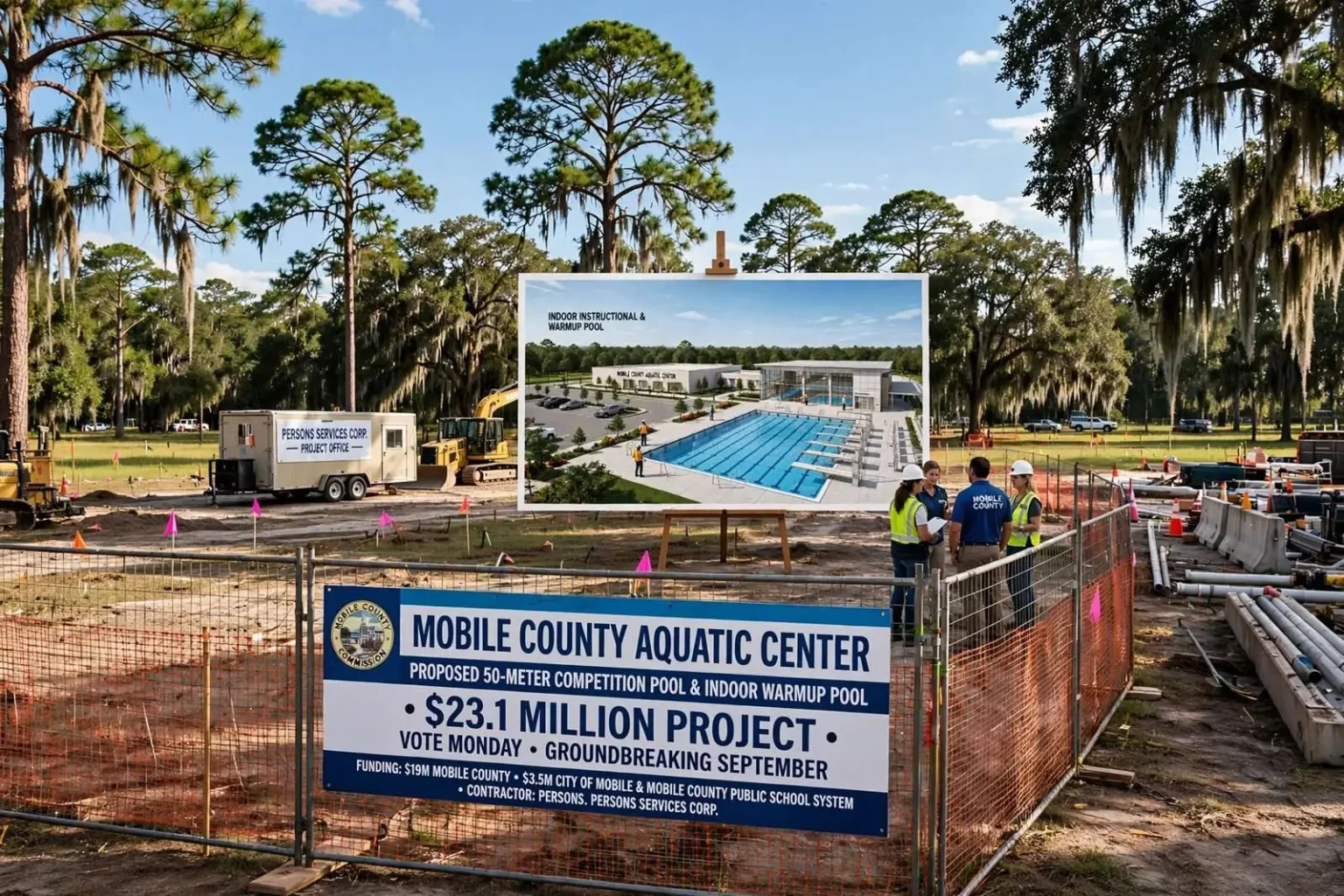
The Mobile County Commission is scheduled to vote Monday on a $23.1 million construction bid that would move the long-discussed Mobile County Aquatic Center from planning into an actual groundbreaking. Commissioners announced the bid during Thursday’s work session. If approved, Persons Services Corp. would build the facility using $19 million from the county, along with an additional $3.5 million combined from the City of Mobile and the Mobile County Public School System.
The vote represents the most concrete step yet in a project that local officials have discussed for years as they worked to identify a site, settle on a design, and line up money from multiple public partners. Rather than a singlegovernment check, the funding plan spreads the cost across county, city, and school system budgets, an arrangement that reflects how broadly officials expect the facility to be used. County leaders have framed the aquatic center as infrastructure for the entire Gulf Coast region rather than an amenity for a single neighborhood.
Commissioner Connie Hudson, who has led the push for the project, said the facility would fill a gap in the community’s recreational and athletic offerings. “It’s 12 to 18 months for the work to be completed,” Hudson said. “For the community, it’s a tremendous achievement. We have so much interest in this area in competitive swimming. We have people who are interested in recreational swimming and interest in people who are training for lifeguard duties and scuba diving. … This will meet the needs of the community.”
What the Bid Covers
The first phase of construction, which commissioners are expected to approve Monday, covers a 50-meter outdoor pool complete with dive wells, along with an indoor section that will function as an instructional and warmup pool. Locker rooms and restrooms are also included in the initial phase. Together, those elements would give the region its first public facility capable of hosting full-length competitive meets with proper warmup space, something coaches and meet organizers in the area have long said is missing.
A 50-meter pool is the standard length for Olympic and major collegiate competition, and building one with dedicated dive wells allows a single venue to accommodate swimming, diving, and instructional programs at the same time. The indoor warmup pool serves a dual purpose: competitors use it to loosen up before races, and learn-to-swim classes can run in it year-round without competing for lane space. That separation is what allows large meets to operate on tight schedules without shutting down daily programming for the rest of the community.
If the bid is approved, county officials anticipate breaking ground in September. Hudson said the construction window of 12 to 18 months would put the facility on a pace to open well within a few years of the vote, though large public projects of this scale routinely see schedules adjusted as utility relocations, weather delays, and supply issues arise. The bid process itself followed months of design work and cost estimation, with officials working to keep the project within the funding that the three public partners had committed.
A Second Phase Still Taking Shape
A second phase would add a 25-meter pool to the complex. Hudson said that portion of the project is still working through the funding process, with organizers seeking between $8 million and $10 million to get it built. The additional pool would expand the complex’s capacity for lessons, therapy and fitness swimming, and additional meet hosting, easing pressure on the main competition pool once the facility is running at full use.
Planning the second phase separately is a common approach for public recreation projects, allowing the core competition venue to move forward on committed money while supporters pursue additional grants, partnerships, and appropriations for the expansion. Officials have not announced a timeline for the second phase, and its construction would depend on closing the remaining funding gap of $8 million to $10 million.
Who Is Paying for It
The $23.1 million first phase draws on $19 million from Mobile County, with the remaining $3.5 million combined from the City of Mobile and the Mobile County Public School System. That split gives each partner a stake in how the facility operates: the county as the primary funder and owner, the city as a partner whose residents will make up much of the user base, and the school system as an institution whose swim programs and physical education offerings stand to benefit directly.
Multi-government funding arrangements of this kind have become the standard model for major recreation projects in Mobile County, where no single budget line can comfortably absorb a project of this size. Pooling money also spreads political risk and ensures that the facility is designed from the start to serve multiple constituencies rather than a single user group. The school system’s involvement matters particularly for competitive swimming, since high school teams across the county currently lack a dedicated long-course venue for training and meets.
Persons Services Corp., the contractor tapped to build the first phase, would take on a project that involves specialized work beyond ordinary construction. Competition pools demand precise level tolerances, commercial-grade filtration and water treatment systems, and deck and mechanical infrastructure sized for heavy use. Firms that build aquatic facilities are a specialized segment of the construction industry, and the bid award process for a project of this size involves review of both price and relevant experience.
Why Supporters Say It Matters
Backers of the project see it as more than a neighborhood amenity. Mobile Sports Authority Executive Director Danny Corte said the aquatic center could open the door to hosting competitive swim meets that the area has had to pass on in the past due to a lack of adequate facilities. “This is a huge investment for sports tourism,” Corte said. “We have been missing out on some of the larger swim meets over the years because of our facilities.”
Sports tourism has become a meaningful part of the Gulf Coast economy, with traveling athletes and their families filling hotels, restaurants, and shops during multi-day events. Swim meets are a particularly strong draw because they bring large numbers of participants and spectators who stay for the duration of a meet, often spanning a full weekend. Organizations that bid for regional and sectional meets typically must demonstrate access to a long-course pool with adequate seating, warmup space, and parking, which is exactly what the first phase is designed to provide.
The aquatic center would also serve swimmers far from the competitive ranks. Learn-to-swim instruction addresses a persistent safety issue in a coastal region surrounded by bays, rivers, and the Gulf, where swimming ability is a basic life skill. Training pipelines for lifeguards and scuba divers, which Hudson cited among the community’s interests, depend on pool access that can accommodate certification coursework, and the facility’s design anticipates those uses alongside recreational lap swimming and family swim time.
Context: Recreation Investment in Mobile County
If commissioners approve the bid Monday, the project would represent one of the more significant recreational infrastructure investments in Mobile County in recent years, combining county, city and school system dollars to build a facility intended to serve recreational swimmers, competitive athletes and safety-training programs alike. Public officials have described it as a generational asset, the kind of facility that shapes where meets are held, where teams train, and where families spend weekends for decades after the ribbon-cutting.
The project’s progress has been tracked closely by the region’s swimming community, which has long operated without a public long-course venue of its own. Swimmers and teams from the Mobile area have historically traveled to facilities in other cities for major meets, adding cost and logistics to every competition season. A home venue changes that calculation for clubs, high school programs, and Masters swimmers alike, and it gives meet directors a reason to bring events to Mobile rather than send local swimmers elsewhere.
For the Mobile County Public School System, access to the complex could expand what athletic departments are able to offer. Swimming programs require pool time that most school campuses cannot provide, and shared access to a county facility allows teams to practice and host meets without each school bearing the cost of its own pool. The same access extends to physical education programming and water-safety instruction during the school year.
What Happens Next
The commission’s vote Monday is the immediate hurdle. If the bid is approved, the next steps are contract execution with Persons Services Corp., permitting, and site preparation leading into the anticipated September groundbreaking. Construction of the first phase would then proceed on the 12-to-18-month timeline Hudson described, with the outdoor competition pool, indoor warmup pool, and support facilities rising together as a single project.
Attention will then shift to the second phase, where the remaining $8 million to $10 million still must be identified before the 25-meter pool can be added. Officials have continued to work the funding question through the same mix of sources that carried the first phase, and supporters of the project have pointed to the first phase’s progress as evidence that the full vision for the complex can be completed over time.
For residents, the practical effect of Monday’s vote is straightforward: a project that has existed mostly in planning documents and funding resolutions would become a construction site, with a visible timeline toward an opening day. County officials have emphasized that the facility is being designed for the broadest possible use, from competitive meets sanctioned by regional swimming bodies to a child’s first swim lesson, and the bid approval would set that vision in motion. Commissioners are expected to take up the bid at their regular Monday meeting, where the vote would formally commit the county’s $19 million share and set the groundbreaking in motion.