Mobile County COVID-19 Case Count Rises to 18 as Statewide Testing Expands
Mobile County's confirmed coronavirus cases climbed to 18 as Alabama health officials reported 4,082 statewide tests and one confirmed death, with local leaders urging continued social distancing.
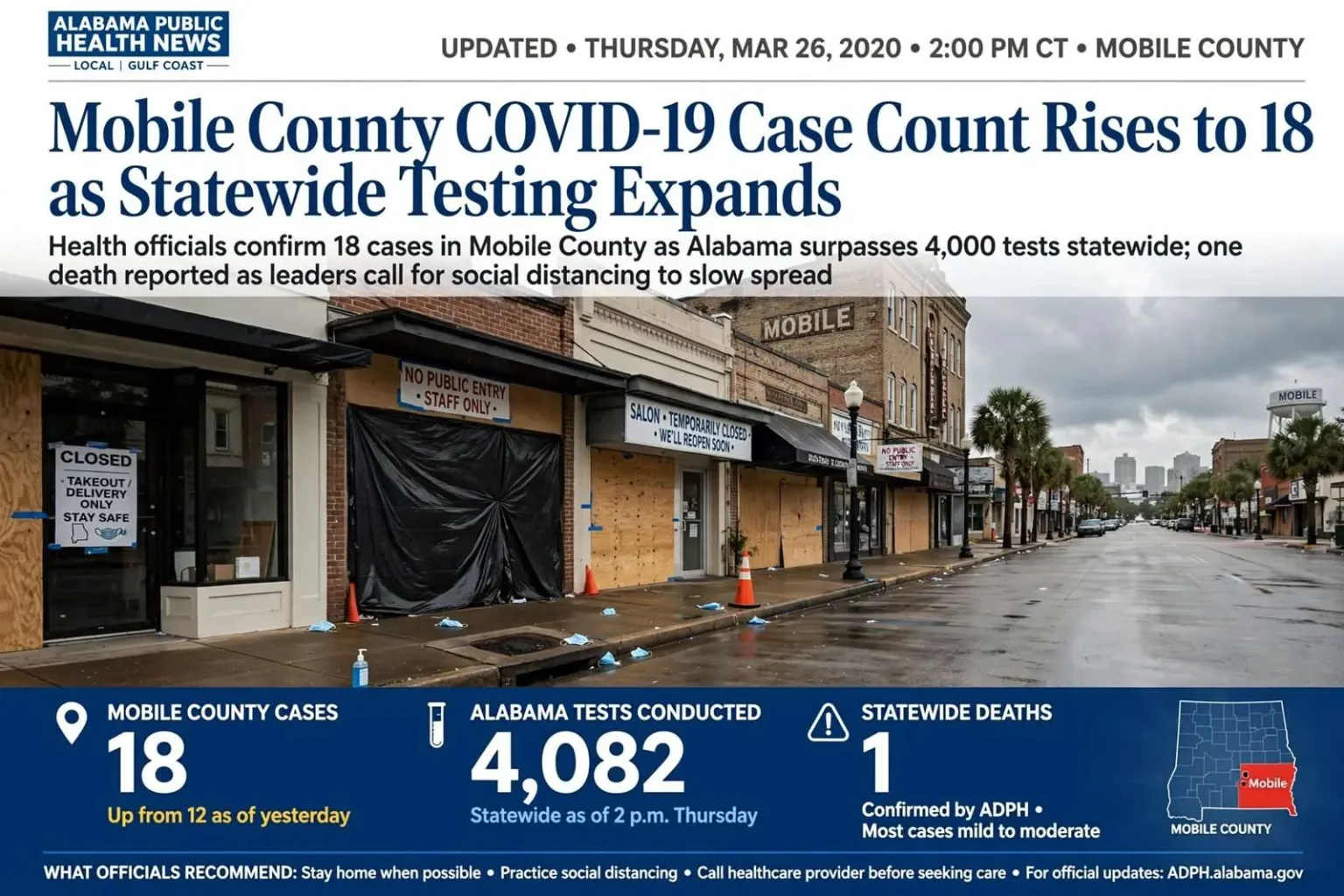
Mobile County’s confirmed COVID-19 case count climbed to 18 as of Thursday afternoon, according to the latest update from the Alabama Department of Public Health, as the coronavirus outbreak continued to spread across the state. The daily tally has become the number local officials and residents watch most closely, a running measure of how far the virus has reached into the Gulf Coast’s largest county.
The state health agency reported that 4,082 COVID-19 tests had been conducted across Alabama as of 2 p.m. Thursday, with one confirmed death statewide. ADPH updates its county-by-county case totals daily on its website as new lab results come in from hospitals, private labs and the state’s own testing sites, and each afternoon’s update resets the picture for local emergency managers, school officials and newsrooms tracking the outbreak.
Mobile County’s rising tally reflects a trend playing out across south Alabama and the rest of the state, where health officials have urged residents to limit trips outside the home, avoid gatherings and practice social distancing to slow the virus’s spread. The guidance amounts to a civic ask as much as a medical one: because the virus moves person to person, every avoided gathering is a place the chain of transmission cannot go.
What officials have done
County and city leaders across the region have already closed non-essential businesses, restricted restaurant service to takeout and delivery, and postponed public events in an effort to reduce person-to-person contact. The orders reshaped daily life within days — empty dining rooms, boarded-up event calendars and workplaces shifted to remote arrangements where possible — and officials have said the measures will remain in place as long as the spread requires them.
The closures follow the strategy public health officials describe as flattening the curve: slowing the pace of infections so that serious cases arrive at hospitals over weeks rather than days, keeping intensive care capacity from being overwhelmed. Every restriction on gatherings is aimed at that outcome, and Mobile County’s hospital systems have been preparing for a potential surge by conserving protective equipment and expanding bed capacity where they can.
Health officials have cautioned that confirmed case counts likely understate the true scope of community spread, since testing capacity remained limited in the early weeks of the outbreak and many people with mild symptoms were not being tested. The 18 confirmed cases in Mobile County, in other words, represent the known cases — people tested and confirmed by a lab — rather than the full total of infections circulating in the community.
Testing and capacity
ADPH has continued to work with hospitals and private laboratories to expand testing availability as supplies allow. The constraint has been the same across the country: swabs, reagents and protective gear are all finite, and priority has gone to patients with symptoms, health care workers and people with known exposures. As more testing materials arrive, the daily counts are expected to rise simply because more people can be tested — a change officials warn should not be misread as the outbreak accelerating overnight.
Residents who develop a fever, cough or shortness of breath are advised to call their health care provider before seeking in-person care, so that clinics and emergency rooms can take precautions to prevent further spread. The call-first protocol lets providers direct patients to the right entrance or testing site and keeps waiting rooms — where other patients may be vulnerable — from becoming transmission points.
Anyone with severe symptoms, including difficulty breathing, should seek emergency medical attention immediately. Health officials distinguish between the majority of cases, which produce mild to moderate illness manageable at home with rest and fluids, and the smaller share that develop serious respiratory trouble. Knowing which is which — and calling ahead in the first case, going in promptly in the second — is the practical advice that has defined the outbreak’s early weeks.
Public health guidance also asks the family members of a suspected case to take precautions at home: a sick person should stay in a separate room where possible, surfaces should be disinfected regularly, and everyone in the household should wash hands often and avoid touching the face. Those measures, unglamorous as they are, remain the backbone of the response while treatment options and a vaccine remain ahead.
Staying informed
Local officials say they will continue to provide updates as the Alabama Department of Public Health releases new figures, and they are urging Mobile County residents to stay informed through official state and county channels rather than relying on rumors or unverifiable sources on social media. Misinformation has traveled nearly as fast as the virus itself, and officials have singled out false claims about cures, testing availability and school closures as the most common problems.
The state’s daily dashboard is the anchor for accurate numbers, and the county’s emergency management and public information channels relay changes in closures and guidance as they are issued. Residents are encouraged to sign up for official alerts where available and to check announcements from school systems directly rather than forwarding screenshots from unverified accounts.
For older adults and people with underlying conditions — the groups at highest risk of severe illness — officials recommend extra precautions: staying home as much as possible, having groceries and medications delivered, and asking family to check in by phone. Faith communities and neighborhood groups across Mobile County have organized exactly those errand services for higher-risk neighbors, one of the quieter adaptations the outbreak has produced.
The weeks ahead will test how well the region’s precautions hold. Health officials say the effectiveness of social distancing shows up in the numbers only after a lag, because infections acquired before the restrictions take up to two weeks to appear as cases. That makes the coming daily updates harder to read and easier to misread — and makes the officials’ core message all the more insistent: keep your distance, wash your hands, call before you go to the doctor, and trust the official numbers over the rumors.
The economic strain of the closures has grown alongside the health concern. Restaurants shifted to takeout and delivery almost overnight, salons and gyms went dark, and hourly workers across the hospitality sector saw shifts evaporate. Local leaders have pointed residents toward the assistance programs being assembled at the federal and state level, and chambers of commerce in Mobile and Baldwin counties began compiling resources for small businesses navigating the shutdown.
School closures added another layer for families. Districts across south Alabama shut their buildings, moved to remote or take-home instruction, and organized meal distributions for students who rely on school breakfast and lunch. The closures also left working parents rearranging childcare, one more ripple of an outbreak that touches nearly every institution in the county. Food banks and assistance ministries, already stretched, reported rising demand as both school closures and job losses hit the same households at once.
Health care providers in Mobile County have meanwhile adapted their own operations. Some clinics separated respiratory patients from others at the door, telehealth visits expanded for routine appointments, and elective procedures were evaluated case by case to conserve supplies and staff time. Hospital officials have asked the public not to visit patients unnecessarily, another step in keeping the virus out of facilities that need to stay functional.
The count of 18 confirmed cases puts Mobile County among the state’s larger concentrations, unsurprising for Alabama’s most populous county and home to a port, a major airport and busy interstate corridors. Cases reported in smaller counties across south Alabama reinforced what epidemiologists expected: the virus does not respect county lines, and the region’s communities will rise or fall on the precautions taken together.
Statewide, the single confirmed death underscored the stakes behind the daily numbers. Health officials have stressed that most cases resolve without hospitalization, but the mortality seen in other countries and early U.S. hotspots shows why the state is acting before its hospitals are strained rather than after. The one death reported as of Thursday’s update is expected to be followed by others as the outbreak progresses — the grim arithmetic officials are trying to slow.
Each daily update from the state carries the same instruction attached to it: the numbers are a guide, but the behavior of residents is the treatment.
Residents with questions about the outbreak have several reliable starting points: the Alabama Department of Public Health’s website and its daily updates, the county health department’s announcements, and their own health care providers. Officials repeat the same closing advice each day because it remains the whole strategy in miniature — stay home when you can, keep your distance when you cannot, wash your hands, and let the verified numbers, not the rumors, guide what you do next.