
Mobile County COVID-19 Cases Jump Back Into Triple Digits; No New Deaths
Mobile County reported 108 new COVID-19 cases with no new deaths, as health officials clarified face covering rules for restaurant staff.
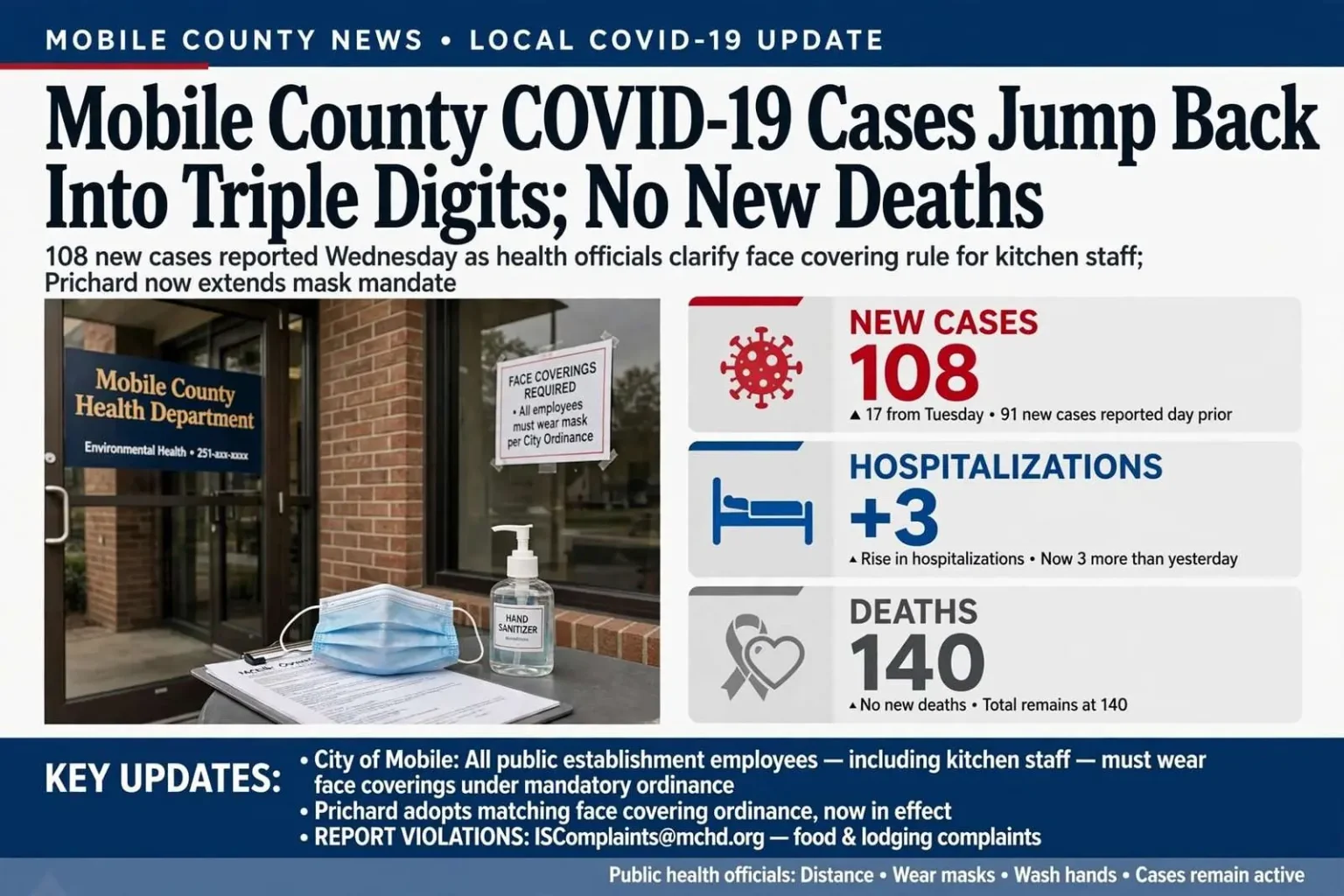
Mobile County’s daily count of newly reported COVID-19 cases climbed back into triple digits, with 108 new cases reported Wednesday by the Mobile County Health Department — up from 91 the day before. Health officials said the county’s death toll held steady at 140, while hospitalizations rose by three.
Questions continued to come in about the City of Mobile’s mandatory face covering ordinance, particularly about whether kitchen employees must mask up. Pebbles King of the health department said that under the city ordinance, all employees of public establishments are required to wear face coverings — including kitchen staff preparing food.
King also noted that Prichard had passed a face covering ordinance of its own, extending the requirement in that city as well. The health department set up an email address, [email protected], for complaints related to the food and lodging industries.
The return to triple-digit daily case counts was a number health officials watch closely, because it signals whether the virus’s spread is accelerating or stabilizing. The one-day jump from 91 to 108 new cases moved Mobile County back above a threshold that had marked the difference between a slowing outbreak and an active one. The death toll holding at 140 was the day’s steadier news, though deaths are a lagging indicator — they reflect infections that occurred weeks earlier — while hospitalizations, which rose by three, tend to track the outbreak’s direction more closely and were still moving the wrong way.
The numbers landed in the middle of a period when Mobile County had already endured months of the pandemic. Case counts that spring had driven hospital capacity concerns across the region, and local officials had been watching daily reports for signs of whether restrictions and behavioral changes were bending the curve. A single day’s increase does not establish a trend, but in a county Mobile’s size, triple digits in a day means the virus was circulating widely enough that officials continued to emphasize the basics: distancing, hand washing, and face coverings.
The mask question that kept coming
Among the questions the health department fielded, one kept recurring: do restaurant kitchen workers have to wear masks, or does the requirement apply only to staff who interact with the public? The answer, delivered by Pebbles King of the health department, was unambiguous. Under the City of Mobile’s mandatory face covering ordinance, all employees of public establishments are required to wear face coverings — including kitchen staff preparing food behind the scenes.
The clarification mattered to an industry that was already straining under the pandemic. Restaurants in Mobile were operating with reduced seating capacity, spaced tables and limited bar service, and kitchens presented their own challenges: close quarters, shared equipment, and shifts that put crews side by side for hours. From the public-health perspective, the reasoning was straightforward — an infected cook who feels fine can contaminate a workplace and, indirectly, the food service chain, and the ordinance was written to cover the workplace rather than just the customer-facing parts of it.
Mobile’s face covering ordinance was among the measures cities across Alabama adopted during the pandemic as case counts climbed. The requirement covered employees and, in most circumstances, members of the public inside public establishments, with limited exemptions for medical conditions and other circumstances recognized under the rules. Enforcement was generally designed to be educational first — businesses were expected to post signage and remind patrons — but health officials made clear the obligations on businesses were real, particularly in the food service and lodging sectors where the public comes into close contact with staff.
Prichard extends the requirement
King’s note that Prichard had passed a face covering ordinance of its own extended the requirement across another chunk of Mobile County. Prichard, just north of Mobile, is one of the county’s larger cities, and its decision meant that residents and workers moving between the two cities — a daily occurrence for commuters, shoppers and restaurant workers — faced consistent rules on both sides of the city line rather than a patchwork.
The alignment between the two cities simplified things for businesses operating near the boundary, but other parts of the county remained under different rules, since ordinances adopted by municipalities did not extend into unincorporated areas or into cities that had not acted. That patchwork quality was one of the defining features of pandemic-era regulation in Alabama, where the state’s mask order and local ordinances layered on top of each other and local officials were left to explain the differences to a public trying to comply.
A complaint line for food and lodging
For the food and lodging industries — the sectors where face covering questions arose most often — the health department created a dedicated channel: [email protected]. The email address gave restaurant and hotel patrons, as well as employees, a direct way to report concerns about compliance, funneling them to the environmental health staff who already inspect restaurants and lodging facilities across the county.
The complaint process sits alongside the department’s regular inspection duties. Mobile County Health Department environmental inspectors visit food establishments on a routine schedule, checking temperatures, hygiene practices and facility conditions, and pandemic-era requirements were folded into that existing framework. A complaint email could trigger follow-up with the business, an advisory visit or a formal inspection depending on what inspectors found, and the department’s approach emphasized correction over punishment in the ordinance’s early months.
For workers, the complaint channel also served as a backstop. Employees who felt pressured to skip masks in close kitchen quarters, or who saw protocols ignored during a rush, could raise concerns without confronting an employer directly. Public health officials have long relied on that kind of reporting — from food safety complaints to smoke-free-air violations — because inspectors cannot be everywhere, and the people inside a business see what the public does not.
What the numbers meant for the county
The county’s figures — 108 new cases, 140 deaths, a three-patient rise in hospitalizations — formed a snapshot of an outbreak that remained active rather than fading. Health departments in Alabama during the pandemic updated their dashboards daily, and the numbers Mobile County reported were part of the data stream that state officials used to make decisions about hospital capacity, testing distribution and public health orders.
Behind each daily number are the mechanics of outbreak reporting. Cases confirmed Wednesday were collected through testing done over the previous several days, processed by commercial and public health laboratories, and reported to the county for investigation. Health department staff then worked to trace contacts, advise isolation and track clusters — work that becomes harder as volume rises, which is why triple-digit days strained the tracing apparatus that worked smoothly when case counts were lower.
The steady death toll, meanwhile, offered no reassurance about the weeks ahead. COVID-19 deaths reported on a given day typically reflect infections from two to four weeks earlier, so the 140 lives lost by Wednesday represented the earlier surge, and the current case counts would shape that grim arithmetic in the weeks to come. Hospitalizations, sitting between the two, were the number clinicians watched most closely — an increase of three patients matters little on its own, but a string of such days fills intensive care units.
For residents, the department’s message remained the same combination it had been for months: wear the mask where the ordinance requires it, keep distance where possible, and report concerns through the channels set up for that purpose — including the food and lodging complaint address — so that the businesses feeding and housing the public could be held to the standards local governments had put in place.
The 108-case day also arrived amid ongoing questions about testing access, which shaped how the county’s outbreak could be read. Case counts depend on who gets tested, and during the pandemic Mobile County’s testing sites — operated by the health department, hospitals and private providers — saw demand surge whenever cases climbed, sometimes creating waits that discouraged testing. Officials repeatedly noted that reported totals undercounted actual infections, since people with mild or asymptomatic cases did not always seek tests, meaning the true spread was generally wider than the daily figures showed.
Contact tracing scaled with the caseload. When the county reported a few dozen cases a day, health department staff could call each positive person promptly, interview them about their recent contacts, and reach those contacts quickly enough to make a difference. At triple digits, the same work became a race against the virus’s incubation period, and officials acknowledged that tracing worked best when residents took it upon themselves to notify close contacts rather than waiting for a call.
The hospital picture tied the local outbreak to the broader region. Mobile’s hospitals serve not just the county but much of southwest Alabama and the Mississippi Gulf Coast, so admissions rose with spread across the whole service area rather than Mobile County alone. A rise of three patients in a single day was manageable; a week of similar rises was the kind of trajectory that forced hospitals to postpone elective procedures and add staff, as they had done earlier in the pandemic.
Through it all, the health department’s public guidance kept circling back to the measures within individuals’ control. Face coverings — now clearly required for all employees of public establishments in Mobile and Prichard alike, kitchen crews included — distancing, and hand hygiene remained the tools available without waiting for a vaccine or a treatment, and the complaint channel for food and lodging businesses gave residents a way to support the rules rather than simply hope for compliance. As the county watched its daily numbers climb back toward and past 100, those were the levers officials kept pulling.


