Mobile County Grand Jury Recommends Nodine’s Impeachment Over Drug Abuse, Domestic Violence Findings
A special Mobile County grand jury has recommended impeaching Commissioner Stephen Nodine, citing drug test results, a multistate painkiller prescription scheme and alleged domestic violence against Angel Downs, whose death remains under investigation in Baldwin County.
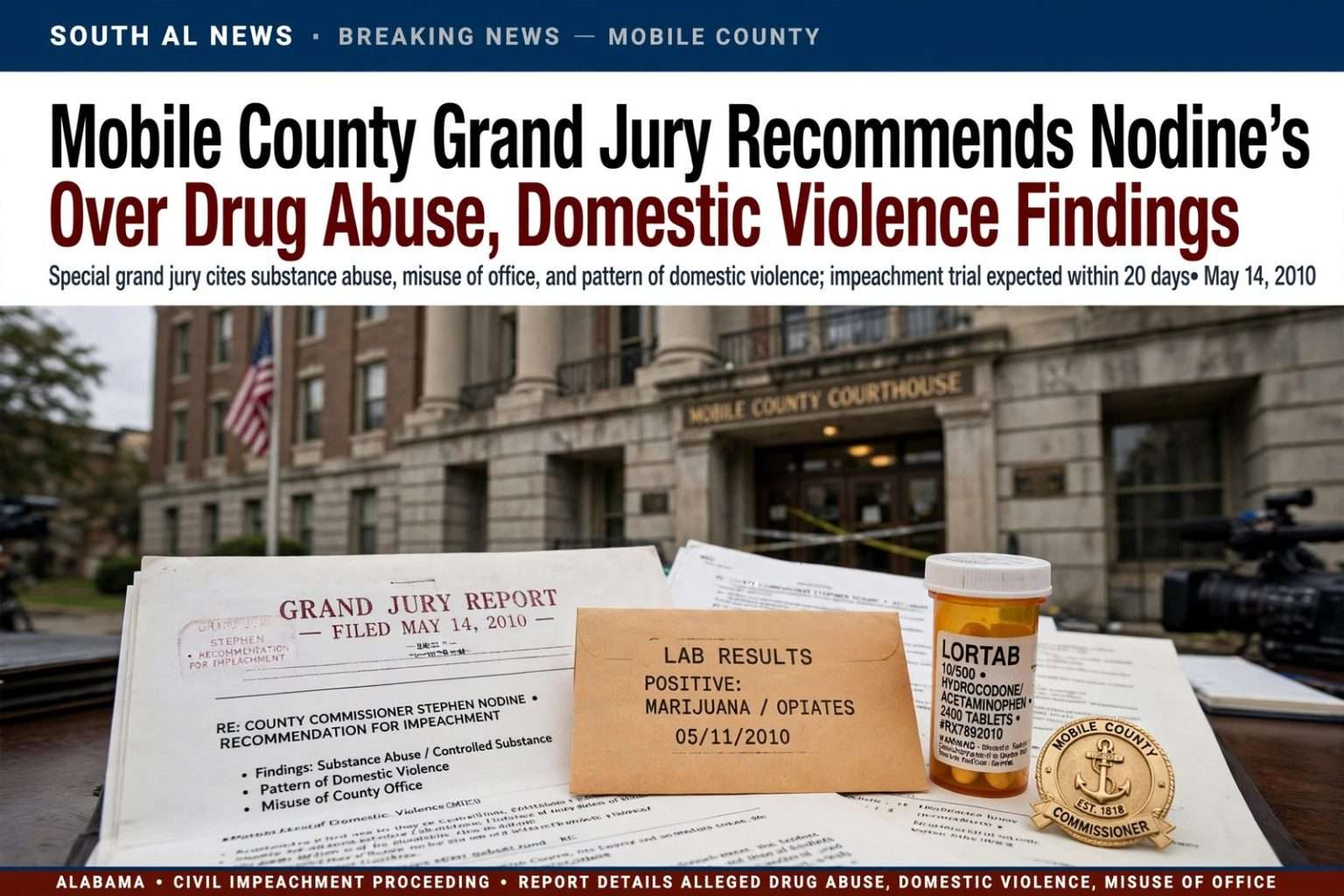
A Mobile County special grand jury recommended on Friday that County Commissioner Stephen Nodine be impeached and removed from office, citing findings of substance abuse, misuse of his county position, and a pattern of alleged domestic violence against a woman with whom he was romantically involved. The recommendation sets in motion a jury trial, expected to be held within 20 days, that would decide whether Nodine keeps the commission seat he has held since 2004.
The grand jury’s report, filed as part of Alabama’s civil impeachment process for elected county officials, lists five formal grounds for removal: willful neglect of duty, corruption in office, incompetency, habitual drunkenness or addiction to a controlled substance, and moral turpitude. Alabama law allows any elected county officer to be removed through this process, which is separate from and does not require a criminal conviction.
Grand Jury Cites Drug Test Results and a Pattern of Abuse
According to the report, laboratory testing found that Nodine had marijuana and opiates in his system as recently as May 11, 2010, only days before the grand jury issued its findings. Investigators also determined that in January 2010, Nodine obtained more than 2,400 Lortab tablets — a brand-name hydrocodone and acetaminophen painkiller — from at least nine pharmacies across four states, using prescriptions written by at least four different doctors. That pattern, sometimes called “doctor shopping,” is a practice regulators and pharmacy boards nationwide have worked for years to detect by flagging patients who fill overlapping prescriptions for the same controlled substance across multiple providers and pharmacies to avoid raising any single provider’s suspicion.
The grand jury also concluded that during an extramarital relationship with a woman identified in the report as Downs, Nodine engaged in repeated acts of domestic violence, including stalking, harassment, verbal abuse, physical abuse and threats. The report went further, finding that Nodine used the authority of his elected office on multiple occasions to prevent law enforcement from pursuing charges against him for that abusive and, the grand jury said, criminal conduct.
Alabama’s domestic violence statutes cover a broad range of conduct beyond physical injury, including harassment, stalking and the communication of threats between people who have or have had a dating or family relationship. Advocates who work with domestic violence survivors often note that abuse tends to escalate gradually, moving from control and verbal intimidation toward physical acts, and that survivors can face steep barriers to reporting abuse when the alleged abuser holds public office, carries influence over local law enforcement, or otherwise wields authority over the systems meant to protect them. The grand jury’s finding that Nodine specifically used his commission seat to head off law enforcement action reflects a dynamic researchers who study intimate partner violence have long identified: victims of abuse by public officials or law enforcement-adjacent figures often have fewer safe avenues to seek help.
An Intoxicated Appearance at the Oil Spill Command Post
Perhaps the most publicly visible incident cited in the grand jury’s report took place in the first week of May 2010, when Nodine appeared at the unified command center coordinating the regional response to the Deepwater Horizon oil spill while acting in his official capacity as county commissioner. The report describes Nodine as “so intoxicated and belligerent” that security personnel asked him to leave the premises under threat of arrest.
That incident occurred against the backdrop of one of the largest environmental disasters in U.S. history. The Deepwater Horizon drilling rig, operated by BP in the Gulf of Mexico roughly 40 miles off the Louisiana coast, exploded on April 20, 2010, killing 11 workers and triggering a subsea wellhead blowout that spilled millions of barrels of oil into the Gulf over the following months. Alabama’s coastline, including Mobile and Baldwin counties, sat squarely in the path of oil that eventually washed ashore on beaches from Louisiana to the Florida Panhandle. In response, federal, state and local officials stood up unified command posts — staffed jointly by the Coast Guard, BP, and state and local emergency management personnel — to coordinate cleanup operations, beach protection efforts and public communication. Local elected officials, including county commissioners in coastal jurisdictions, were frequently involved in those command structures because county governments in Alabama play a direct role in coastal management, beach access, tourism-dependent local economies and emergency response coordination. It was in that official capacity, according to the grand jury’s report, that Nodine’s conduct at the command post drew the attention of security officials.
How Impeachment of a County Official Works in Alabama
Alabama’s constitution and state code provide a specific mechanism for removing certain county officials from office for misconduct, distinct from the criminal courts. Impeachment proceedings against county officers such as commissioners are typically initiated through the circuit court, often following a grand jury’s investigation and recommendation, and are tried before a jury much like a civil case. The grounds available under Alabama law mirror those cited in the Nodine report: willful neglect of duty, corruption in office, incompetency, intemperance in the use of intoxicating liquors or narcotics, and offenses involving moral turpitude while in office. If a jury finds the grounds proven, the official is removed and, depending on the specific findings, may also be barred from holding public office in the future. Because the process runs independently of any parallel criminal investigation, an official can face impeachment proceedings, a criminal case, or both at the same time, arising from the same underlying conduct.
The Mobile County Commission, the body on which Nodine serves, is a three-member governing board responsible for county roads and bridges, public safety funding, the county jail, parks and a range of other services for the residents of Alabama’s most populous county outside the Birmingham metro area. Commissioners are elected to represent specific districts and jointly oversee the county’s budget and administration, making the seat one of the more consequential local offices in southwest Alabama.
A Death Investigation Runs in Parallel
The grand jury’s impeachment findings arrive as investigators in neighboring Baldwin County continue examining the death of Angel Downs, the woman named in the domestic violence allegations. Downs’ body was discovered days earlier at a Gulf Shores condominium complex, and Nodine, who had been in a relationship with her, was questioned by investigators before the impeachment report’s findings became public. Authorities had not announced criminal charges connected to her death as of this report, and the separate impeachment proceeding concerns Nodine’s fitness to hold office rather than any specific criminal culpability in her death.
A memorial service honoring Downs was scheduled for 6 p.m. Tuesday at the pavilion inside Gulf Shores State Park, a widely used public gathering space on the Alabama coast known for its beaches, nature trails and views of the Gulf of Mexico.
Domestic violence allegations against a sitting elected official also raise questions that extend well beyond any one case. National organizations that track intimate partner violence, including the National Domestic Violence Hotline, note that abuse cuts across every income level, profession and community, and that access to power, money or public standing can make it harder rather than easier for victims to be believed or protected, particularly when the alleged abuser has influence over local law enforcement or the courts. Advocates generally encourage anyone experiencing abuse, or anyone concerned about someone who might be, to reach out to a local domestic violence shelter or a national hotline, both of which can provide confidential safety planning regardless of who is involved.
What the Coming Weeks Were Expected to Determine
With the grand jury’s recommendation filed, the next step in the process was a jury trial on the impeachment charges, expected within 20 days of the report. That timeline reflects the relatively swift procedural track Alabama law sets for removal cases once a grand jury has returned formal findings, in recognition of the public interest in resolving questions about a sitting official’s fitness for office without prolonged delay. A jury sitting in such a proceeding would weigh evidence on each of the five grounds cited — neglect of duty, corruption, incompetency, substance abuse and moral turpitude — and could vote to remove Nodine from the commission, or clear him of the allegations.
The prescription drug findings in the grand jury’s report also touch on a broader public health concern that Alabama and much of the country were grappling with around 2010: the widespread availability of prescription opioid painkillers like hydrocodone-based Lortab, and the rise of “doctor shopping” as a means of obtaining large quantities of the drugs outside legitimate medical need. State prescription drug monitoring programs, which track controlled-substance prescriptions across pharmacies in something close to real time, were still being built out and refined in many states during that period specifically to catch the kind of multi-state, multi-provider prescription pattern described in the grand jury’s findings.
Editor’s Note
This article has been rewritten and expanded from its original 2010 report to add background and context for readers. Public records and subsequent news coverage confirm that Nodine was indicted on a murder charge in connection with Downs’ death later in May 2010 and resigned his commission seat before the impeachment case could go to trial. A subsequent criminal trial on the murder charge, held later that year, ended in a hung jury after the panel could not reach a unanimous verdict. Nodine later resolved the case through a plea agreement on lesser charges, including harassment and perjury, and separately faced a federal firearms charge tied to drug use. Alabama’s Bureau of Pardons and Paroles granted Nodine a pardon in early 2026, more than a decade and a half after Downs’ death, restoring his eligibility to hold public office. Southalnews.com will continue to report on matters of public record as they are confirmed.