Mobile County Health Officials Urge Households to Build a Plan Before the Next Storm
The Mobile County Health Department is urging residents to build an emergency plan during National Preparedness Month, with particular attention to households that depend on power for medical equipment.
MOBILE — With the most active stretch of hurricane season under way, the Mobile County Health Department is using National Preparedness Month to press a message it repeats year-round: the work of getting ready has to happen before there is a storm on the map.
September is National Preparedness Month, an annual observance led by FEMA’s Ready Campaign that encourages individuals, families and communities to prepare before disasters strike. This year’s theme, “Americans Stand Ready,” emphasizes everyday actions that protect households and, collectively, strengthen whole communities.
For Mobile County, the timing is not arbitrary. September falls in the heart of a season in which severe weather, flash flooding, extended power outages and other emergencies can disrupt daily life with little warning.
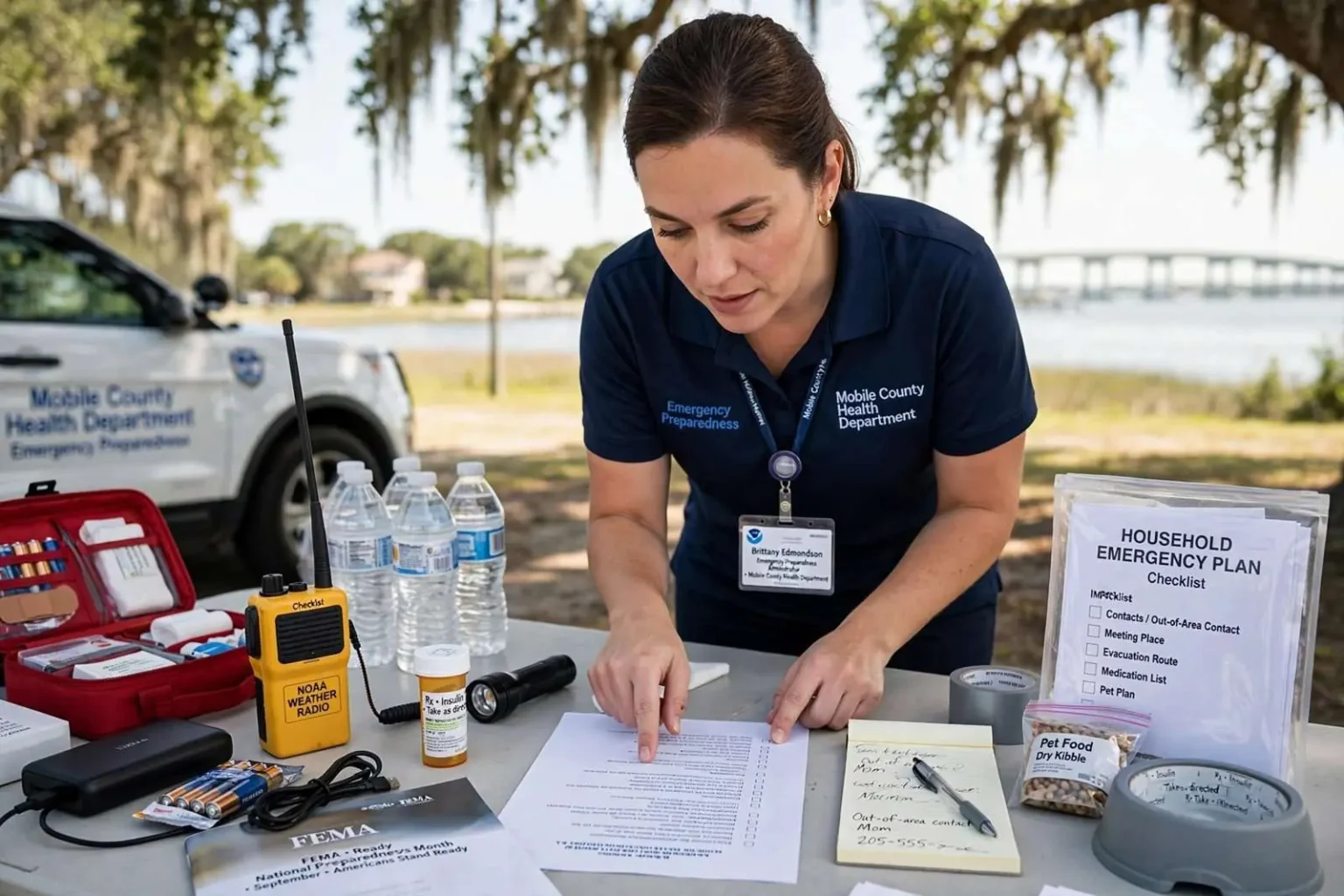
“Preparedness is not about panic — it is about taking practical steps before an emergency occurs,” said Brittany Edmondson, emergency preparedness administrator for the Mobile County Health Department. “When families have a plan, supplies and a way to stay informed, they are better positioned to protect themselves, support their neighbors and recover more quickly.”
Why September Is the Sharp End of the Season
The Atlantic hurricane season runs from June 1 through Nov. 30, but the risk is not spread evenly across those six months. Activity climbs through late summer as sea surface temperatures peak and atmospheric conditions become more favorable, and the climatological peak of the season falls in early to mid-September.
Mobile County sits on a stretch of coast where the hazard is layered. A tropical system approaching the northern Gulf brings wind, but the water is usually the greater threat: storm surge pushed into Mobile Bay and the surrounding low-lying land, and inland rainfall flooding that can occur well away from the coastline and hours after the winds have eased. The county’s river and delta systems mean flooding is not solely a beachfront concern.
Even a storm that causes limited structural damage can produce the hazard that most often affects the most households: a multi-day power outage across a hot, humid region.
Preparedness Starts at Home
“An emergency plan should reflect the real needs of each household,” Edmondson said. “For some families, that means having food, water and flashlights ready. For others, it may mean making a plan for medical equipment, medications, a caregiver, transportation or pets. The most important step is to plan early—before an emergency is imminent.”
A household emergency plan, in the framework MCHD and FEMA use, answers a short list of questions in advance.
How will family members receive alerts? How will they communicate with one another if cell service is degraded or if they are separated when a warning is issued? Will they shelter in place or evacuate, and on what trigger? Where will they meet — one location near the home for a sudden event such as a fire, and one outside the neighborhood for an event that makes the area inaccessible?
Households should also identify an out-of-area emergency contact. During a regional disaster, local phone networks are often congested while long-distance calls or text messages still get through, so a relative or friend in another state can serve as a relay point when family members cannot reach each other directly. Text messages generally succeed on congested networks when voice calls fail.
Important medical information should be kept where it can be grabbed quickly: a current list of medications and dosages, allergies, physician contacts, insurance information and copies of essential documents. FEMA also encourages households to build the plan around the specific people in it — children, older adults, people with disabilities, people who rely on medications or powered medical equipment, and pets.
That last category is a common gap. Many public shelters have restrictions on animals, and households that have not identified a pet-friendly option in advance are the ones that delay evacuating.
Build a Kit Before You Need It
An emergency can cut off access to food, water, electricity, pharmacies, stores and communication for several days at a stretch. FEMA recommends that households keep enough supplies on hand to be self-sufficient for that period, and that they store those supplies in one or two portable, easy-to-carry containers rather than scattered through a house that may have to be left in a hurry.
A basic emergency supply kit should include:
- Water — at least 1 gallon per person per day for several days, for drinking and sanitation
- A several-day supply of non-perishable food and a manual can opener
- Flashlights, extra batteries, and a battery-powered or hand-crank radio
- A NOAA Weather Radio with tone alert, if available
- A first-aid kit and needed prescription medications
- Cellphone charging cables and a portable backup battery or power bank
- Dust masks, plastic sheeting, scissors and duct tape for sheltering in place, when appropriate
- Moist towelettes, garbage bags and plastic ties for hygiene and sanitation
- Important documents, insurance information, identification and emergency contacts in a waterproof, portable container
- Cash, since power outages may affect ATMs, card readers and other electronic payment systems
A kit is not a one-time purchase. Residents should review theirs at least annually and replace expired food, water, batteries, medications and other supplies — the failure mode of a well-built kit is almost always a dead battery or an expired prescription discovered at the worst possible moment.
FEMA also recommends keeping emergency supplies in more than one place: at home, at work and in vehicles. Emergencies do not wait for a household to be assembled under one roof, and a family scattered across a workday is the ordinary case rather than the exception. Federal preparedness resources, including family planning forms and emergency-kit checklists, are available through FEMA’s national preparedness campaign.
When a Power Outage Becomes a Medical Emergency
MCHD singled out the residents for whom an outage is not merely an inconvenience: those who depend on electricity and routine care, including people who use oxygen concentrators, motorized wheelchairs or refrigerated medications such as insulin.
For those households, the health department’s guidance is that a backup plan has to exist before the lights go out, because the window to improvise is short. That means knowing how long a device’s battery lasts and how it will be recharged; whether the equipment supplier offers an emergency protocol; whether there is a backup supply of oxygen; how refrigerated medication will be kept cool and for how long; and where the household will go if the outage extends beyond what the equipment can bridge.
It also means telling someone. Utilities in many areas maintain lists of customers with medical equipment, and emergency management agencies plan capacity based in part on how many residents in an area have known medical or functional needs. A household that has never registered its situation is invisible to that planning.
What a Medical-Needs Shelter Provides, and What It Does Not
For a narrow group of residents, the plan may end at a shelter designed for them specifically. At the direction of the Mobile County Emergency Management Agency and local elected officials, MCHD may open and operate a medical-needs shelter during certain emergencies to support eligible residents with power-dependent, life-support or other qualifying medical needs.
The limits on that support are as important as the support itself. Space is limited, and the shelter is intended for individuals who require electricity for life-support equipment — it is not a general-population shelter and not a substitute for a hospital.
Residents who go must bring their own medications, medical supplies and a caregiver over the age of 18. The caregiver requirement is the one that most often surprises families: the shelter provides a safe, powered place to be, not nursing care, and a resident who depends on someone else for daily assistance needs to arrive with that person.
What the shelter does provide is cots, blankets, electricity and three standard meals a day. Anyone with specific dietary needs is advised to bring their own food, since standard meal service cannot accommodate every restriction.
Because eligibility is defined in advance and space is finite, MCHD urges residents to make arrangements and understand the eligibility requirements well before an emergency — not on the day an evacuation order is issued. A household that waits until a storm is in the Gulf to ask whether it qualifies is asking the question at the point when the answer is hardest to act on.
The Work That Happens Between Storms
MCHD’s Emergency Preparedness team works year-round with the Mobile County Emergency Management Agency, healthcare coalitions, local leaders and community partners. That work includes outreach, education, planning and coordination for people who may have medical or functional needs during a disaster.
“True preparedness is not something we can accomplish overnight,” Edmondson said. “It takes teamwork, consistent outreach and community engagement throughout the year. Our medical-needs shelter planning is one example of how local partners work together to help residents stay safe and ready during a major incident.”
Medical-needs sheltering is one of the more complicated pieces of disaster response, which is why it is planned in advance rather than assembled during an event. A general population shelter is designed to provide a safe building, food and water. A medical-needs shelter must additionally arrange staffing, power for equipment, medication storage, accessible transportation to get residents there, and a defined intake standard for who it can safely serve. Each of those requires agreements with partners that have to be negotiated long before a storm forms.
The division of labor between agencies is worth understanding. A county emergency management agency coordinates the overall response — evacuation decisions, shelter openings, damage assessment, requests for state and federal assistance. A county health department owns the health side of that response: continuity of medical care, disease surveillance after flooding, environmental health concerns such as water and food safety, and the health-specific components of sheltering. The two work as a unit during an event, and the coordination that makes that possible is built during the quiet months.
How to Actually Get the Alert
A plan is only as good as the warning that triggers it, and warnings do not arrive by a single channel.
Wireless Emergency Alerts are sent automatically to capable mobile phones in a targeted area for the most serious warnings, including tornado warnings, flash flood warnings and evacuation orders. They require no signup, but they can be switched off in a phone’s settings, which is worth checking.
NOAA Weather Radio broadcasts warnings continuously and does not depend on cellular networks or the internet, which is why emergency managers still recommend a battery-powered or hand-crank receiver as a backup. Local emergency management agencies also operate opt-in notification systems that deliver more localized information than a federal alert — road closures, shelter openings, boil-water notices — and those require signing up in advance.
A household with only one alert channel has a single point of failure. The recommendation is redundancy: a phone, a radio and a neighbor who will knock on the door.
Small Steps, Done Now
Preparedness guidance can sound like an all-or-nothing project, and that framing is itself an obstacle. The version that works is incremental: pick up extra water on the next grocery trip, photograph insurance documents and important papers with a phone, check the flashlight batteries, fill the prescription before it runs low rather than after, agree on a meeting place at dinner, write the out-of-area contact’s number on paper in case a phone is dead.
Residents can find local preparedness information through MCHD’s Emergency Preparedness program and the Mobile County Emergency Management Agency.
The department’s closing argument is a community one rather than an individual one. When households prepare in advance, fewer of them need rescue, shelters are less strained, and neighbors have the capacity to help each other — which is what makes a county recover faster after the water goes down.