University of South Alabama Mobile
Mobile County JROTC Cadets Trade Drills for Robotics in New STEM Academy
Mobile County JROTC cadets spent a week at Spring Hill College exploring engineering and marine biology in a new STEM-focused academy.
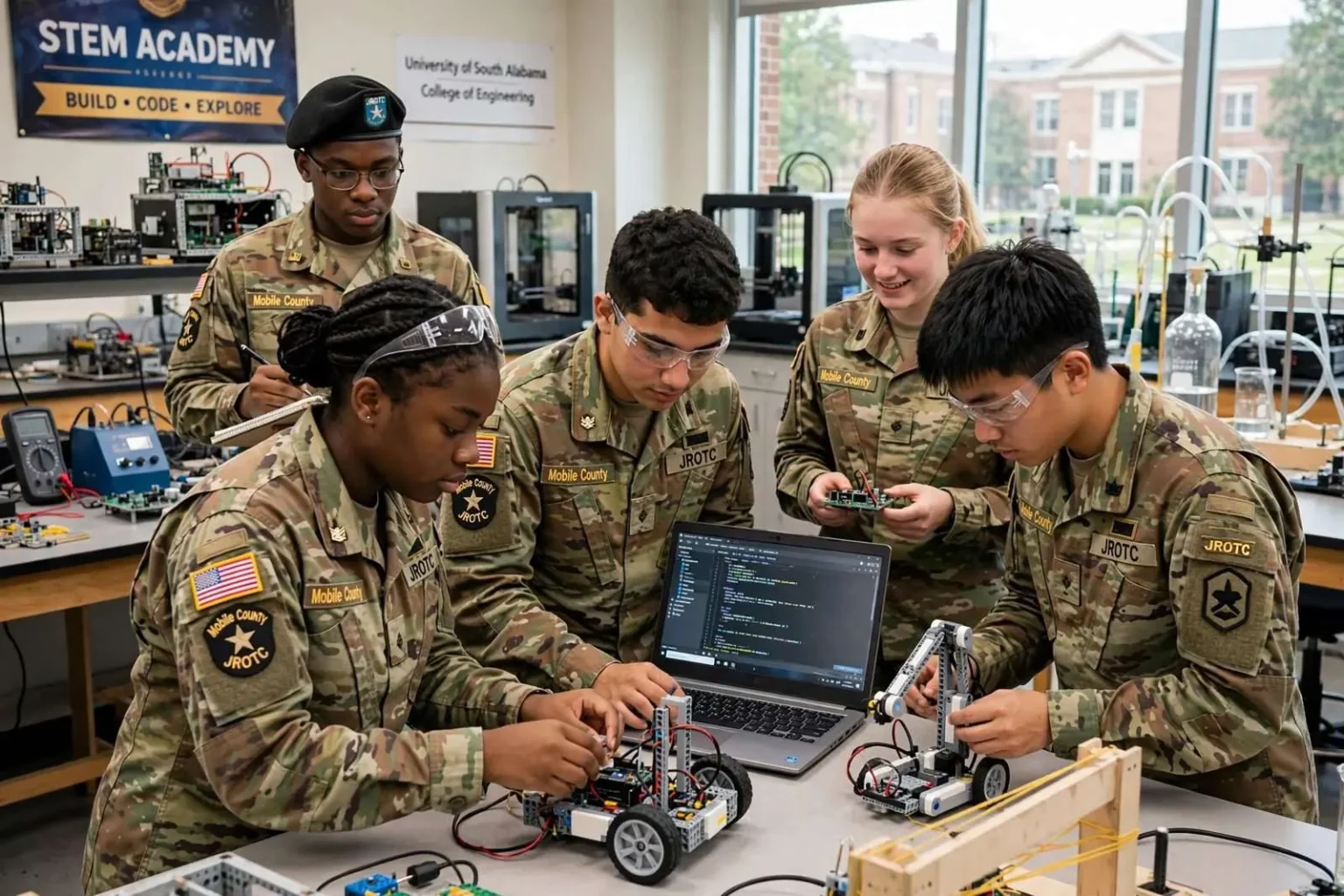
Mobile County JROTC cadets expecting a week of physical training instead found themselves in a college engineering lab and out on Dauphin Island studying marine biology, part of a new academic push layered on top of the program’s traditional drills. The 126 cadets taking part make up the inaugural class of the Mobile County JROTC STEM Academy, a weeklong program centered on science, technology, engineering and math, and their days looked far closer to a college immersion course than to a summer camp.
Participants come from 11 different high schools across the county, a mix designed to pull students from every corner of Alabama’s largest school system rather than concentrating the opportunity in a handful of schools. For the week they stayed in dorms at Spring Hill College, giving teenagers from across Mobile County a preview of residential college life while they worked on team projects, heard from motivational speakers and toured local industry sites. Living on a college campus, organizers said, was part of the curriculum in itself.
“We’re using engineering as the hook to bring relevance to the math and sciences,” said Susan Pruet, president of STEMWorks LLC and a former teacher who helped design the academy’s curriculum. Pruet said the program is aimed less at students who already gravitate toward STEM fields and more at those who have never had the chance to discover an interest in them — a deliberate choice that shapes who gets invited and how the week is structured. The point is not to find the students already headed for engineering school, but to open the door for those who never considered it.
Touring the Region’s Industrial Backbone
During the week, cadets toured sites including Evonik, Austal USA, the Dauphin Island Sea Lab and BAE Southeast Shipyards along the Mobile River, alongside a full day at the University of South Alabama’s College of Engineering. The itinerary reads like a map of the Gulf Coast economy: chemical manufacturing, warship construction, marine science and shipbuilding represent some of the region’s most reliable sources of well-paying technical jobs, and each stop connected classroom subjects to a workplace students could stand inside.
Back at Spring Hill, the hands-on work was chosen to make abstract concepts physical. Activities ranged from building catapults to exploring basic physics through a classic Heron’s fountain water experiment, exercises that have survived in engineering classrooms because they force students to see pressure, energy and trajectory in action rather than on a worksheet. Team-based projects also let the cadets practice the collaboration skills that JROTC already teaches, this time applied to engineering problems instead of drill formations.
Changing How Students See Themselves
For some cadets, the week reshaped how they see their own interests. One sophomore who toured the university campus said she was surprised to find herself enjoying the material, describing engineering in particular as more interesting than she expected and something that gave her new ideas to think about. That reaction is precisely the outcome Pruet’s design aims for: a student who assumed engineering was not for her leaving a week with it under consideration.
Another cadet said seeing an actual college classroom helped ease worries he’d had about large, unfamiliar lecture halls, calling the experience different but far from uncomfortable. Demystifying college is a recurring theme in programs of this kind, because students who have never set foot on a campus often overestimate how alienating it will be. Sleeping in a dorm, walking a university quad and sitting in real classrooms for a week does a kind of reassurance no brochure can match.
The academy’s first class also gets a credential of its own: 126 students drawn from 11 schools who can carry the experience back to their home campuses, where JROTC instructors can build on it during the regular school year. Programs like this tend to grow from their pilot classes, and the cadets who spent the week on Spring Hill’s campus are the test case for whether the formula translates into more Mobile County students pursuing STEM coursework in the years ahead.
A Director Building Pipelines
Mobile County Public Schools JROTC Director Lt. Col. (ret.) Frank Barrow, who has helped launch several career-pipeline programs in the district, has framed initiatives like the STEM Academy as a natural evolution of what JROTC is for. The program’s core mission has always been citizenship, leadership and discipline, but the acronym on the schedule is no longer the whole story. By pairing military-style structure with exposure to college campuses and employers, the district is betting that cadets will graduate with both the habits and the direction to use them.
Career-pipeline programs have become a priority for school systems across the Gulf Coast as regional employers — shipbuilders, chemical plants, aerospace contractors and healthcare systems — report persistent difficulty filling technical positions. The gap is rarely a shortage of capable students; it is a shortage of students who ever saw themselves in those careers. That is exactly the problem Pruet described the academy as solving: reaching the cadet who has never been given a reason to believe that physics class connects to a paycheck on the Mobile River.
The structure of the week reflected that goal at every step. Mornings and afternoons alternated between team projects and site visits, so students never spent a full day in a lecture hall, and the motivational speakers were chosen to bridge the gap between a teenager’s current life and a technical career. The dorm experience at Spring Hill College — a historic Catholic college in Mobile’s Spring Hill neighborhood — added its own quiet lesson about what residential college life actually feels like.
Why the Industry Tours Matter
The tours gave each company a recruiting opportunity as much as a field trip. Evonik’s local chemical operations, Austal’s ship construction halls, and BAE’s shipyard work along the Mobile River all depend on a steady flow of graduates with math and science backgrounds, and the companies have every incentive to make a strong impression on 126 students who will be making course and career decisions within a few years. The Dauphin Island Sea Lab, the marine science campus for the state’s public universities, showed the research side of the same waters the cadets see every day.
The full day at the University of South Alabama’s College of Engineering connected those workplaces to their source. Students who tour a shipyard see what engineers produce; students who walk an engineering college see how they get there. Seeing both in the same week, with dorm life in between, compresses years of vague career information into a few concrete days, and it does so for students who might not otherwise have access to any of it.
The hands-on activities — catapults, the Heron’s fountain experiment — did the same work at a smaller scale. Building something that has to actually work, in a team, on a deadline, is the closest a classroom can come to the conditions of an engineering job, and it doubles as a lesson in why the math matters. A catapult that fires short is not a grade; it is a physics problem with an obvious fix.
A First Class With a Job to Do
The inaugural class of 126 now carries the program’s reputation. If the week produces the intended results — more cadets enrolling in advanced math and science courses, more applications to engineering programs, more students who can name a specific career they saw up close — the district has a model it can expand to more schools and more students in future summers. If the formula needs adjusting, this first class provides the evidence for how.
Either way, the shift the academy represents is already visible: JROTC in Mobile County is no longer only about drills and uniforms, but about giving students a structured path from discipline to career. For the sophomores and juniors who spent a week in college dorms touring the region’s biggest employers, the question the program was designed to answer — what could I actually do with this? — now has a set of concrete, local answers.
STEM as an Economic Development Strategy
The academy also fits into a larger economic argument that Mobile County leaders have been making for years: the region’s growth depends on workforce, and workforce depends on what happens in its high schools. Major announcements of new industrial investment routinely arrive with the caveat that jobs will go wherever qualified workers can be found, and Gulf Coast employers competing for engineers and skilled technicians cannot assume local students will be among them unless the pipeline starts early.
Programs like the STEM Academy are one answer. A week is short, but a week spent inside a shipyard, a chemical plant and a university engineering college can redirect a student’s entire course selection in the fall, and course selections are where careers actually begin. Educators who design these programs talk about “engineered serendipity” — carefully arranged experiences that put a student in the right place at the right moment — and the structure of this academy is built on exactly that principle.
The partnership model matters too. Spring Hill College donated the dormitory experience, the University of South Alabama opened its engineering college, industry hosts prepared visits, and STEMWorks designed the curriculum, with the school system’s JROTC program recruiting and organizing the students. Pulling that coalition together for an inaugural week takes coordination across institutions that do not always work in concert, and its success makes a second year easier to assemble.
What Cadets Take Home
Beyond the sites and experiments, the week gave cadets a network. Students from 11 high schools who spent seven days together in dorms and on buses return to their campuses knowing peers across the county who share a new interest, and instructors can build on those connections during the school year. Motivational speakers and mentors from the week become contacts rather than strangers, which is often how a first internship or scholarship application starts.
The cadets themselves, by their own reactions, seemed to get the message. The sophomore surprised to find engineering interesting and the cadet reassured about college lecture halls were describing the two transformations the program was built to produce: a changed sense of what is interesting, and a lowered sense of intimidation about what comes next. Neither shows up on a standardized test, but both show up in what a student signs up for the following semester.
For Mobile County Public Schools, the stakes are straightforward. The district educates tens of thousands of students across a county larger than some states, and its JROTC program touches thousands of them with a structure built on leadership and service. Adding STEM to that foundation does not replace the program’s mission; it connects the mission to the region’s economy. If the first class of the JROTC STEM Academy is any indication, the connection is already taking hold.