Mobile County Reports Second COVID-19 Death as Health Officials Urge Social Distancing
Mobile County Health Department officials confirmed a second COVID-19 death and urged residents and merchants to follow social distancing guidelines.
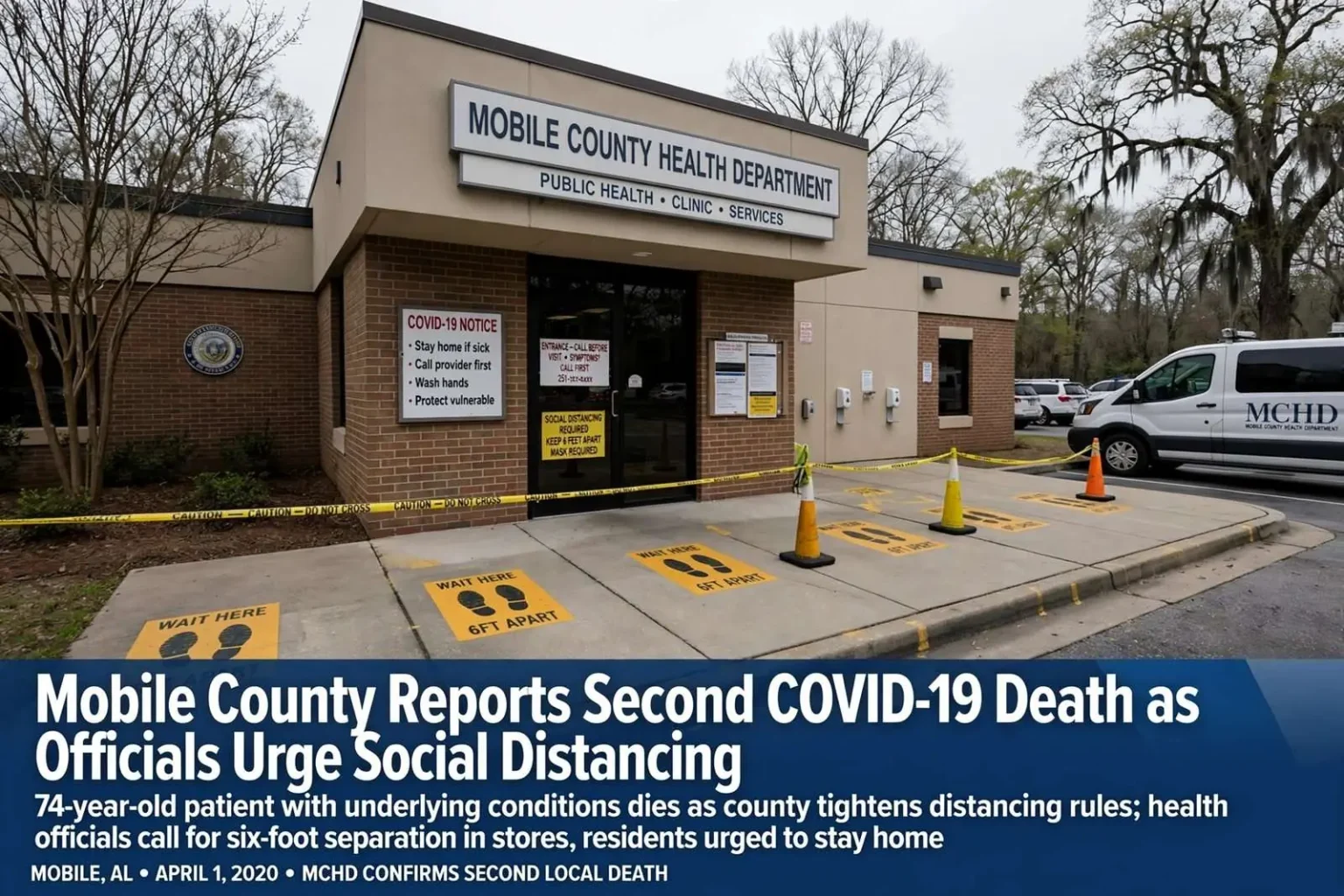
The Mobile County Health Department confirmed Wednesday that a second local patient who had tested positive for COVID-19 has died, as the coronavirus outbreak continued to spread across the region in the early spring of 2020.
Health officials said the patient, a 74-year-old man with underlying medical conditions, had gone to a hospital showing known COVID-19 symptoms and was admitted. He eventually succumbed to the illness, though officials said the exact date of death was unclear, a reflection of how quickly cases were being processed and confirmed as the local outbreak accelerated.
“We are sad to report our second death in Mobile County,” Health Officer Bernard Eichold said. “The MCHD team is conducting case contact disease surveillance of individuals who have tested positive for COVID-19. Everyone should take this (illness) very seriously and keep persons infected in their thoughts and prayers.”
Eichold also renewed calls for local merchants to limit the number of customers allowed inside their stores at one time and to mark off six feet of spacing in checkout lines, in line with state and federal social distancing recommendations. The requests were aimed at the grocery stores, pharmacies and other businesses still seeing heavy foot traffic, where shoppers waiting in lines stood close together for extended periods — exactly the conditions public health officials had identified as most likely to spread the virus from person to person.
Who is most at risk
According to the health department, most people infected with COVID-19 experience mild respiratory symptoms such as fever, cough and shortness of breath, though some cases become severe enough to require hospitalization. Older adults and people with underlying medical conditions — heart disease, diabetes, lung disease and similar chronic illnesses — face a substantially higher risk of serious complications, which is why the department’s early deaths involved patients in that category.
Officials urged anyone experiencing symptoms to contact their healthcare provider first so appropriate precautions could be taken before an in-person visit. Calling ahead allows medical staff to prepare for a potentially infectious patient, whether that means arranging a telehealth evaluation, directing the patient to a designated screening location, or having protective equipment ready at the door. Walk-in visits without warning put other patients and staff at risk and strain the supply of masks and gowns that hospitals were already working to conserve.
Public health guidance at the time emphasized that people with mild symptoms should stay home, isolate themselves from others in their household, and monitor their condition, seeking emergency care only for warning signs such as difficulty breathing, persistent chest pain or confusion. Residents without a regular healthcare provider were encouraged to contact the health department for guidance rather than arriving unannounced at an emergency room.
Statewide and local restrictions tighten
The death came as Alabama Gov. Kay Ivey’s order closing “non-essential” businesses remained in effect statewide, a measure that left mostly grocery stores, pharmacies and gun shops open to the public. The order represented one of the state’s most significant interventions of the outbreak’s first month, aimed at reducing the close contact that occurs in retail settings, salons, entertainment venues and gathering places while keeping open the businesses residents depend on for food, medicine and daily necessities.
In Mobile, Mayor Sandy Stimpson went a step further, requiring the businesses still allowed to operate to enforce social distancing among their customers. Those new citywide rules were set to take effect at 7 a.m. Thursday, April 2. Under the city’s requirement, stores that remained open had to actively manage the flow and spacing of customers rather than leaving it to individual shoppers, the same approach Eichold had urged merchants to adopt voluntarily.
How contact tracing works
At the center of the department’s response is the case contact disease surveillance Eichold described. When a Mobile County resident tests positive for COVID-19, public health staff attempt to identify everyone the patient was in close contact with during the period they may have been infectious. Those contacts are then notified of their exposure, asked to monitor themselves for symptoms, and advised to quarantine for the recommended period in case they are carrying the virus without knowing it.
Contact investigation is one of the oldest tools in public health, long used against tuberculosis, measles and other communicable diseases, and it became the backbone of the early response to COVID-19 across Alabama. Its effectiveness depends on speed and on public cooperation: every day of delay allows another round of spread among people who do not yet know they were exposed, and every contact who declines to quarantine weakens the net the department is trying to cast around the outbreak.
In the outbreak’s early weeks, with testing capacity limited and results sometimes taking days to return, surveillance work carried extra weight. The official count of confirmed cases lagged behind the true number of infections in the community, which is why health officials repeatedly cautioned residents to behave as though the virus was present everywhere, regardless of what the daily numbers showed.
The local health department’s role
The Mobile County Health Department is one of Alabama’s oldest county health agencies, responsible for communicable disease control, restaurant inspections, immunizations and a wide range of community health services across the county. In an outbreak, it serves as the coordination point between the Alabama Department of Public Health, hospitals, physicians and city governments — the agency that confirms local cases, investigates exposure chains and issues the guidance that schools, businesses and residents follow.
Dr. Bernard Eichold, the county’s health officer, became the public face of the local response, appearing in updates as the outbreak progressed. County health officers in Alabama hold significant statutory authority during public health emergencies, including the ability to issue orders to control the spread of disease, which placed the department at the center of decisions about closures and distancing measures alongside the governor’s office and Mobile’s city hall.
The Mobile County Health Department and the Alabama Department of Public Health continued to urge residents to practice social distancing, wash their hands frequently, avoid gathering in groups, and stay home when sick. Officials stressed that the measures were not symbolic: slowing the spread of the virus, even if it could not be stopped entirely, was intended to keep the number of severely ill patients at any one time within what local hospitals could handle, protecting both COVID-19 patients and everyone else who needed hospital care.
What residents should do now
For residents, the department’s advice remained straightforward. Stay home except for essential trips. Keep at least six feet between yourself and people outside your household. Wash hands often with soap and water for at least 20 seconds, use hand sanitizer when soap is unavailable, avoid touching the face, and disinfect frequently touched surfaces. Anyone who develops fever, cough or shortness of breath should call a healthcare provider before going anywhere in person, and anyone who has been in close contact with a confirmed case should self-quarantine and watch for symptoms.
The department also asked residents to check on older neighbors and relatives by phone rather than in person, since social distancing for high-risk individuals means limiting face-to-face contact precisely when they may need help with groceries and medications. Family members running errands for elderly relatives were encouraged to leave deliveries at the door rather than visiting inside.
Officials acknowledged the disruption the restrictions caused businesses, workers and families, but they continued to stress that the sacrifices of the outbreak’s early weeks determine what the following months look like. Communities that distance early and seriously, the guidance held, record fewer deaths per case and give their hospitals a fighting chance to manage the surge.
The second death in the county underscored what health officials had been warning about since the first local case was announced: that the virus moves fastest among people with chronic health conditions and among older residents, and that a community’s outcome depends heavily on how seriously individuals and businesses take distancing precautions in the outbreak’s early weeks.
For businesses, the new rules raised practical questions that owners spent the final days of March working through: how many customers a store floor could hold while maintaining six feet of separation, who would monitor the door, and how to mark checkout lines with tape or floor decals before the city’s deadline arrived Thursday morning. Larger grocery chains had already adopted queue limits on their own in other states, but small shops and independent pharmacies had to improvise, and some shifted to curbside pickup or phone orders to avoid crowds altogether.
Workers in retail, grocery and pharmacy jobs found themselves in a new position during the outbreak — counted among the workers whose jobs could not be done from home and whose exposure risk rose with every shift. Public health guidance encouraged employers to stagger shifts, provide sanitizer at registers, clean high-touch surfaces more frequently, and send home any employee showing symptoms without penalty, though enforcement of such practices varied widely from business to business.
Churches, schools and community organizations across Mobile County had already suspended in-person gatherings in the weeks before the death was announced, and officials used each update to reinforce that the suspension of normal life was the point of the exercise. Every gathering avoided, every trip deferred and every six-foot gap held in a checkout line translated directly into fewer chains of transmission for the health department’s investigators to chase.
The Mobile County Health Department said it would continue providing updates as additional cases and deaths are confirmed, and residents were encouraged to rely on the department and the Alabama Department of Public Health for accurate information rather than on rumor and social media, which officials said had already spread significant misinformation about the virus locally.